
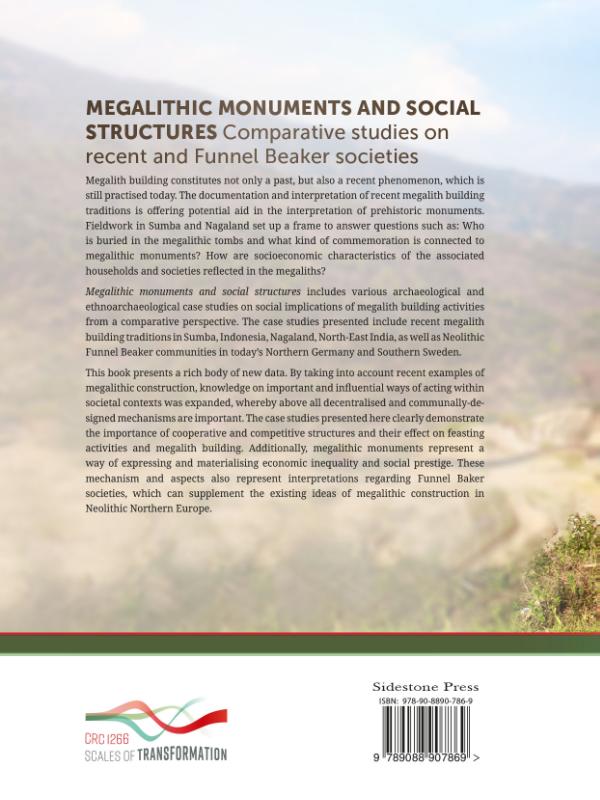
Megalithic monuments and social structures comparative studies on recent and Funnel Beaker societies
Ook verkrijgbaar als
Megalith building constitutes not only a past, but also a recent phenomenon, which is still practised today. The documentation and interpretation of recent megalith building traditions is offering potential aid in the interpretation of prehistoric monuments. Fieldwork in Sumba and Nagaland set up a frame to answer questions such as: Who is buried in the megalithic tombs and what kind of commemoration is connected to megalithic monuments? How are socioeconomic characteristics of the associated households and societies reflected in the megaliths?
Megalithic monuments and social structures includes various archaeological and ethnoarchaeological case studies on social implications of megalith building activities from a comparative perspective. The case studies presented include recent megalith building traditions in Sumba, Indonesia, Nagaland, North-East India, as well as Neolithic Funnel Beaker communities in today's Northern Germany and Southern Sweden.
This book presents a rich body of new data. By taking into account recent examples of megalithic construction, knowledge on important and influential ways of acting within societal contexts was expanded, whereby above all decentralised and communally-designed mechanisms are important. The case studies presented here clearly demonstrate the importance of cooperative and competitive structures and their effect on feasting activities and megalith building. Additionally, megalithic monuments represent a way of expressing and materialising economic inequality and social prestige. These mechanism and aspects also represent interpretations regarding Funnel Baker societies, which can supplement the existing ideas of megalithic construction in Neolithic Northern Europe.
Contents:
Foreword and acknowledgement
1 Introduction
1.1 Research questions and scientific approach
1.2 Megaliths as a worldwide phenomenon: Space and time of investigation
2 History of research: Megalithic monuments
2.1 Functional interpretations
2.2 Symbolic and ideological interpretations
2.3 Megalithic tombs in their active use
2.4 Megalithic tombs and social differentiation
3 Theoretical background
3.1 Theoretical background of the concept of monumentality
3.2 Cultural memory in pre-modern societies
3.3 The relationship between subsistence strategies and the extent of social differentiation/inequality
3.4 Political and ritual economy
3.5 Excursus: Lineage and Clan structures
3.6 Summary
4 Methodology
4.1 The examination parameters
4.2 Ethnoarchaeological research and the use of analogies
5 The Ethnoarchaeological case studies: Sumba and Nagaland
5.1 Ethnoarchaeological Case Study 1: Sumba
5.2 Ethnoarchaeological case study 2: Nagaland
5.3. Ethnoarchaeological case studies: Summary
6 The archaeological case studies: Funnel Beaker societies in present-day northern Germany and Scania
6.1 Archaeological Case Study 1: Funnel Beaker societies in northern Germany
6.2 Comparison of two archaeological regions: Northern Germany and Scania
7 Synthesis
7.1 The different models
7.2 Comparison and synthesis
8 Summary
References
Appendix: Photos of the ethnoarchaeological field work
Megalithic monuments and social structures includes various archaeological and ethnoarchaeological case studies on social implications of megalith building activities from a comparative perspective. The case studies presented include recent megalith building traditions in Sumba, Indonesia, Nagaland, North-East India, as well as Neolithic Funnel Beaker communities in today's Northern Germany and Southern Sweden.
This book presents a rich body of new data. By taking into account recent examples of megalithic construction, knowledge on important and influential ways of acting within societal contexts was expanded, whereby above all decentralised and communally-designed mechanisms are important. The case studies presented here clearly demonstrate the importance of cooperative and competitive structures and their effect on feasting activities and megalith building. Additionally, megalithic monuments represent a way of expressing and materialising economic inequality and social prestige. These mechanism and aspects also represent interpretations regarding Funnel Baker societies, which can supplement the existing ideas of megalithic construction in Neolithic Northern Europe.
Contents:
Foreword and acknowledgement
1 Introduction
1.1 Research questions and scientific approach
1.2 Megaliths as a worldwide phenomenon: Space and time of investigation
2 History of research: Megalithic monuments
2.1 Functional interpretations
2.2 Symbolic and ideological interpretations
2.3 Megalithic tombs in their active use
2.4 Megalithic tombs and social differentiation
3 Theoretical background
3.1 Theoretical background of the concept of monumentality
3.2 Cultural memory in pre-modern societies
3.3 The relationship between subsistence strategies and the extent of social differentiation/inequality
3.4 Political and ritual economy
3.5 Excursus: Lineage and Clan structures
3.6 Summary
4 Methodology
4.1 The examination parameters
4.2 Ethnoarchaeological research and the use of analogies
5 The Ethnoarchaeological case studies: Sumba and Nagaland
5.1 Ethnoarchaeological Case Study 1: Sumba
5.2 Ethnoarchaeological case study 2: Nagaland
5.3. Ethnoarchaeological case studies: Summary
6 The archaeological case studies: Funnel Beaker societies in present-day northern Germany and Scania
6.1 Archaeological Case Study 1: Funnel Beaker societies in northern Germany
6.2 Comparison of two archaeological regions: Northern Germany and Scania
7 Synthesis
7.1 The different models
7.2 Comparison and synthesis
8 Summary
References
Appendix: Photos of the ethnoarchaeological field work
In het kort
ISBN-13
9789088907869
Uitgever
Verschenen
15 augustus 2019
Bibliografisch
ISBN-139789088907869
SerieScales of Transformation — deel 6
Editie1
TaalEngels eng
Pagina’s450
GeïllustreerdJa
Uitgave
Vorm & inhoud
ProductvormPaperback BC
SamenstellingLos product
Classificatie
NUR (hoofd)Archeologie 682
NUR (alle)682 Archeologie
Medewerkers
Auteur A01Maria Wunderlich
Herkomst
Werk-id (NSTC)500176707
MeldingBevestigd bij publicatie 03
Bijgewerkt6 augustus 2026
Lijkt op dit boek
Durrington Walls and Woodhenge: A place for the living
Durrington Walls and Woodhenge: A place for the living
Indigenous Knowledge in Transformation
Indigenous Knowledge in Transformation
Archaeological Approaches to Inequality, Political Organisation, and Social Complexity
Archaeological Approaches to Inequality, Political Organisation, and Social Complexity
Stadterweiterungen und urbane Dynamik im Mittelalter
Stadterweiterungen und urbane Dynamik im Mittelalter
Prehistoric Shore Settlements of the Southwestern Balkans
Prehistoric Shore Settlements of the Southwestern Balkans
NSTC 500176707 · CB-relatie 9180064 · Bijgewerkt 6 augustus 2026