
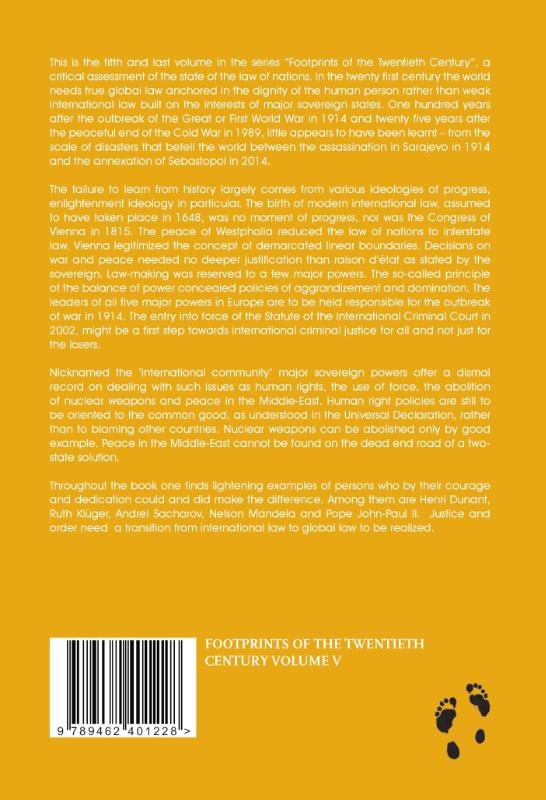
Neither Justice nor order reflections on the state of the law of nations
PaperbackEngels
Ook verkrijgbaar als
This is the fifth and last volume in the series "Footprints of the Twentieth Century", a critical assessment of the state of the law of nations. In the twenty first century the world needs true global law anchored in the dignity of the human person rather than weak international law built on the interests of major sovereign states. One hundred years after the outbreak of the Great or First World War in 1914 and twenty five years after the peaceful end of the Cold War in 1989, little appears to have been learnt - from the scale of disasters that befell the world between the assassination in Sarajevo in 1914and the annexation of Sebastopol in 2014. The failure to learn from history largely comes from various ideologies of progress, enlightenment ideology in particular. The birth of modern international law, assumed to have taken place in 1648, was no moment of progress, nor was the Congress of Vienna in 1815. The peace of Westphalia reduced the law of nations to interstate law. Vienna legitimized the concept of demarcated linear boundaries. Decisions on war and peace needed no deeper justification than raison d'état as stated by the sovereign. Law-making was reserved to a few major powers. The so-called principle of the balance of power concealed policies of aggrandizement and domination. The leaders of all five major powers in Europe are to be held responsible for the outbreak of war in 1914. The entry into force of the Statute of the International Criminal Court in2002, might be a first step towards international criminal justice for all and not just for the losers.Nicknamed the 'international community' major sovereign powers offer a dismalrecord on dealing with such issues as human rights, the use of force, the abolition of nuclear weapons and peace in the Middle-East. Human right policies are still to be oriented to the common good, as understood in the Universal Declaration, rather than to blaming other countries. Nuclear weapons can be abolished only by good example. Peace in the Middle-East cannot be found on the dead end road of a twostate solution.Throughout the book one finds lightening examples of persons who by their courage and dedication could and did make the difference. Among them are Henri Dunant, Ruth Klüger, Andrei Sacharov, Nelson Mandela and Pope John-Paul II. Justice and order need a transition from international law to global law to be realized.
In het kort
ISBN-13
9789462401228
Uitgever
Verschenen
15 september 2014
Bibliografisch
ISBN-139789462401228
Editie1
TaalEngels eng
GeïllustreerdNee
Uitgave
Vorm & inhoud
ProductvormPaperback BC
SamenstellingLos product
Classificatie
NUR (hoofd)Internationaal (publiek)recht 828
NUR (alle)828 Internationaal (publiek)recht
Medewerkers
Auteur A01Frans Alting von Geusau
Herkomst
Werk-id (NSTC)500176585
MeldingBevestigd bij publicatie 03
Bijgewerkt6 augustus 2026
Lijkt op dit boek
Footprints of the 20th Century: Volume V - Neither Justice nor Order

Volume I - Cultural Diplomacy
Footprints of the 20th Century: Volume III - Western cooperation
Footprints of the 20th Century: Volume IV - European Unification into the Twenty-First Century
Shaping the law for global crises
Discover International Law
3
On Building Peace

Ideas in conflict
The World Community between Hegemony and Constitutionalism
NSTC 500176585 · CB-relatie 8037459 · Bijgewerkt 6 augustus 2026