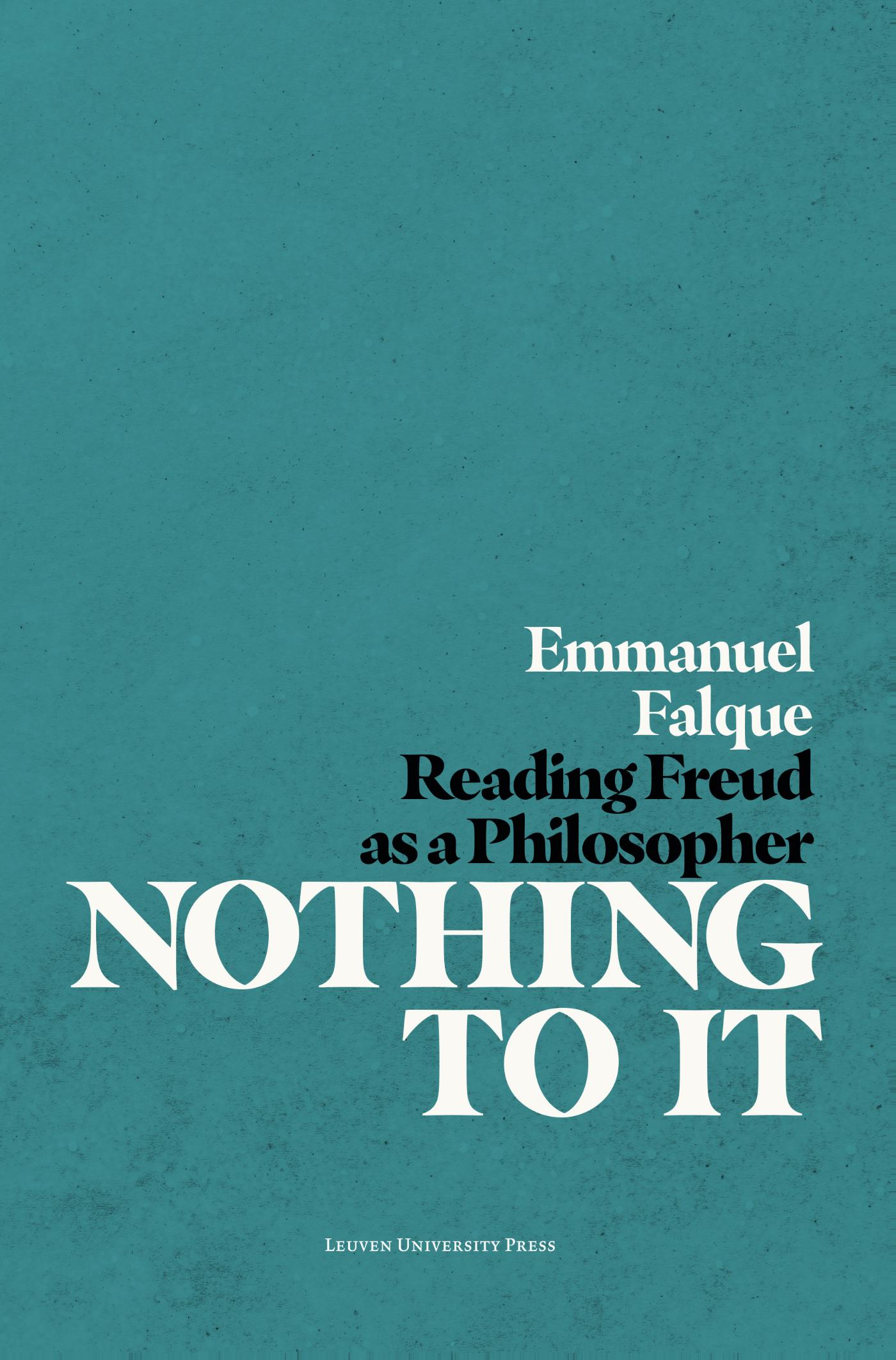
Nothing to It Reading Freud as a Philosopher
Ook verkrijgbaar als
Foreword by Philippe Van HautePreface Opening ActPhilosophizing in psychoanalysis The doctrine of experience The other Rubicon The backlash IntroductionGo take a lookChapter OneKeep moving, nothing to see The end of the Enlightenment Toward another paradigm Collapse of the system Chapter TwoBeware of it Conceiving the inconceivable The disillusion of psychoanalysis Primitive man Chapter ThreeIt’s not nothing The drive at the frontier Rooting in the organic Presence and resistance Chapter FourWhat is it? A disturbing uncanny Death and repetition The anorganic Chapter FiveIt concerns me Being lived The knight of the Id Being there for something Chapter SixIt touches me Where the Id was The draining of the Zuyderzee The great cavalcade ConclusionWhat’s God have to do with it? For the salvation of the Id Apart from it The realm of the Id EpilogueRegarding all of itNotes Bibliography Index rerum Index nominumThe special role of psychoanalysis in the development of phenomenologyThe confrontation between philosophy and psychoanalysis has had its heyday. After the major debates between Paul Ricoeur, Maurice Merleau-Ponty, Jacques Derrida, Gilles Deleuze, and Michel Henry, this dialogue now seems to have broken down. It has therefore proven necessary and gainful to revisit these debates to explore their re-usability and the degree to which they can provide new insights from a contemporary point of view. It can be said that contemporary philosophy suffers from an 'excess of meaning', and this is exactly where psychoanalysis comes in and may raise key questions. This is precisely what a philosophical reading of Freud demonstrates. To say 'Nothing to It' indicates that the 'It'-or Freudian Id-is not visible as it never shows itself as a 'phenomenon'. Such a reading of Freud exemplifies how psychoanalysis has a special role to play in phenomenology's development.The confrontation between philosophy and psychoanalysis has had its heyday. After the major debates between Paul Ricoeur, Maurice Merleau-Ponty, Jacques Derrida, Gilles Deleuze, and Michel Henry, this dialogue now seems to have broken down. It has therefore proven necessary and gainful to revisit these debates to explore their re-usability and the degree to which they can provide new insights from a contemporary point of view. It can be said that contemporary philosophy suffers from an ‘excess of meaning’, and this is exactly where psychoanalysis comes in and may raise key questions. This is precisely what a philosophical reading of Freud demonstrates. To say ‘Nothing to It’ indicates that the ‘It’—or Freudian Id—is not visible as it never shows itself as a ‘phenomenon’. Such a reading of Freud exemplifies how psychoanalysis has a special role to play in phenomenology's development.
In het kort
ISBN-13
9789461663214
Uitgever
Verschenen
10 februari 2020
Imprint
Bibliografisch
ISBN-139789461663214
SerieFigures of the Unconscious — deel 0
Editie1
TaalEngels eng
Pagina’s137
GeïllustreerdNee
Uitgave
UitgeverUniversitaire Pers Leuven
ImprintLeuven University Press
CB-relatie-id8004161
Verschenen10 februari 2020
StatusLeverbaar 04
BeschikbaarheidBeschikbaar 20
Zonder prijsPrijs volgt
Vorm & inhoud
ProductvormE-book ED
VormdetailE107 PDF
SamenstellingLos product
Beveiliging e-bookDigitaal watermerk 02
Classificatie
NUR (hoofd)Filosofie algemeen 730
NUR (alle)730 Filosofie algemeen
Trefwoordenpsychology · psychoanalysis · continental philosophy · consciousness · phenomenology
Medewerkers
Auteur A01Emmanuel Falque
Herkomst
Werk-id (NSTC)500248148
MeldingBevestigd bij publicatie 03
Bijgewerkt6 augustus 2026
Trefwoorden
Lijkt op dit boek







NSTC 500248148 · CB-relatie 8004161 · Bijgewerkt 6 augustus 2026