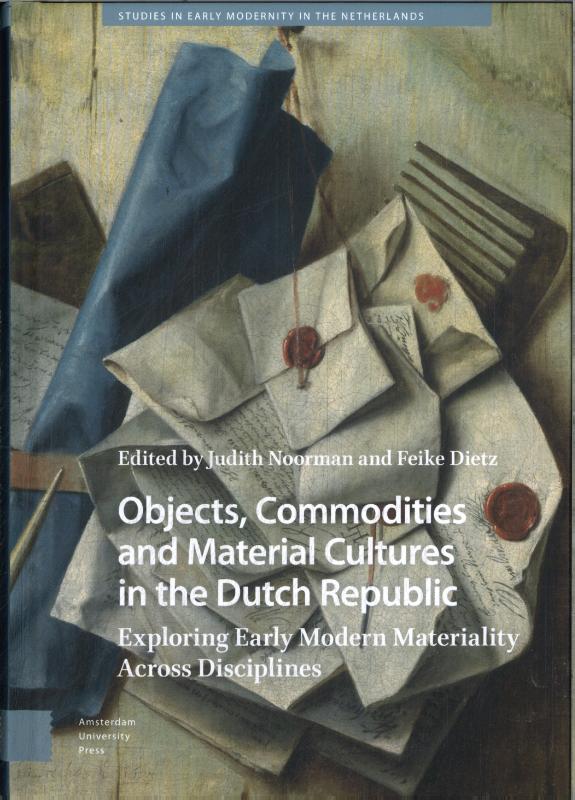
Objects, Commodities and Material Cultures in the Dutch Republic Exploring Early Modern Materiality Across Disciplines
Feike Dietz red.
AcknowledgementsFeike Dietz and Judith Noorman - Introduction: Objects, Commodities and Material Cultures in the Dutch Republic. Exploring Early Modern Materiality Across Disciplines2. Weixuan Li and Lucas van der Deijl - The Anatomical Atlas: Govert Bidloo and Gerard de Lairesse’s Anatomia Humani Corporis (1685)3. Djoeke van Netten - The Bullet and the Printing Press: Objects Celebrating the Battle of Gibraltar (1607) 4. Saskia Beranek - A Baluster: Amalia van Solms and the Global Trade in Japanese Lacquer5. Lieke van Deinsen and Feike Dietz - The Graphometer and the Book: How Petronella Johanna de Timmerman (1723/1724–1786) Merged Science and Poetry 6. Hanneke Grootenboer, Cynthia Kok and Marrigje Paijmans - Shells: Shaping Curiosity in the Dutch Republic7. Gabri van Tussenbroek - The VOC Boardroom: A Forensic Investigation into the Built Environment8. Maartje Stols-Witlox - The Muller: Insights into Practical Artistic Knowledge through Re-Making Experiments9. Judith Noorman - Blue Paper: Its Life, Origin, History and Artistic ExplorationList of illustrations with photo creditsIndexHow did objects move between places and people, and how did they reshape the Republic’s arts, cultures and sciences? ‘Objects’ were vitally significant for the early modern Dutch Republic, which is known as an early consumer society, a place famous for its exhaustive production of books, visual arts and scientific instruments. What happens when we push these objects and their materiality to the centre of our research? How do they invite us to develop new perspectives on the early modern Dutch Republic? And how do they contest the boundaries of the academic disciplines that have traditionally organized our scholarship? In Objects, Commodities and Material Cultures, the interdisciplinary community of specialists around the Amsterdam Centre for the Study of Early Modernity innovatively explores the diverse early modern world of objects. Its contributors take a single object or commodity as a point of departure to study and discuss various aspects of early modern art, culture and history: from natural objects to consumer goods, from knowledge instruments to artistic materials. The volume aims to unravel how objects have moved through regions, cultures and ages, and how objects impacted people who lived and worked in the Dutch Republic.
In het kort
ISBN-13
9789048562770
Uitgever
Verschenen
20 oktober 2024
Imprint
Bibliografisch
ISBN-139789048562770
Editie1
TaalEngels eng
Pagina’s252
GeïllustreerdJa
Uitgave
UitgeverAmsterdam University Press
ImprintAmsterdam University Press
CB-relatie-id7400597
Verschenen20 oktober 2024
StatusLeverbaar 04
BeschikbaarheidBeschikbaar 20
Adviesprijs (incl. btw)€ 129,00
Vorm & inhoud
ProductvormHardback BB
SamenstellingLos product
Classificatie
NUR (hoofd)Kunstgeschiedenis 654
NUR (alle)654 Kunstgeschiedenis
Medewerkers
Redacteur B01Judith Noorman
Redacteur B01Feike Dietz
Herkomst
Werk-id (NSTC)501603182
MeldingBevestigd bij publicatie 03
Bijgewerkt6 augustus 2026
Lijkt op dit boek
NSTC 501603182 · CB-relatie 7400597 · Bijgewerkt 6 augustus 2026