
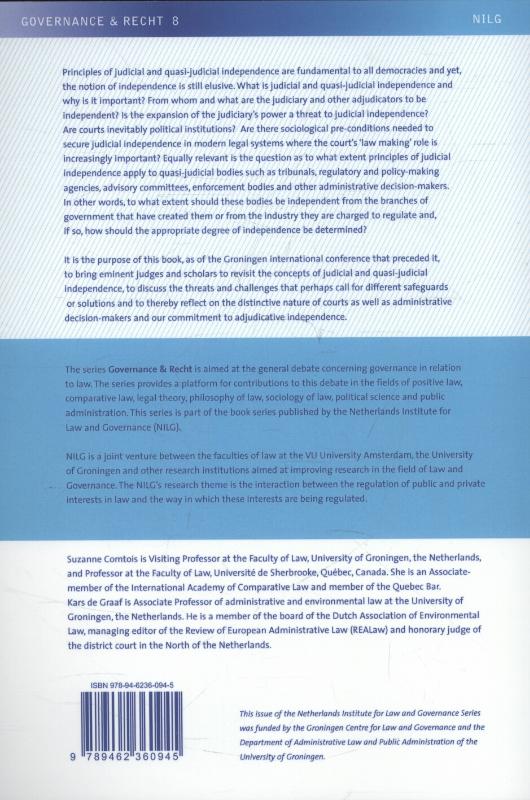
Principles of judicial and quasi-judicial independence are fundamental to all democracies and yet, the notion of independence is still elusive. What is judicial and quasi-judicial independence and why is it important? From whom and what are the judiciary and other adjudicators to be independent? Is the expansion of the judiciary's power a threat to judicial independence? Are courts inevitably political institutions? Are there sociological pre-conditions needed to secure judicial independence in modern legal systems where the court's 'law making' role is increasingly important? Equally relevant is the question as to what extent principles of judicial independence apply to quasi-judicial bodies such as tribunals, regulatory and policy-making agencies, advisory committees, enforcement bodies and other administrative decision-makers. In other words, to what extent should these bodies be independent from the branches of government that have created them or from the industry they are charged to regulate and, if so, how should the appropriate degree of independence be determined? It is the purpose of this book, as of the Groningen international conference that preceded it, to bring eminent judges and scholars to revisit the concepts of judicial and quasi-judicial independence, to discuss the threats and challenges that perhaps call for different safeguards or solutions and to thereby reflect on the distinctive nature of courts as well as administrative decision-makers and our commitment to adjudicative independence.
In het kort
ISBN-13
9789462360945
Uitgever
Verschenen
18 september 2013
Bibliografisch
Uitgave
UitgeverKoninklijke Boom uitgevers PW
CB-relatie-id7500275
Verschenen18 september 2013
StatusOnbekend 00
Vorm & inhoud
ProductvormPaperback BC
SamenstellingLos product
Classificatie
NUR (hoofd)Staats- en bestuursrecht 823
NUR (alle)823 Staats- en bestuursrecht
Medewerkers
Redacteur B01Suzanne Comtois
Redacteur B01Kars de Graaf
Herkomst
Werk-id (NSTC)500262808
MeldingBevestigd bij publicatie 03
Bijgewerkt6 augustus 2026
Lijkt op dit boek
NSTC 500262808 · CB-relatie 7500275 · Bijgewerkt 6 augustus 2026