
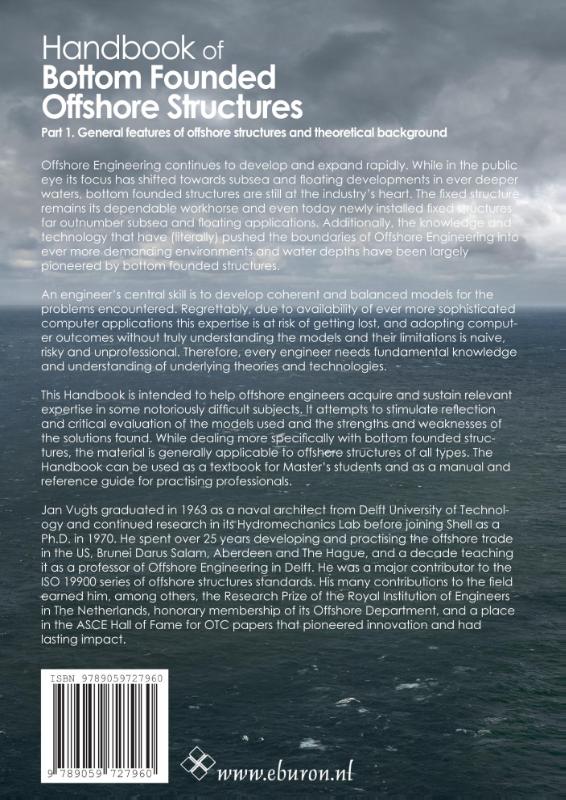
Part 1 general features of offshore structures and theoretical background
Paperback696 pagina’sEngels
Offshore Engineering continues to develop and expand rapidly. While in the public eye its focus has shifted towards subsea and floating developments in ever deeper waters, bottom founded structures are still at the industry's heart. The fixed structure remains its dependable workhorse and even today newly installed fixed structures far outnumber subsea and floating applications. Additionally, the knowledge and technology that have (literally) pushed the boundaries of Offshore Engineering into ever more demanding environments and water depths have been largely pioneered by bottom founded structures.An engineer's central skill is to develop coherent and balanced models for theproblems encountered. Regrettably, due to availability of ever more sophisticatedcomputer applications this expertise is at risk of getting lost, and adopting computeroutcomes without truly understanding the models and their limitations is naive,risky and unprofessional. Therefore, every engineer needs fundamental knowledgeand understanding of underlying theories and technologies.This Handbook is intended to help offshore engineers acquire and sustain relevantexpertise in some notoriously difficult subjects. It attempts to stimulate reflectionand critical evaluation of the models used and the strengths and weaknesses ofthe solutions found. While dealing more specifically with bottom founded structures,the material is generally applicable to offshore structures of all types. TheHandbook can be used as a textbook for Master's students and as a manual andreference guide for practising professionals.Jan Vugts graduated in 1963 as a naval architect from Delft University of Technologyand continued research in its Hydromechanics Lab before joining Shell as aPh.D. in 1970. He spent over 25 years developing and practising the offshore tradein the US, Brunei Darus Salam, Aberdeen and The Hague, and a decade teachingit as a professor of Offshore Engineering in Delft. He was a major contributor to theISO 19900 series of offshore structures standards. His many contributions to the fieldearned him, among others, the Research Prize of the Royal Institution of Engineersin The Netherlands, honorary membership of its Offshore Department, and a placein the ASCE Hall of Fame for OTC papers that pioneered innovation and hadlasting impact.
In het kort
ISBN-13
9789059727960
Uitgever
Verschenen
18 december 2013
Serie
Handbook of bottom founded offshore structures
Bibliografisch
ISBN-139789059727960
SerieHandbook of bottom founded offshore structures
Editie1
TaalEngels eng
Pagina’s696
GeïllustreerdJa
Uitgave
UitgeverEburon Uitgeverij B.V.
CB-relatie-id7804140
Verschenen18 december 2013
StatusInactief 08
BeschikbaarheidContact leverancier 99
Adviesprijs (incl. btw)€ 150,00
Vorm & inhoud
ProductvormPaperback BC
SamenstellingLos product
Classificatie
NUR (hoofd)Werktuigbouwkunde 978
NUR (alle)978 Werktuigbouwkunde
Medewerkers
Auteur A01Jan Vugts
Herkomst
Werk-id (NSTC)500271100
MeldingBevestigd bij publicatie 03
Bijgewerkt6 augustus 2026
Lijkt op dit boek

CRISPR-Cas based strategies against HIV-1 and human coronaviruses

Comparative CRISPR-based systems for HIV gene editing
Inleiding werktuigbouwkundig tekenen, construeren & 3D ontwerpen

Advies
Werktuigkundige Systemen
Werktuigkundige Systemen

Basisboek ontwerpen
Ontwerpen van Technische Innovaties

Regeltechniek

Statica en sterkteleer
NSTC 500271100 · CB-relatie 7804140 · Bijgewerkt 6 augustus 2026