
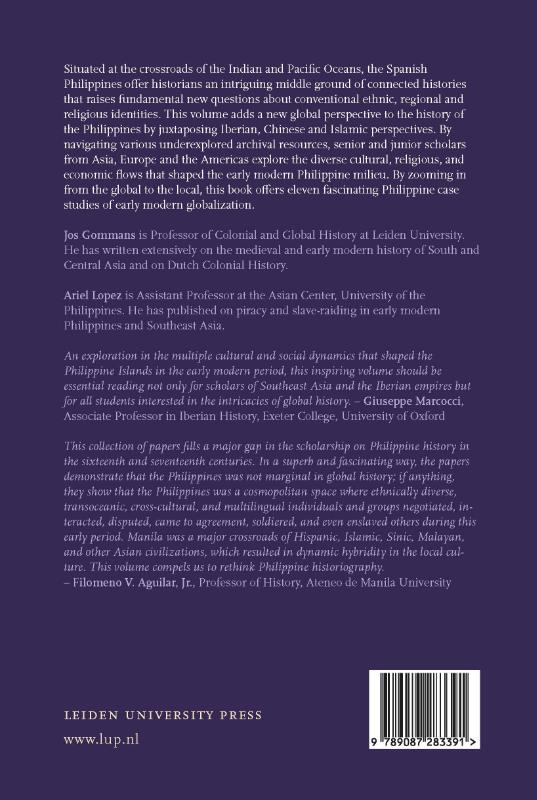
Philippine Confluence Iberian, Chinese and Islamic Currents, c. 1500-1800
Ariel Lopez red.
Situated at the crossroads of the Indian and Pacific Oceans, the Spanish Philippines offer historians an intriguing middle ground of connected histories that raises fundamental new questions about conventional ethnic, regional and religious identities. This volume adds a new global perspective to the history of the Philippines by juxtaposing Iberian, Chinese and Islamic perspectives. By navigating various underexplored archival resources, senior and junior scholars from Asia, Europe and the Americas explore the diverse cultural, religious, and economic flows that shaped the early modern Philippine milieu. By zooming in from the global to the local, this book offers eleven fascinating Philippine case studies of early modern globalization.
Jos Gommans is Professor of Colonial and Global History at Leiden University. He wrote extensively on the medieval and early modern history of South and Central Asia and on Dutch Colonial History. He is also the director of the Leiden-based Cosmopolis Programme.
Ariel Lopez is Assistant Professor at the Asian Center, University of the Philippines. He received his PhD, MA and BA in History from Leiden University as part of the Cosmopolis Programme. He has published articles on piracy and slave-raiding in early modern Philippines and Southeast Asia.
"An exploration in the multiple cultural and social dynamics that shaped the Philippine Islands in the early modern period, this inspiring volume should be essential reading not only for scholars of southeast Asia and the Iberian empires but for all students interested in the intricacies of global history."
– Giuseppe Marcocci, Associate Professor in Iberian History, Exeter College, University of Oxford
"This collection of papers fills a major gap in the scholarship on Philippine history in the sixteenth and seventeenth centuries. In a superb and fascinating way, the papers demonstrate that the Philippines was not marginal in global history; if anything, they show that the Philippines was a cosmopolitan space where ethnically diverse, transoceanic, cross-cultural, and multilingual individuals and groups negotiated, interacted, disputed, came to agreement, soldiered, and even enslaved others during this early period. Manila was a major crossroads of Hispanic, Islamic, Sinic, Malayan, and other Asian civilizations, which resulted in dynamic hybridity in the local culture. This volume compels us to rethink Philippine historiography."
– Filomeno V. Aguilar, Jr., Professor of History, Ateneo de Manila University
Jos Gommans is Professor of Colonial and Global History at Leiden University. He wrote extensively on the medieval and early modern history of South and Central Asia and on Dutch Colonial History. He is also the director of the Leiden-based Cosmopolis Programme.
Ariel Lopez is Assistant Professor at the Asian Center, University of the Philippines. He received his PhD, MA and BA in History from Leiden University as part of the Cosmopolis Programme. He has published articles on piracy and slave-raiding in early modern Philippines and Southeast Asia.
"An exploration in the multiple cultural and social dynamics that shaped the Philippine Islands in the early modern period, this inspiring volume should be essential reading not only for scholars of southeast Asia and the Iberian empires but for all students interested in the intricacies of global history."
– Giuseppe Marcocci, Associate Professor in Iberian History, Exeter College, University of Oxford
"This collection of papers fills a major gap in the scholarship on Philippine history in the sixteenth and seventeenth centuries. In a superb and fascinating way, the papers demonstrate that the Philippines was not marginal in global history; if anything, they show that the Philippines was a cosmopolitan space where ethnically diverse, transoceanic, cross-cultural, and multilingual individuals and groups negotiated, interacted, disputed, came to agreement, soldiered, and even enslaved others during this early period. Manila was a major crossroads of Hispanic, Islamic, Sinic, Malayan, and other Asian civilizations, which resulted in dynamic hybridity in the local culture. This volume compels us to rethink Philippine historiography."
– Filomeno V. Aguilar, Jr., Professor of History, Ateneo de Manila University
In het kort
ISBN-13
9789087283391
Uitgever
Verschenen
30 juni 2020
Imprint
Bibliografisch
ISBN-139789087283391
Editie1
TaalEngels eng
Pagina’s380
GeïllustreerdJa
Uitgave
UitgeverLeiden University Press
ImprintLeiden University Press
CB-relatie-id6345163
Verschenen30 juni 2020
StatusOnbekend 00
BeschikbaarheidContact leverancier 99
Zonder prijsPrijs volgt
Vorm & inhoud
ProductvormPaperback BC
SamenstellingLos product
Classificatie
NUR (hoofd)Geschiedenis algemeen 680
NUR (alle)680 Geschiedenis algemeen
Medewerkers
Redacteur B01Jos Gommans
Redacteur B01Ariel Lopez
Herkomst
Werk-id (NSTC)500561773
MeldingBevestigd bij publicatie 03
Laatste CB-bericht7766
Bijgewerkt5 augustus 2026
Lijkt op dit boek
India after World History
Colonial Encounters and Slavery in Early Modern Asia
Cross-Cultural Heritage
East Asia beyond the Archives
Staging asia
Being a Slave
The Basel Mission between Switzerland, Germany and South India
World History – A Genealogy
The Indonesian Left in the Twentieth Century
Discovering Manila
NSTC 500561773 · CB-relatie 6345163 · Laatste CB-bericht 7766 · Bijgewerkt 5 augustus 2026