
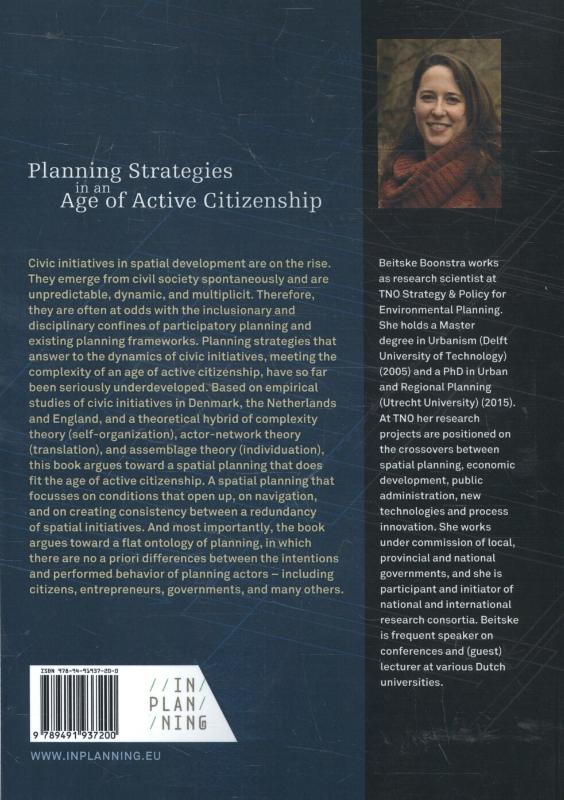
Planning strategies in an age of active citizenship a post-structuralist agenda for self-organization in spatial planning
Ook verkrijgbaar als
Civic initiatives in spatial development are on the rise. They emerge from civil society spontaneously and are unpredictable, dynamic, and multiplicit. Therefore, they are often at odds with the inclusionary and disciplinary confines of participatory planning and existing planning frameworks. Planning strategies that answer to the dynamics of civic initiatives, meeting the complexity of an age of active citizenship, have so far been seriously underdeveloped.Based on empirical studies of civic initiatives in Denmark, the Netherlands and England, and a theoretical hybrid of complexity theory (self-organization), actor-network theory (translation), and assemblage theory (individuation), this book argues toward a spatial planning that does fit the age of active citizenship.A spatial planning that focusses on conditions that open up, on navigation, and on creating consistency between a redundancy of spatial initiatives. And most importantly, the book argues toward a flat ontology of planning, in which there are no a priori differences between the intentions and performed behavior of planning actors - including citizens, entrepreneurs, governments, and many others.
In het kort
ISBN-13
9789491937200
Uitgever
Verschenen
15 januari 2016
Imprint
Bibliografisch
ISBN-139789491937200
SeriePhD Series In Planning — deel 7
Editie1
TaalEngels eng
Pagina’s418
GeïllustreerdJa
Uitgave
UitgeverCoöperatie In Planning U.A.
ImprintIn Planning
CB-relatie-id6341653
Verschenen15 januari 2016
StatusOnbekend 00
Vorm & inhoud
ProductvormPaperback BC
SamenstellingLos product
Classificatie
NUR (hoofd)Sociale geografie algemeen 900
NUR (alle)900 Sociale geografie algemeen
Medewerkers
Auteur A01Beitske Boonstra
Herkomst
Werk-id (NSTC)500058915
MeldingBevestigd bij publicatie 03
Bijgewerkt6 augustus 2026
Lijkt op dit boek
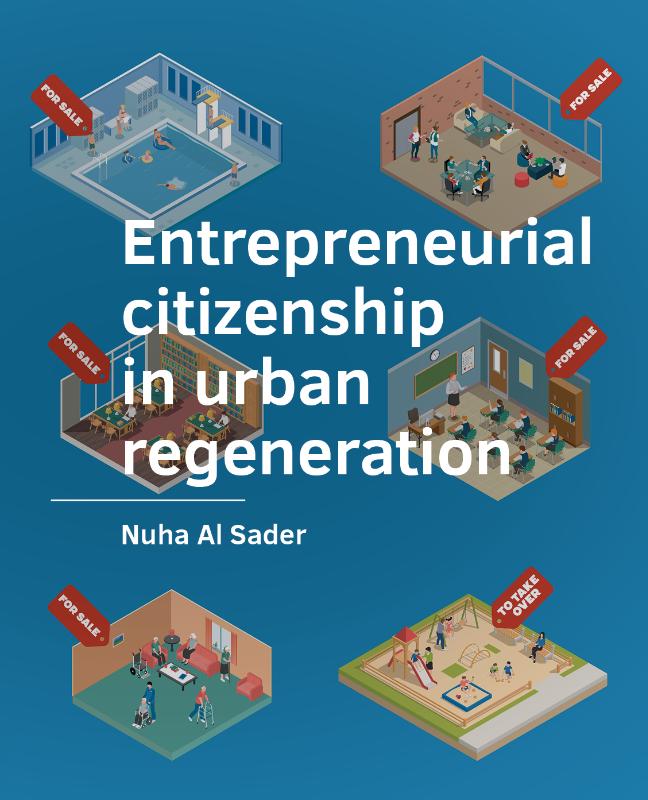
Entrepreneurial citizenship in urban regeneration
Planning with self‑organised initiatives: from fragmentation to resilience

Developing places for human capabilities
Complex Adaptive Systems & Urban Morphogenesis
Cities for or against citizens?
Negotiation and design for the self-organising city
Emerging Governance
Crafting local welfare landscapes
Local Activism in Urban Neighborhood Governance
Planet homeless
NSTC 500058915 · CB-relatie 6341653 · Bijgewerkt 6 augustus 2026