
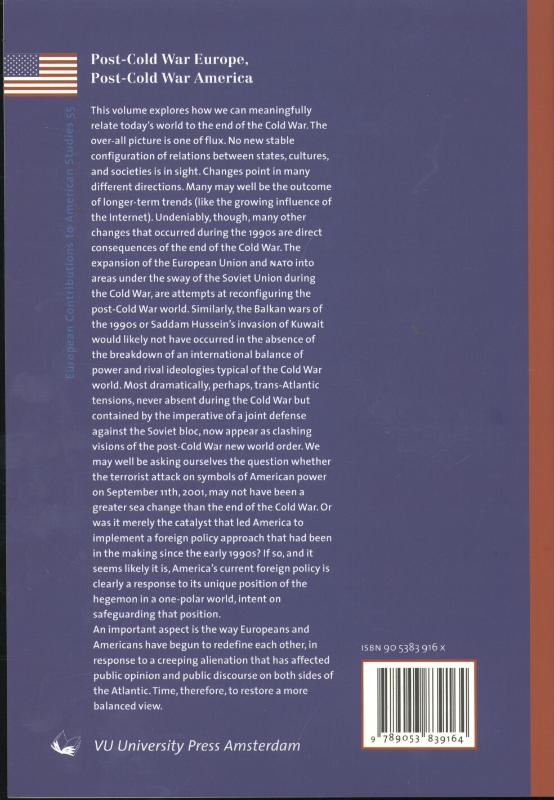
This volume explores how we can meaningfully relate today's world to the end of the Cold War. The over-all picture is one of flux. No new stable configuration of relations between states, cultures, and societies is in sight. Changes point in many different directions. Many may well be the outcome of longer-term trends (like the growing influence of the Internet). Undeniably, though, many other changes that occurred during the 1990s are direct consequences of the end of the Cold War. The expansion of the European Union and NATO into areas under the sway of Soviet Union during the Cold War, are attempts at reconfiguring the post-Cold War world. Similarly, the Balkan wars of the 1990s or Saddam Hussein's invasion of Kuwait would likely not have occurred in the absence of the breakdown of an international balance of power and rival ideologies typical of the Cold War world. Most dramatically, perhaps, trans-Atlantic tensions, never absent during the Cold War but contained by the imperative of a joint defense against the Soviet bloc, now appear as clashing visions of the post-Cold War new world order. We may well be asking ourselves the question whether the terrorist attack on symbols of American power on September 11th 2001, may not have been a greater sea change than the end of the Cold War. Or was it merely the catalyst that led America to implement a foreign policy approach that had been in the making since the early 1990s? If so, and it seems likely it is, America's current foreign policy is clearly a response to its unique position of the hegemon in a one-polar world, intent on safeguarding that position.
An important aspect is the way Europeans and Americans have begun to redefine each other, in repsonse to a creeping alienation that has affected public opinion and public discourse on both sides of the Atlantic. Time, therefore, to restore more balanced view.
An important aspect is the way Europeans and Americans have begun to redefine each other, in repsonse to a creeping alienation that has affected public opinion and public discourse on both sides of the Atlantic. Time, therefore, to restore more balanced view.
In het kort
ISBN-13
9789053839164
Uitgever
Verschenen
18 juli 2012
Bibliografisch
ISBN-139789053839164
SerieEuropean contributions to American studies — deel 55
Editie1
TaalEngels eng
Pagina’s203
GeïllustreerdJa
Uitgave
Vorm & inhoud
ProductvormPaperback BC
SamenstellingLos product
Classificatie
NUR (hoofd)Moderne geschiedenis (1870-heden) 686
NUR (alle)686 Moderne geschiedenis (1870-heden)
Medewerkers
Redacteur B01Ruud Janssens
Redacteur B01Rob Kroes
Herkomst
Werk-id (NSTC)500286103
MeldingBevestigd bij publicatie 03
Bijgewerkt6 augustus 2026
Lijkt op dit boek









NSTC 500286103 · CB-relatie 7300949 · Bijgewerkt 6 augustus 2026