
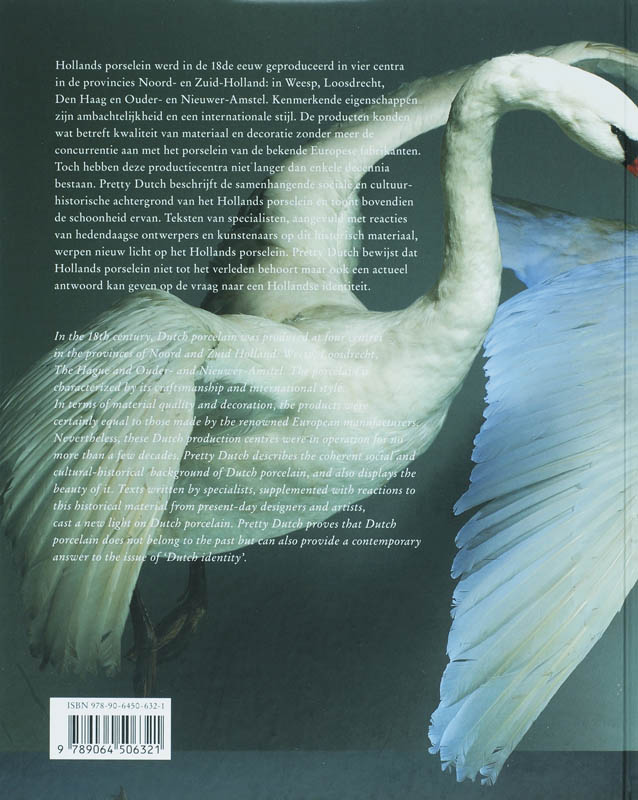
Pretty Dutch 18de-eeuws Hollands porcelein = 18th century Dutch porcelain
G. Hall vert.
HardbackNederlandsLeverbaar
Hollands porselein werd in de 18de eeuw geproduceerd in vier centra in de provincies Noord- en Zuid-Holland: in Weesp, Loosdrecht, Den Haag en Ouder- en Nieuwer-Amstel. Kenmerkende eigenschappen zijn ambachtelijkheid en een internationale stijl. De producten konden wat betreft kwaliteit van materiaal en decoratie zonder meer de concurrentie aan met het porselein van de bekende Europese fabrikanten. Toch hebben deze productiecentra niet langer dan enkele decennia bestaan. Pretty Dutch beschrijft de samenhangende sociale en cultuurhistorische achtergrond van het Hollands porselein en toont bovendien de schoonheid ervan. Teksten van specialisten, aangevuld met reacties van hedendaagse ontwerpers en kunstenaars op dit historisch materiaal, werpen nieuw licht op het Hollands porselein. Pretty Dutch bewijst dat Hollands porselein niet tot het verleden behoort maar ook een actueel antwoord kan geven op de vraag naar een Hollandse identiteit.
In the 18th century, Dutch porcelain was produced at four centres in the provinces of Noord and Zuid Holland: Weesp, Loosdrecht, The Hague and Ouder- and Nieuwer-Amstel. The porcelain is characterized by its craftsmanship and international style.
In terms of material quality and decoration, the products were certainly equal to those made by the renowned European manufacturers. Nevertheless, these Dutch production centres were in operation for no more than a few decades. Pretty Dutch describes the coherent social and cultural-historical background of Dutch porcelain, and also displays the beauty of it. Texts written by specialists, supplemented with reactions to this historical material from present-day designers and artists, cast a new light on Dutch porcelain. Pretty Dutch proves that Dutch porcelain does not belong to the past but can also provide a contemporary answer to the issue of 'Dutch identity'.
In the 18th century, Dutch porcelain was produced at four centres in the provinces of Noord and Zuid Holland: Weesp, Loosdrecht, The Hague and Ouder- and Nieuwer-Amstel. The porcelain is characterized by its craftsmanship and international style.
In terms of material quality and decoration, the products were certainly equal to those made by the renowned European manufacturers. Nevertheless, these Dutch production centres were in operation for no more than a few decades. Pretty Dutch describes the coherent social and cultural-historical background of Dutch porcelain, and also displays the beauty of it. Texts written by specialists, supplemented with reactions to this historical material from present-day designers and artists, cast a new light on Dutch porcelain. Pretty Dutch proves that Dutch porcelain does not belong to the past but can also provide a contemporary answer to the issue of 'Dutch identity'.
In het kort
ISBN-13
9789064506321
Uitgever
Verschenen
19 april 2007
Bibliografisch
ISBN-139789064506321
Editie1
TaalNederlands dut
GeïllustreerdJa
Uitgave
Uitgevernai010 uitgevers/publishers
CB-relatie-id7100743
Verschenen19 april 2007
StatusLeverbaar 04
BeschikbaarheidBeschikbaar 20
Adviesprijs (incl. btw)€ 24,50
Vorm & inhoud
ProductvormHardback BB
SamenstellingLos product
Classificatie
NUR (hoofd)Kunst algemeen 640
NUR (alle)640 Kunst algemeen
Medewerkers
Redacteur B01A. Trumpie
Vertaler B06G. Hall
Herkomst
Werk-id (NSTC)500660010
MeldingBevestigd bij publicatie 03
Bijgewerkt6 augustus 2026
Lijkt op dit boek

NSTC 500660010 · CB-relatie 7100743 · Bijgewerkt 6 augustus 2026