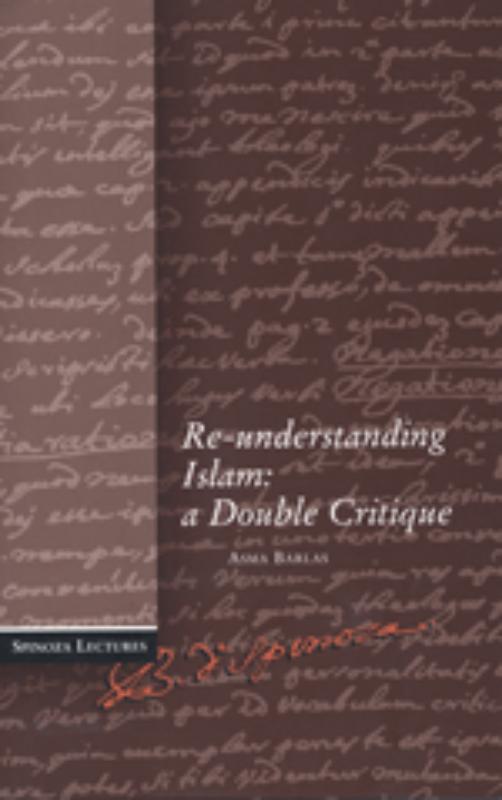
Re-understanding Islam: A Double Critique
"Spinoza Lectures
Asma Barlas is Professor of Politics and Director of the Center for the Study of Culture, Race, and Ethnicity, at Ithaca College in New York State. She is the author of Islam, Muslims, and the U.S.: Essays on Religion and Politics (2004), Believing Women in Islam: Unreading Patriarchal Interpretations of the Quran (2002), and Democracy, Nationalism and Communalism: The Colonial Legacy in South Asia (1995). She has received awards from the International Center for Islam and Pluralism in Indonesia, the American Institute of Pakistan Studies, the American Association of University Women and the United Nations Department for Public Information. For her c.v. see http://faculty.ithaca.edu/abarlas/.
In these two lectures, Barlas offers a double critique: of Muslims for reading sexual inequality and oppression into Islams scripture, the Quran, and a critique of the West for failing to develop morally relevant ways of speaking about Islam and Muslims.
In Believing Women in Islam: Between secular and religious politics and theology she considers some approaches to the so-called anti-women verses in the Quran (and to the Quran generally) that are putatively liberating for Muslim women. These approaches range from saying an outright no to the Quran to saying an unqualified yes to it. Barlas explores, and also critiques, the religious and political terrain that lies between this no and yes as a way to explain what is at stake for Muslims in different approaches to the text. While she does not build toward one conclusion, she illustrates both the problems with the secular Muslim politics of saying no to the Quran and the liberatory possibilities inherent in the scripture providing one reads it in light of certain theological and hermeneutic principles.
Would Spinoza Understand Me? Europe, Islam, and the Mirror of Difference. Barlas asks this question as a point of departure for arguing that the ideological template that the West uses to make sense of Islam impedes thinking about it in morally relevant ways, hence also feeling solidarity with Muslims. It does this by treating difference itself as wild and oppositional, by re-inscribing a long history of Western violence against Muslims as discrete and episodic thus masking its continuities, and by reframing many Western transgressions as acts of reverse violence by Muslims thus transforming Westerners into victims. She substanitiates her critique by tracing three tropes about Islam/Muslims from medieval European Biblical exegesis to contemporary secular discourses."
Asma Barlas is Professor of Politics and Director of the Center for the Study of Culture, Race, and Ethnicity, at Ithaca College in New York State. She is the author of Islam, Muslims, and the U.S.: Essays on Religion and Politics (2004), Believing Women in Islam: Unreading Patriarchal Interpretations of the Quran (2002), and Democracy, Nationalism and Communalism: The Colonial Legacy in South Asia (1995). She has received awards from the International Center for Islam and Pluralism in Indonesia, the American Institute of Pakistan Studies, the American Association of University Women and the United Nations Department for Public Information. For her c.v. see http://faculty.ithaca.edu/abarlas/.
In these two lectures, Barlas offers a double critique: of Muslims for reading sexual inequality and oppression into Islams scripture, the Quran, and a critique of the West for failing to develop morally relevant ways of speaking about Islam and Muslims.
In Believing Women in Islam: Between secular and religious politics and theology she considers some approaches to the so-called anti-women verses in the Quran (and to the Quran generally) that are putatively liberating for Muslim women. These approaches range from saying an outright no to the Quran to saying an unqualified yes to it. Barlas explores, and also critiques, the religious and political terrain that lies between this no and yes as a way to explain what is at stake for Muslims in different approaches to the text. While she does not build toward one conclusion, she illustrates both the problems with the secular Muslim politics of saying no to the Quran and the liberatory possibilities inherent in the scripture providing one reads it in light of certain theological and hermeneutic principles.
Would Spinoza Understand Me? Europe, Islam, and the Mirror of Difference. Barlas asks this question as a point of departure for arguing that the ideological template that the West uses to make sense of Islam impedes thinking about it in morally relevant ways, hence also feeling solidarity with Muslims. It does this by treating difference itself as wild and oppositional, by re-inscribing a long history of Western violence against Muslims as discrete and episodic thus masking its continuities, and by reframing many Western transgressions as acts of reverse violence by Muslims thus transforming Westerners into victims. She substanitiates her critique by tracing three tropes about Islam/Muslims from medieval European Biblical exegesis to contemporary secular discourses."
In het kort
ISBN-13
9789023244585
Uitgever
Verschenen
25 november 2008
Serie
Bibliografisch
Uitgave
UitgeverUitgeverij Van Gorcum B.V.
CB-relatie-id6127604
Verschenen25 november 2008
StatusLeverbaar 04
BeschikbaarheidBeschikbaar 20
Adviesprijs (incl. btw)€ 11,50
Vorm & inhoud
ProductvormPaperback BC
SamenstellingLos product
Classificatie
NUR (hoofd)Filosofie algemeen 730
NUR (alle)730 Filosofie algemeen
Medewerkers
Auteur A01a. Barlas
Herkomst
Werk-id (NSTC)500610425
MeldingBevestigd bij publicatie 03
Bijgewerkt6 augustus 2026
Lijkt op dit boek



NSTC 500610425 · CB-relatie 6127604 · Bijgewerkt 6 augustus 2026