
Representations of Revolution by Female Novelists from Burney to Austen
PaperbackEngels
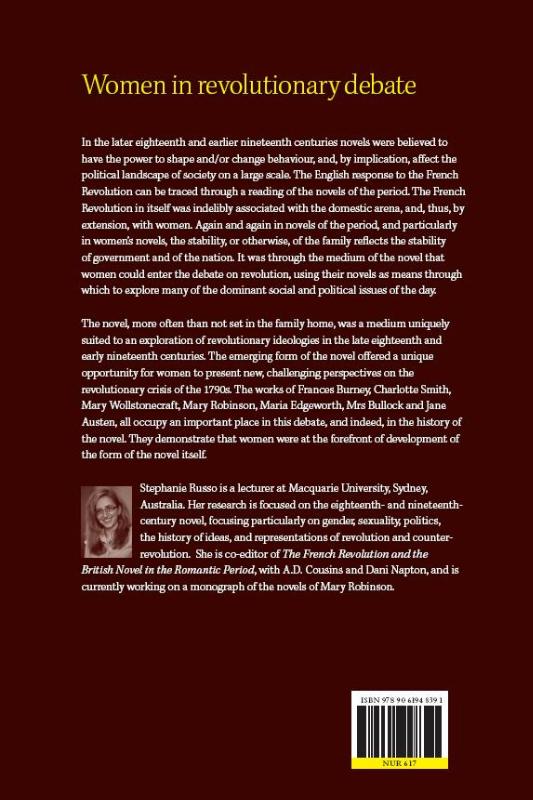
In the later eighteenth and earlier nineteenth centuries novels were believed to have the power to shape and/or change behaviour, and, by implication, affect the political landscape of society on a large scale. The English response to the French Revolution can be traced through a reading of the novels of the period. The French Revolution in itself was indelibly associated with the domestic arena, and, thus, by extension, with women. Again and again in novels of the period, and particularly in womens novels, the stability, or otherwise, of the family reflects the stability of government and of the nation. It was through the medium of the novel that women could enter the debate on revolution, using their novels as means through which to explore many of the dominant social and political issues of the day.
The novel, more often than not set in the family home, was a medium uniquely suited to an exploration of revolutionary ideologies in the late eighteenth- and early nineteenth- centuries. The emerging form of the novel offered a unique opportunity for women to present new, challenging perspectives on the revolutionary crisis of the 1790s. The works of Frances Burney, Charlotte Smith, Mary Wollstonecraft, Mary Robinson, Maria Edgeworth, Mrs Bullock and Jane Austen, all occupy an important place in this debate, and indeed, in the history of the novel. They demonstrate that women were at the forefront of development of the form of the novel itself.
Stephanie Russo is a lecturer at Macquarie University, Sydney, Australia. Her research is focused on the eighteenth- and nineteenthcentury novel, focusing particularly on gender, sexuality, politics, the history of ideas, and representations of revolution and counterrevolution.
She is co-editor of 'The French Revolution and the British Novel in the Romantic Period', with A.D. Cousins and Dani Napton, and is currently working on a monograph of the novels of Mary Robinson.
The novel, more often than not set in the family home, was a medium uniquely suited to an exploration of revolutionary ideologies in the late eighteenth- and early nineteenth- centuries. The emerging form of the novel offered a unique opportunity for women to present new, challenging perspectives on the revolutionary crisis of the 1790s. The works of Frances Burney, Charlotte Smith, Mary Wollstonecraft, Mary Robinson, Maria Edgeworth, Mrs Bullock and Jane Austen, all occupy an important place in this debate, and indeed, in the history of the novel. They demonstrate that women were at the forefront of development of the form of the novel itself.
Stephanie Russo is a lecturer at Macquarie University, Sydney, Australia. Her research is focused on the eighteenth- and nineteenthcentury novel, focusing particularly on gender, sexuality, politics, the history of ideas, and representations of revolution and counterrevolution.
She is co-editor of 'The French Revolution and the British Novel in the Romantic Period', with A.D. Cousins and Dani Napton, and is currently working on a monograph of the novels of Mary Robinson.
In het kort
ISBN-13
9789061948391
Uitgever
Verschenen
13 januari 2012
Imprint
Bibliografisch
ISBN-139789061948391
Editie1
TaalEngels eng
GeïllustreerdNee
Uitgave
UitgeverHes & de Graaf Publishers
ImprintHes & De Graaf Publishers
CB-relatie-id7600533
Verschenen13 januari 2012
StatusOnbekend 00
Vorm & inhoud
ProductvormPaperback BC
SamenstellingLos product
Classificatie
NUR (hoofd)Literatuurwetenschap 617
NUR (alle)617 Literatuurwetenschap
Herkomst
Werk-id (NSTC)500516204
MeldingBevestigd bij publicatie 03
Bijgewerkt6 augustus 2026
Lijkt op dit boek

The Secret - 20 jaar Limited edition
A Companion to Tom Phillips
A Companion to Tom Phillips
A Companion to Tom Phillips
Wat zich aan het oog onttrekt
Joyce Translated
In gesprek met marsmannetjes
Affect in Translation and Interpreting
Affect in Translation and Interpreting
Affect in Translation and Interpreting
NSTC 500516204 · CB-relatie 7600533 · Bijgewerkt 6 augustus 2026