
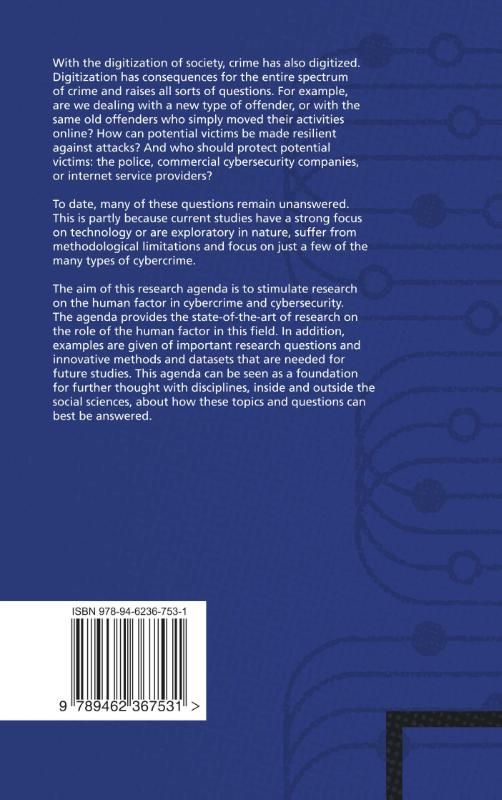
Research Agenda The human factor in cybercrime and cybersecurity
PaperbackEngels
Ook verkrijgbaar als
With the digitization of society, crime has also digitized. Digitization has consequences for the entire spectrumof crime and raises all sorts of questions. For example, are we dealing with a new type of offender, or with thesame old offenders who simply moved their activities online? How_can potential victims be made resilientagainst attacks? And who should protect potential victims: the_police, commercial cybersecurity companies, or_internet service providers?To date, many of these questions remain unanswered. This is partly because current studies have a strong focuson technology or are exploratory in nature, suffer from methodological limitations and focus on just a few of the many types of cybercrime. The aim of this research agenda is to stimulate research on the human factor in cybercrime and cybersecurity. The agenda provides the state-of-the-art of research on the role of the human factor in this fi eld. In addition, examples are given of important research questions and innovative methods and datasets that are needed for future studies. This agenda can be seen as a foundation for further thought with disciplines, inside and outside the social sciences, about how these topics and questions can best be_answered.
In het kort
ISBN-13
9789462367531
Uitgever
Verschenen
15 mei 2017
Bibliografisch
ISBN-139789462367531
Editie1
TaalEngels eng
GeïllustreerdNee
Uitgave
UitgeverKoninklijke Boom uitgevers PW
CB-relatie-id7500275
Verschenen15 mei 2017
StatusOnbekend 00
BeschikbaarheidContact leverancier 99
Adviesprijs (incl. btw)€ 26,50
Vorm & inhoud
ProductvormPaperback BC
SamenstellingLos product
Classificatie
NUR (hoofd)Mens en maatschappij algemeen 740
NUR (alle)740 Mens en maatschappij algemeen
Medewerkers
Redacteur B01Rutger Leukfeldt
Herkomst
Werk-id (NSTC)500082611
MeldingBevestigd bij publicatie 03
Bijgewerkt6 augustus 2026
Lijkt op dit boek
Cybercrime among companies

Essentials in Cybercrime
Cybercriminal networks
Victimisation in a digitised society
Cybercrime and the police
Victimisation in a digitised society
Cyber Safety
Cyber Safety
Measuring cybercrime in Europe: The role of crime statistics and victimisation surveys

Law Enforcement in Digital Society
NSTC 500082611 · CB-relatie 7500275 · Bijgewerkt 6 augustus 2026