
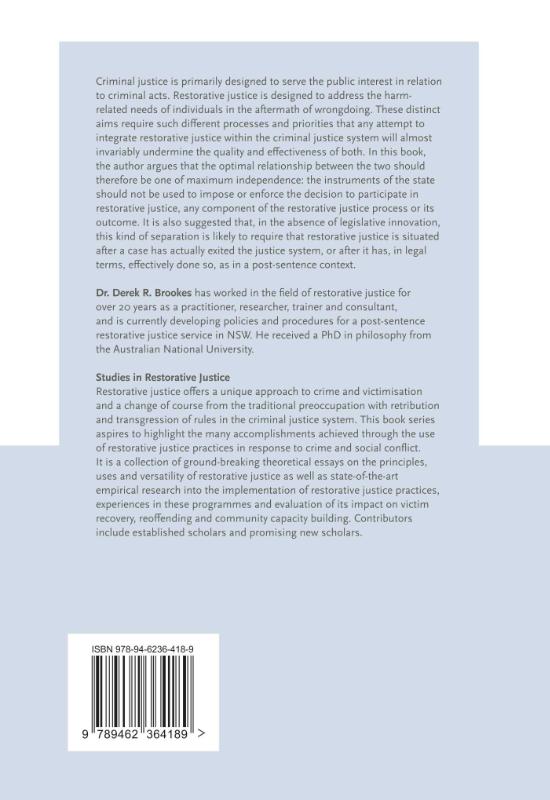
Restorative Justice and Criminal Justice The Case for Parallelism
Ook verkrijgbaar als
About the series; Acknowledgements; Preface; 1 Introduction; 1.1 The debate; 1.2 The case; 2 Foundations; 2.1 Public vs. private interest; 2.2 Passive vs. active responsibility; 2.3 Public vs. private censure; 3 Implementation; 3.1 Guiding principles; 3.2 Logistics; 3.3 Mainstreaming; 4 Advantages; 4.1 Equality; 4.2 Proportionality; 4.3 Due process; 4.4 Boundaries; 4.5 Sincerity; 4.6 Trust; 4.7 Integrity; 4.8 Inclusiveness; 4.9 Self-Determination; 5 Challenges; 5.1 Victims; 5.2 Offenders; 5.3 Criminal justice; 6 Conclusion; Bibliography; IndexThis book discusses the optimal relationship between restorative justice and criminal justice.Criminal justice is primarily designed to serve the public interest in relation to criminal acts. Restorative justice is designed to address the harmrelated needs of individuals in the aftermath of wrongdoing. These distinct aims require such different processes and priorities that any attempt to integrate restorative justice within the criminal justice system will almost invariably undermine the quality and effectiveness of both. In this book, the author argues that the optimal relationship between the two should therefore be one of maximum independence: the instruments of the state should not be used to impose or enforce the decision to participate in restorative justice, any component of the restorative justice process or its outcome. It is also suggested that, in the absence of legislative innovation, this kind of separation is likely to require that restorative justice is situated after a case has actually exited the justice system, or after it has, in legal terms, effectively done so, as in a post-sentence context.
In het kort
ISBN-13
9789462364189
Uitgever
Verschenen
21 februari 2023
Bibliografisch
ISBN-139789462364189
SerieStudies in Restorative Justice — deel 5
Editie1
TaalEngels eng
Pagina’s307
GeïllustreerdNee
Uitgave
UitgeverKoninklijke Boom uitgevers PW
CB-relatie-id7500275
Verschenen21 februari 2023
StatusOnbekend 00
BeschikbaarheidContact leverancier 99
Zonder prijsPrijs volgt
Vorm & inhoud
ProductvormHardback BB
SamenstellingLos product
Classificatie
NUR (hoofd)Algemene sociale wetenschappen 741
NUR (alle)741 Algemene sociale wetenschappen
Trefwoordenmediation · crime · international · victimology · victimisation · criminology · re-integration · maximalism · resolution · dispute · victim · offender · adr · penology · integrationism · criminal
Medewerkers
Herkomst
Werk-id (NSTC)501527059
MeldingBevestigd bij publicatie 03
Bijgewerkt6 augustus 2026
Trefwoorden
Lijkt op dit boek
Restorative justice from a children’s rights perspective
Restorative Justice: The Art of an Emancipated Crime Approach
Building Bridges
Being consequential about restorative justice

Desert in a reparative frame

Remaking justice after sexual violence
The Praxis of Justice
The Praxis of Justice
Legislative Proposal to Introduce Provisions Governing Restorative Justice Services into the Dutch Code of Criminal Procedure and Explanatory Memorandum
NSTC 501527059 · CB-relatie 7500275 · Bijgewerkt 6 augustus 2026