
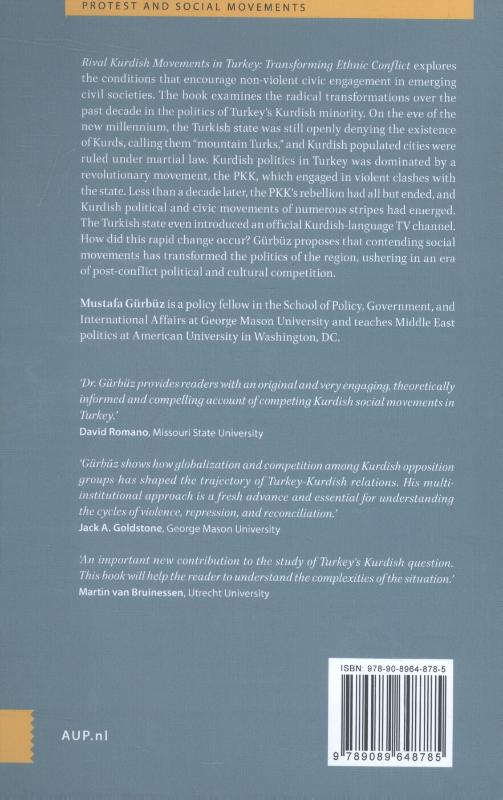
Rival kurdish movements in Turkey transforming ethnic conflict
Ook verkrijgbaar als
This book explores the conditions that encourage non-violent civic engagement in emerging civil societies. Gürbüz examines the radical transformations over the past decade in the politics of Turkey's Kurdish minority. On the eve of the new millennium, the Turkish state was still openly denying the existence of Kurds, calling them "mountain Turks," and Kurdish populated cities were ruled under martial law. Kurdish politics in Turkey was dominated by a revolutionary movement, the PKK, which engaged in violent clashes with the state. Less than a decade later, the PKK's rebellion had all but ended, and Kurdish political and civic movements of numerous stripes had emerged. The Turkish state even introduced an official Kurdish-language TV channel. How did this rapid change occur? Gürbüz proposes that contending social movements has transformed the politics of the region, ushering in an era of post-conflict political and cultural competition.
In het kort
ISBN-13
9789089648785
Uitgever
Verschenen
13 januari 2016
Imprint
Bibliografisch
ISBN-139789089648785
SerieProtest and Social Movements — deel 7
Editie1
TaalEngels eng
Pagina’s200
GeïllustreerdJa
Uitgave
UitgeverAmsterdam University Press
ImprintAmsterdam University Press
CB-relatie-id7400597
Verschenen13 januari 2016
StatusInactief 08
BeschikbaarheidContact leverancier 99
Adviesprijs (incl. btw)€ 81,99
Vorm & inhoud
ProductvormHardback BB
SamenstellingLos product
Medewerkers
Auteur A01Mustafa Gürbüz
Herkomst
Werk-id (NSTC)100034333
MeldingBevestigd bij publicatie 03
Bijgewerkt6 augustus 2026
Lijkt op dit boek
NSTC 100034333 · CB-relatie 7400597 · Bijgewerkt 6 augustus 2026