AI-GEGENEREERD
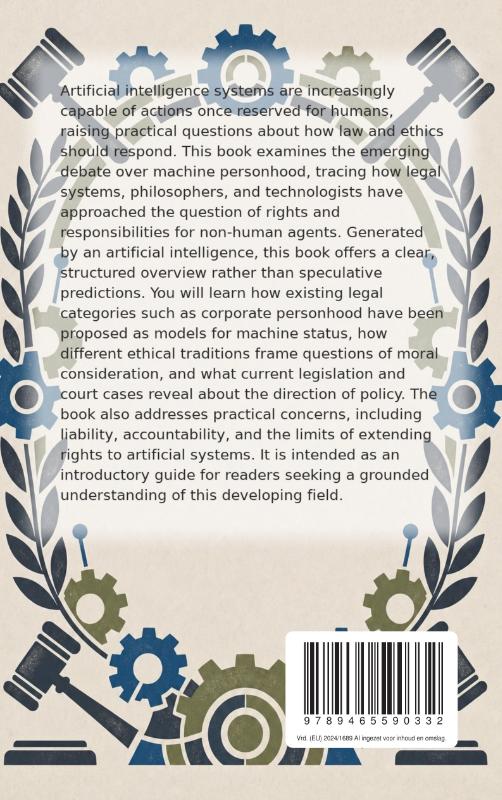
Robot Rights How Machine Intelligence Is Redefining Law, Ethics, and Personhood
Paperback120 pagina’sEngelsAI-gegenereerd
Artificial intelligence systems are increasingly capable of actions once reserved for humans, raising practical questions about how law and ethics should respond.Artificial intelligence systems are increasingly capable of actions once reserved for humans, raising practical questions about how law and ethics should respond. This book examines the emerging debate over machine personhood, tracing how legal systems, philosophers, and technologists have approached the question of rights and responsibilities for non-human agents. Generated by an artificial intelligence, this book offers a clear, structured overview rather than speculative predictions. You will learn how existing legal categories such as corporate personhood have been proposed as models for machine status, how different ethical traditions frame questions of moral consideration, and what current legislation and court cases reveal about the direction of policy. The book also addresses practical concerns, including liability, accountability, and the limits of extending rights to artificial systems. It is intended as an introductory guide for readers seeking a grounded understanding of this developing field.Artificial intelligence systems are increasingly capable of actions once reserved for humans, raising practical questions about how law and ethics should respond. This book examines the emerging debate over machine personhood, tracing how legal systems, philosophers, and technologists have approached the question of rights and responsibilities for non-human agents. Generated by an artificial intelligence, this book offers a clear, structured overview rather than speculative predictions. You will learn how existing legal categories such as corporate personhood have been proposed as models for machine status, how different ethical traditions frame questions of moral consideration, and what current legislation and court cases reveal about the direction of policy. The book also addresses practical concerns, including liability, accountability, and the limits of extending rights to artificial systems. It is intended as an introductory guide for readers seeking a grounded understanding of this developing field.
In het kort
ISBN-13
9789465590332
Uitgever
Verschenen
16 juli 2026
Imprint
Bibliografisch
ISBN-139789465590332
Editie1
TaalEngels eng
Pagina’s120
GeïllustreerdNee
Uitgave
UitgeverAndries B.V.
ImprintWaries B.V.
CB-relatie-id6750323
Verschenen16 juli 2026
StatusAangekondigd 02
BeschikbaarheidContact leverancier 99
Adviesprijs (incl. btw)€ 16,95
Vorm & inhoud
ProductvormPaperback BC
SamenstellingLos product
Classificatie
NUR (hoofd)Recht algemeen 820
NUR (alle)820 Recht algemeen
Herkomst
Werk-id (NSTC)501686054
MeldingUpdate 04
Laatste CB-bericht7768
Bijgewerkt5 augustus 2026
Lijkt op dit boek
The Future of Artificial Intelligence
How Artificial Intelligence Developed

How the Rule of Law Protects the Citizen
Using AI Mindfully and Critically
All About Autonomous Vehicles
All About Robotics
Criminal Behavior and Accountability of Artificial Intelligence Systems
AI Course

The Strangest Lawsuits Ever

AI in the Classroom
NSTC 501686054 · CB-relatie 6750323 · Laatste CB-bericht 7768 · Bijgewerkt 5 augustus 2026