
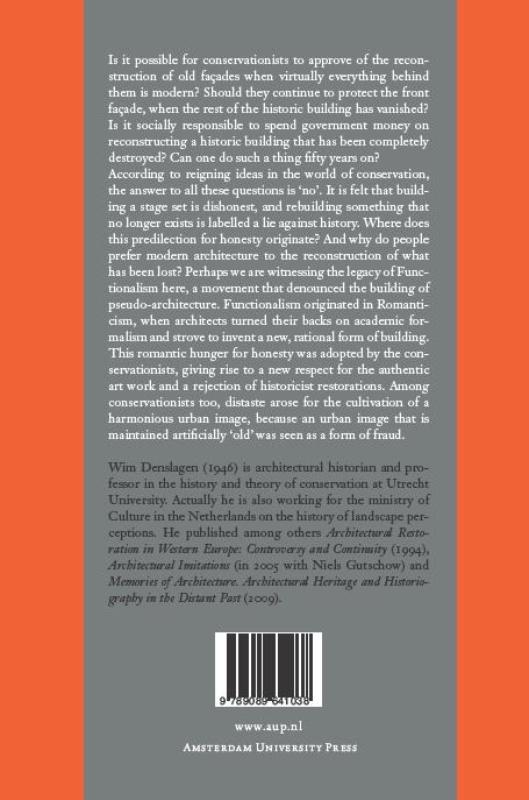
Romantic Modernism nostalgia in the World of Conservation
D. Gardner vert.
Paperback261 pagina’sEngels
Ook verkrijgbaar als
Is it possible for conservationists to approve of the reconstruction of old façades when virtually everything behind them is modern? Should they continue to protect the front façade, when the rest of the historic building has vanished? Is it socially responsible to spend government money on reconstructing a historic building that has been completely destroyed? Can one do such a thing fifty years on?
According to reigning ideas in the world of conservation, the answer to all these questions is no. It is felt that building a stage set is dishonest, and rebuilding something that no longer exists is labelled a lie against history. Where does this predilection for honesty originate? And why do people prefer modern architecture to the reconstruction of what has been lost? Perhaps we are witnessing the legacy of Functionalism here, a movement that denounced the building of pseudo-architecture. Functionalism originated in Romanticism, when architects turned their backs on academic formalism and strove to invent a new, rational form of building. This romantic hunger for honesty was adopted by the conservationists, giving rise to a new respect for the authentic art work and a rejection of historicist restorations. Among conservationists too, distaste arose for the cultivation of a harmonious urban image, because an urban image that is maintained artificially old was seen as a form of fraud.
In het kort
ISBN-13
9789089641038
Uitgever
Verschenen
14 mei 2009
Bibliografisch
ISBN-139789089641038
Editie1
TaalEngels eng
Pagina’s261
GeïllustreerdJa
Uitgave
UitgeverAmsterdam University Press
CB-relatie-id7400597
Verschenen14 mei 2009
StatusInactief 08
BeschikbaarheidContact leverancier 99
Adviesprijs (incl. btw)€ 30,00
Vorm & inhoud
ProductvormPaperback BC
SamenstellingLos product
Classificatie
NUR (hoofd)Bouwkunst, architectuur 648
NUR (alle)648 Bouwkunst, architectuur
Medewerkers
Auteur A01W. Denslagen
Vertaler B06D. Gardner
Herkomst
Werk-id (NSTC)500101578
MeldingBevestigd bij publicatie 03
Bijgewerkt6 augustus 2026
Lijkt op dit boek






NSTC 500101578 · CB-relatie 7400597 · Bijgewerkt 6 augustus 2026