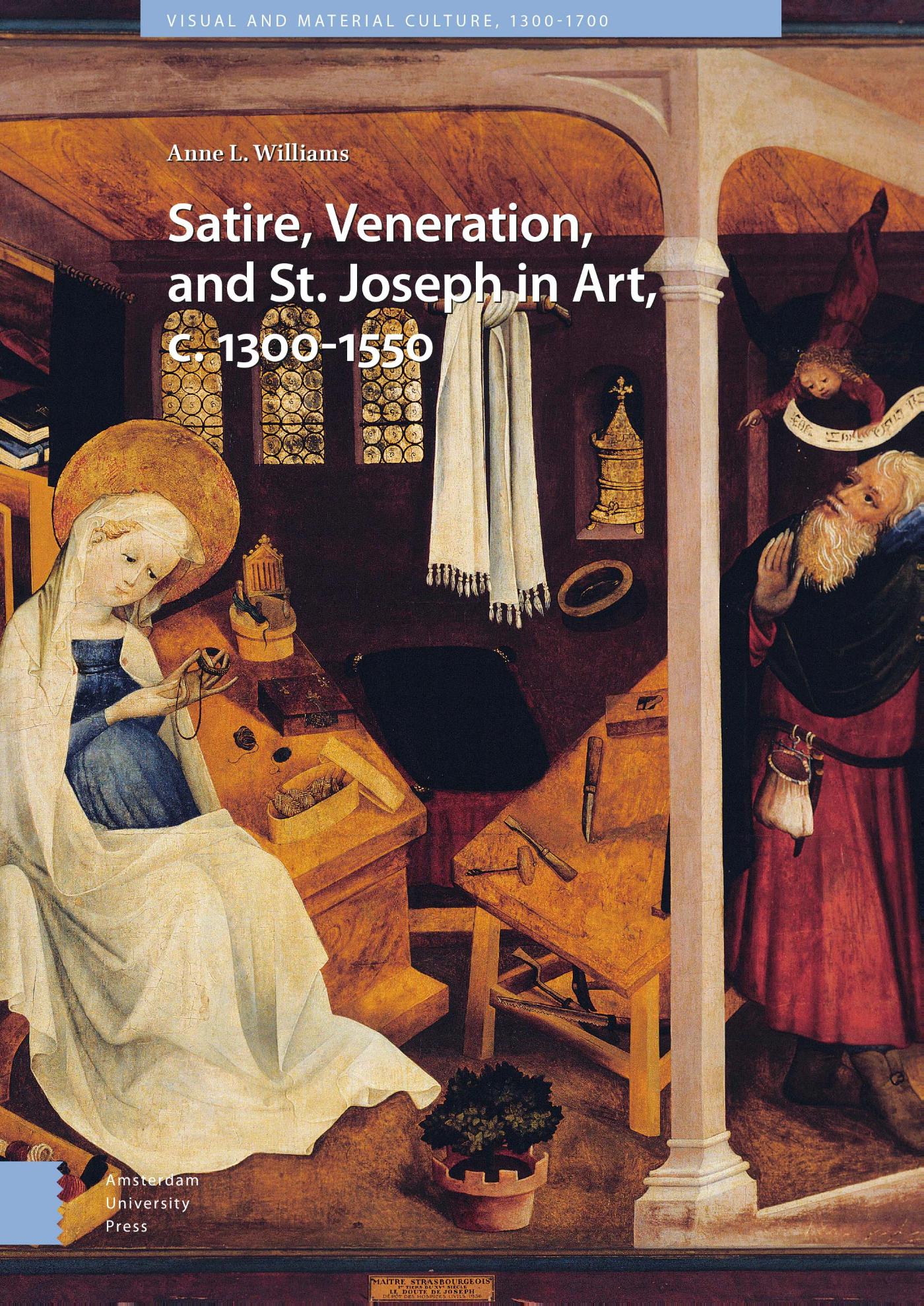
Satire, Veneration, and St. Joseph in Art, c. 1300-1550
Satire, Veneration, and St. Joseph in Art, c. 1300-1550 is the first to reclaim satire as a central component of Catholic altarpieces, devotional art, and veneration, moving beyond humor's relegation to the medieval margins or to the profane arts alone. The book challenges humor's perception as a mere teaching tool for the laity and the antithesis of 'high' veneration and theology, a divide perpetuated by Counter-Reformation thought and the inheritance of Mikhail Bakhtin (Rabelais and His World, 1965). It reveals how humor, laughter, and material culture played a critical role in establishing St. Joseph as an exemplar in western Europe as early as the thirteenth century. Its goal is to open a new line of interpretation in medieval and early modern cultural studies, by revealing the functions of humor in sacred scenes, the role of laughter as veneration, and the importance of play for pre-Reformation religious experiences.
In het kort
ISBN-13
9789048534111
Uitgever
Verschenen
10 oktober 2019
Imprint
Bibliografisch
ISBN-139789048534111
SerieVisual and Material Culture, 1300-1700 — deel 16
Editie1
TaalEngels eng
Pagina’s244
GeïllustreerdJa
Uitgave
UitgeverAmsterdam University Press
ImprintAmsterdam University Press
CB-relatie-id7400597
Verschenen10 oktober 2019
StatusOnbekend 00
Vorm & inhoud
ProductvormE-book ED
VormdetailE107 PDF
SamenstellingLos product
Beveiliging e-bookAdobe DRM 03
Classificatie
NUR (hoofd)Nieuwe geschiedenis (1500-1870) 685
NUR (alle)685 Nieuwe geschiedenis (1500-1870)
Medewerkers
Auteur A01Anne L. Williams
Herkomst
Werk-id (NSTC)500240888
MeldingBevestigd bij publicatie 03
Bijgewerkt6 augustus 2026
Lijkt op dit boek









NSTC 500240888 · CB-relatie 7400597 · Bijgewerkt 6 augustus 2026