
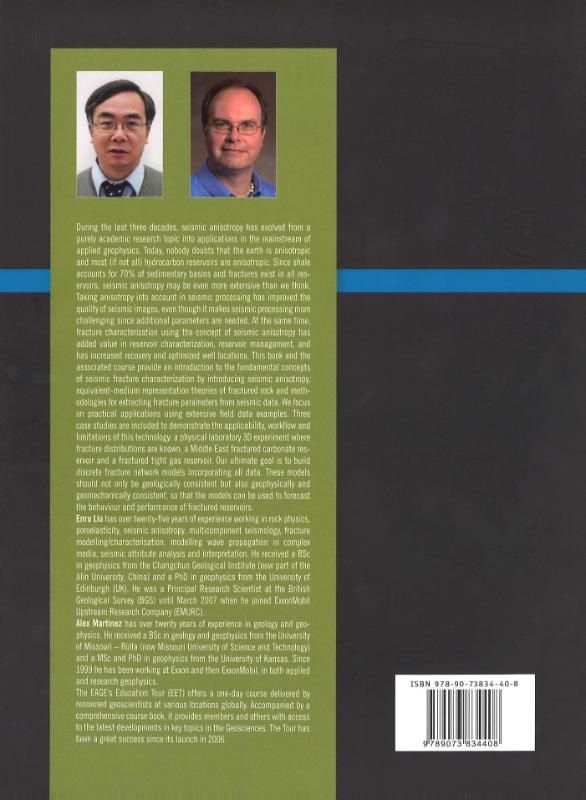
Seismic fracture characterization concepts and practical applications
Ook verkrijgbaar als
During the last three decades, seismic anisotropy has evolved from a purely academic research topic into applications in the mainstream of applied geophysics. Today, nobody doubts that the earth is anisotropic and most (if not all) hydrocarbon reservoirs are anisotropic. Since shale accounts for 70% of sedimentary basins and fractures exist in all reservoirs, seismic anisotropy may be even more extensive than we think. Taking anisotropy into account in seismic processing has improved the quality of seismic images, even though it makes seismic processing more challenging since additional parameters are needed. At the same time, fracture characterization using the concept of seismic anisotropy has added value in reservoir characterization, reservoir management, and has increased recovery and optimized well locations. This book and the associated course provide an introduction to the fundamental concepts of seismic fracture characterization by introducing seismic anisotropy, equivalent-medium representation theories of fractured rock and methodologies for extracting fracture parameters from seismic data. We focus on practical applications using extensive field data examples. Three case studies are included to demonstrate the applicability, workflow and limitations of this technology: a physical laboratory 3D experiment where fracture distributions are known, a Middle East fractured carbonate reservoir and a fractured tight gas reservoir. Our ultimate goal is to build discrete fracture network models incorporating all data. These models should not only be geologically consistent but also geophysically and geomechanically consistent, so that the models can be used to forecast the behaviour and performance of fractured reservoirs.The EAGE's Education Tour (EET) offers a one-day course delivered by renowned geoscientists at various locations globally. Accompanied by a comprehensive course book, it provides members and others with access to the latest developments in key topics in the Geosciences. The Tour has been a great success since its launch in 2006. Table of contents 1. Introduction2. Fundamentals of seismic anisotropy 3. Equivalent medium modelling of fractured rock 4. Estimation of fracture parameters from azimuth analysis of P-wave data 5. Multicomponent seismology and its application to fracture characterization6. Fracture detection using 3D seismic data: physical laboratory studies 7. Mitigation of overburden effects in azimuthal AVO analysis of a Middle East carbonate field 8. Integrated study of fracture characterization of a tight gas reservoir using 3C-3D seismic data at Piceance Basin, Colorado, USA 9. Summary and road ahead References Appendix A. The two-index notation of elastic tensors Appendix B. Wave propagation in anisotropic media Appendix C. Effective elastic constants of cracked media - Hudson's model Appendix D. Plane wave reflection and transmission coefficients in anisotropic media - Schoenberg and Protazio algorithm
In het kort
ISBN-13
9789073834408
Uitgever
Verschenen
11 december 2012
Imprint
Bibliografisch
Uitgave
UitgeverEAGE Publications bv
ImprintEAGE Publications bv
CB-relatie-id8051011
Verschenen11 december 2012
StatusOnbekend 00
Vorm & inhoud
ProductvormPaperback BC
SamenstellingLos product
Classificatie
NUR (hoofd)Geologie 933
NUR (alle)933 Geologie
Medewerkers
Auteur A01Enru Liu
Auteur A01Alex Martinez
Herkomst
Werk-id (NSTC)500189381
MeldingBevestigd bij publicatie 03
Bijgewerkt6 augustus 2026
Lijkt op dit boek



NSTC 500189381 · CB-relatie 8051011 · Bijgewerkt 6 augustus 2026