
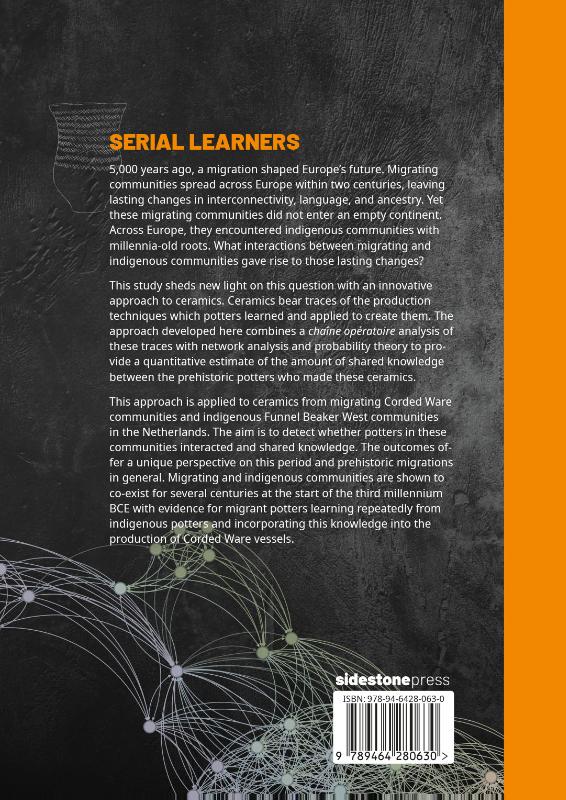
Serial Learners Interactions between Funnel Beaker West and Corded Ware Communities in the Netherlands during the Third Millennium BCE from the Perspective of Ceramic Technology
Hardback284 pagina’sEngels
Ook verkrijgbaar als
1 Beakers, Plagues, and Battle Axes1.1 A Very Short Introduction to the Third Millennium BCE1.2 Three Answers, One Problem1.3 Migration: A Link Between Scales1.4 Thinking with Ceramics1.5 Research Question and Study Area1.6 The Third Millennium BCE: A Matter of Concern1.7 Outlook2 Funnel Beaker West and Corded Ware Communities Co-existed2.1 The Age of Ceramics2.2 Rise and Fall2.3 Re-examining the Absolute Chronology of the Third Millennium BCE2.4 Funnel Beaker West Chronology: What Can We Know?2.5 Funnel Beaker West in the Third Millennium BCE2.6 Overview3 An Archaeology of Learning3.1 Beyond Group Detection3.2 From Sherds to Learning3.3 Overview4 A Probabilistic Analysis of Ceramic Technology4.1 The Chaîne Opératoire as a Network4.2 The Total Chaîne Opératoire as a Probability Space4.3 Final Considerations: Why Go Probabilistic?5 Sample Design5.1 Sampling Strategy5.2 Analytical Techniques5.3 Selected Vessels and Samples5.4 Overview6 Funnel Beaker West Ceramic Technology6.1 Prior Studies6.2 Specific Chaînes Opératoires in the Funnel Beaker West Body of Knowledge6.3 Summary7 Corded Ware Ceramic Technology7.1 Previous Studies7.2 Specific Chaînes Opératoires in the Corded Ware Body of Knowledge7.3 Summary8 Petrography of Funnel Beaker West and Corded Ware Vessels8.1 Fabric Groups8.2 Traces of Techniques8.3 Provenance8.4 Final Remarks9 Abductive Comparison of Specific Chaînes Opératoires9.1 Abductive Comparison9.2 Are There Specialised Production Methods?9.3 Discussion and Conclusion10 Probabilistic Comparison of Specific Chaînes Opératoires10.1 Probabilistic Comparison of Funnel Beaker West and Corded Ware10.2 Expanding the Scope of the Comparisons10.3 Summary11 On the Origins of Neolithic Ceramic Technology11.1 The Roots of Middle and Late Neolithic Ceramic Technology11.2 Final Remarks12 Here to Stay: Indigenous Communities in the 3rd Millennium BCE12.1 Reports of Funnel Beaker Wests’ Death Are Greatly Exaggerated12.2 Learning Prevails12.3 Revising the Neolithic of Northwest Europe13 Eager for Knowledge: Migrants in the Third Millennium BCE13.1 Migrants Learned from Indigenous Communities…13.2 …On More than One Occasion13.3 Concluding Remarks14 Conclusion14.1 Setting the Stage14.2 Business as Usual14.3 Serial Learners14.4 History of Knowledge: A New SynthesisBibliographyAppendicesNederlandstalige SamenvattingEnglish Summary5,000 years ago, a migration shaped Europe’s future. Migrating communities spread across Europe within two centuries, leaving lasting changes in interconnectivity, language, and ancestry. Yet these migrating communities did not enter an empty continent. Across Europe, they encountered indigenous communities with millennia-old roots. What interactions between migrating and indigenous communities gave rise to those lasting changes?This study sheds new light on this question with an innovative approach to ceramics. Ceramics bear traces of the production techniques which potters learned and applied to create them. The approach developed here combines a chaîne opératoire analysis of these traces with network analysis and probability theory to provide a quantitative estimate of the amount of shared knowledge between the prehistoric potters who made these ceramics.This approach is applied to ceramics from migrating Corded Ware communities and indigenous Funnel Beaker West communities in the Netherlands. The aim is to detect whether potters in these communities interacted and shared knowledge. The outcomes offer a unique perspective on this period and prehistoric migrations in general. Migrating and indigenous communities are shown to co-exist for several centuries at the start of the third millennium BCE with evidence for migrant potters learning repeatedly from indigenous potters and incorporating this knowledge into the production of Corded Ware vessels.
In het kort
ISBN-13
9789464280647
Uitgever
Verschenen
18 september 2024
Bibliografisch
ISBN-139789464280647
Editie1
TaalEngels eng
Pagina’s284
GeïllustreerdJa
Uitgave
Vorm & inhoud
ProductvormHardback BB
SamenstellingLos product
Classificatie
NUR (hoofd)Archeologie 682
NUR (alle)682 Archeologie
Medewerkers
Auteur A01Erik Kroon
Herkomst
Werk-id (NSTC)501584813
MeldingBevestigd bij publicatie 03
Bijgewerkt6 augustus 2026
Lijkt op dit boek
Separation, hybridisation, and networks
The eve of destruction?
The Handle Core Concept
Settling with the norm?
Containers of Change
Coming together, keeping apart: Volume 2
Living with Flint
Coming together, keeping apart: Volume 1
The Development of Social Inequality in the Carpathian Basin between 5200 and 1000 BCE
The potters’ perspectives
NSTC 501584813 · CB-relatie 9180064 · Bijgewerkt 6 augustus 2026