
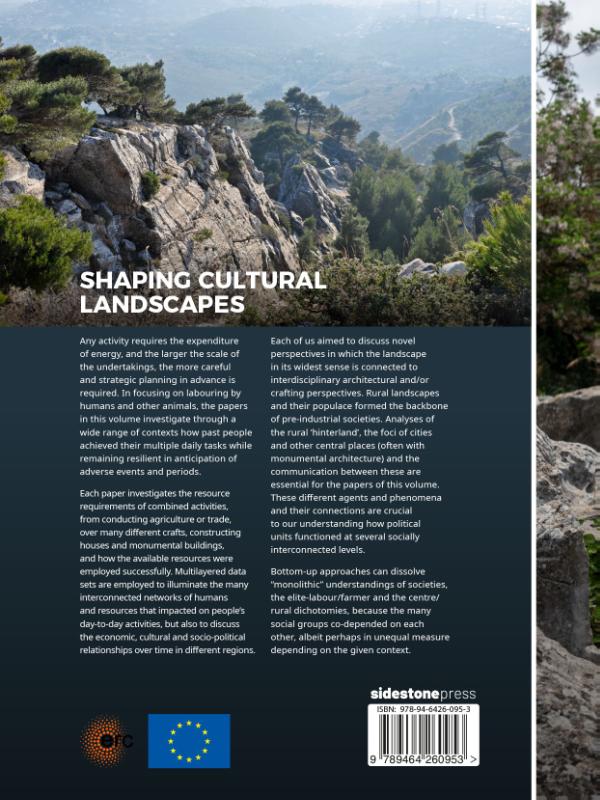
Shaping Cultural Landscapes Connecting Agriculture, Crafts, Construction, Transport, and Resilience Strategies
Hardback320 pagina’sEngels
Shaping Cultural Landscapes through Crafts, Construction, Infrastructure, Agriculture and Resilience Strategies Introduction to the papersAnn Brysbaert, Jari Pakkanen and Irene VikatouThe Life of the Marble Mountain: Agency and Ecology in the Marble Quarries of Ancient Tegea, GreeceJørgen BakkeBuilding the tholos tomb in Tiryns, Greece: comparative labour costs and field methodsAnn Brysbaert, Daniel Turner and Irene VikatouMobility as a drive to shape cultural landscapes: prehistoric route-use in the Argolid and surroundings, GreeceAnn Brysbaert and Irene VikatouTracing the Mycenaean hinterlands. Refining the models of Mycenaean territoriality with insights from the cadastral maps of the Second Venetian Rule in the Peloponnese, GreeceKalliopi EfkleidouClimate, carrying capacity and society: the quest for universal truthsPaul ErdkampEncompassing islandscapes in southern VanuatuJames L. Flexner, Stuart Bedford and Frederique ValentinAfter the Preclassic Collapse. A socio-environmental contextualization of the rise of Naachtun, GuatemalaJulien Hiquet, Cyril Castanet, Lydie Dussol, Philippe Nondédéo, Marc Testé, Louise Purdue, Noémie Tomadini, Sandrine Grouard and Antoine DorisonPlacing the houses of the dead: the spatial setting of Mycenaean necropoleis in the Argive Plain, GreeceStefan MüllerMarble in the mountains – econometrics of quarrying and transporting building stones for the temple of Athena Alea at Tegea, GreeceJari PakkanenShaping a Mycenaean cultural landscape at Kalamianos, GreeceDaniel PullenTime spent at the Heuneburg, Germany, between 600 and 540 BCE to build all their constructionsFrançois RemiseThe agricultural hinterland of Aquincum and Brigetio, Hungary. Landscape, rural settlements, towns and their interactionsBence SimonClassical and Hellenistic pottery kilns from Greek rural areas in their natural and human landscapeFrancesca TomeiTowns in a sea of nomads: territory and trade in Central Somaliland during the Medieval periodJorge de Torres Rodríguez, Alfredo González-Ruibal, Manuel Antonio Franco Fernández, Candela Martínez Barrio and Pablo Gutiérrez de León JuberíasA cross-craft approach to ceramic, glass and iron in the Early Middle Ages. The resources of workshops from southern BelgiumLine Van Wersch, Martine van Haperen and Gaspard PagèsDid ancient building contractors work for free? Stone supply in fourth-century BCE Epidauros, GreeceJean Vanden Broeck-ParantAny activity requires the expenditure of energy, and the larger the scale of the undertakings, the more careful and strategic planning in advance is required. In focusing on labouring by humans and other animals, the papers in this volume investigate through a wide range of contexts how past people achieved their multiple daily tasks while remaining resilient in anticipation of adverse events and periods. Each paper investigates the resource requirements of combined activities, from conducting agriculture or trade, over many different crafts, constructing houses and monumental buildings, and how the available resources were employed successfully. Multilayered data sets are employed to illuminate the many interconnected networks of humans and resources that impacted on people’s day-to-day activities, but also to discuss the economic, cultural and socio-political relationships over time in different regions. Each of us aimed to discuss novel perspectives in which the landscape in its widest sense is connected to interdisciplinary architectural and/or crafting perspectives. Rural landscapes and their populace formed the backbone of pre-industrial societies. Analyses of the rural ‘hinterland’, the foci of cities and other central places (often with monumental architecture) and the communication between these are essential for the papers of this volume. These different agents and phenomena and their connections are crucial to our understanding how political units functioned at several socially interconnected levels. Bottom-up approaches can dissolve “monolithic” understandings of societies, the elite-labour/farmer and the centre/rural dichotomies, because the many social groups co-depended on each other, albeit perhaps in unequal measure depending on the given context.
In het kort
ISBN-13
9789464260960
Uitgever
Verschenen
14 september 2022
Imprint
Bibliografisch
ISBN-139789464260960
Editie1
TaalEngels eng
Pagina’s320
GeïllustreerdJa
Uitgave
UitgeverSidestone Press
ImprintSidestone Press
CB-relatie-id9180064
Verschenen14 september 2022
StatusOnbekend 00
Vorm & inhoud
ProductvormHardback BB
SamenstellingLos product
Classificatie
NUR (hoofd)Archeologie 682
NUR (alle)682 Archeologie
Medewerkers
Herkomst
Werk-id (NSTC)501494854
MeldingBevestigd bij publicatie 03
Bijgewerkt6 augustus 2026
Lijkt op dit boek
Shaping Cultural Landscapes
Farmers’ trade and markets
Quarries and mines in social context
Connectivity Matters!
Complexity and dynamics
Resources in Premodern Societies
Harnessing Horses from Prehistory to History
Beyond heterogeneities
Environmental humanities: a rethinking of landscape archaeology?
ResourceScapes in the Iranian Highlands
NSTC 501494854 · CB-relatie 9180064 · Bijgewerkt 6 augustus 2026