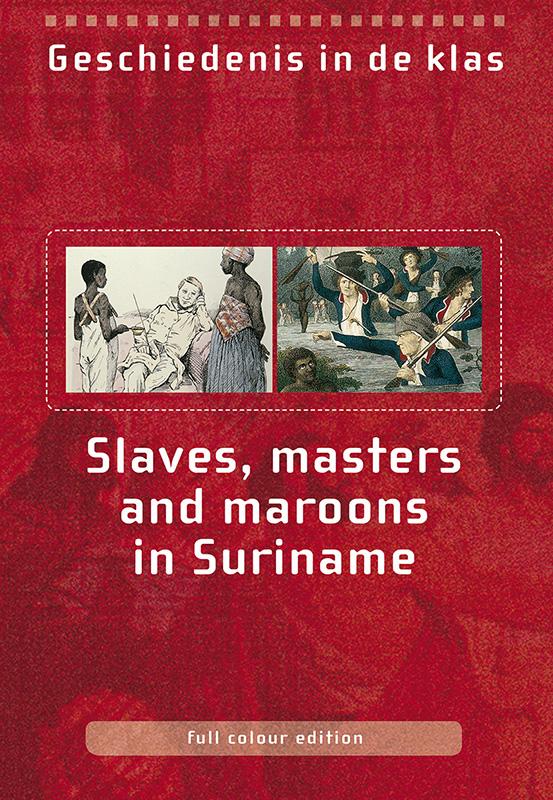
Slaves, masters and maroons in Suriname full colour edition
PaperbackEngels
1 Director and his slaves on a Surinamese coffee plantation – A Play 2 Suriname: Amerindians, Europeans and Africans 3 Artists illustrate the life of slaves, masters and maroons 4 How to go to work – advice for pupils 5 The lives of slaves, masters and maroons, illustratedA collection of unwritten sources on slaves, masters and maroons (runaway slaves) in Suriname.The publications of Geschiedenis in de klas are meant for history education.Why this subject? Suriname’s history is fascinating and should be studied for that reason alone. But there is more to it. About 40% of Suriname’s population is descended from the slaves. A large minority of them now live in the Netherlands.Many Dutch people profited from slavery and the slave trade. The Surinamese are much more aware of this than (other) Dutch.In most Dutch history school books as yet little or no attention has been paid to the Dutch slave trade and slavery. In school books, as well as for instance in television and films slavery in the United States has received much more attention.Ignoring this black page in our national history is not good. The relations between blacks and whites in Suriname’s past still affect the relations between blacks and whites today. Both among blacks and whites the legacy of the slave period is still visible. And it is not so long ago.As an introduction to the subject this booklet begins with an eighteenth century play situated on a Surinamese coffee plantation. Then there is a chapter explaining how the whites and the blacks got to Suriname, and what happened to the original Amerindian population.It is intended that a picture story of fifteen illustrations be constructed from the illustrations on slavery in this booklet.This booklet contains a collection of unwritten sources on slaves, masters and maroons (runaway slaves) in Suriname.The publications of Geschiedenis in de klas are meant for history education.Why this subject? Suriname’s history is fascinating and should be studied for that reason alone. But there is more to it. About 40% of Suriname’s population is descended from the slaves. A large minority of them now live in the Netherlands.Many Dutch people profited from slavery and the slave trade. The Surinamese are much more aware of this than (other) Dutch.In most Dutch history school books as yet little or no attention has been paid to the Dutch slave trade and slavery. In school books, as well as for instance in television and films slavery in the United States has received much more attention.Ignoring this black page in our national history is not good. The relations between blacks and whites in Suriname’s past still affect the relations between blacks and whites today. Both among blacks and whites the legacy of the slave period is still visible. And it is not so long ago.As an introduction to the subject this booklet begins with an eighteenth century play situated on a Surinamese coffee plantation. Then there is a chapter explaining how the whites and the blacks got to Suriname, and what happened to the original Amerindian population.It is intended that a picture story of fifteen illustrations be constructed from the illustrations on slavery in this booklet.
In het kort
ISBN-13
9789073021150
Verschenen
1 mei 2014
Bibliografisch
ISBN-139789073021150
TaalEngels eng
GeïllustreerdJa
Uitgave
CB-relatie-id8712343
Verschenen1 mei 2014
StatusOnbekend 00
BeschikbaarheidContact leverancier 99
Adviesprijs (incl. btw)€ 19,00
Vorm & inhoud
ProductvormPaperback BC
SamenstellingLos product
Classificatie
NUR (hoofd)Mens en maatschappij HAVO/VWO 132
NUR (alle)132 Mens en maatschappij HAVO/VWO
Medewerkers
Auteur A01Annie Biezen-Hurkmans
Herkomst
Werk-id (NSTC)500448896
MeldingBevestigd bij publicatie 03
Bijgewerkt6 augustus 2026
Trefwoorden
Lijkt op dit boek


NSTC 500448896 · CB-relatie 8712343 · Bijgewerkt 6 augustus 2026