
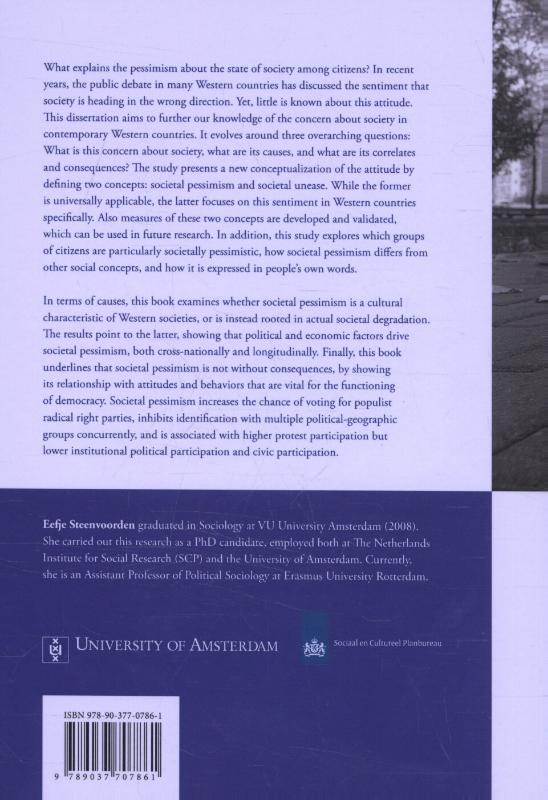
Societal pessimism a study of its conceptualization, causes, correlates and consequences
What explains the concern about the state of society among citizens? In recent years, the public debate in many Western countries has discussed the sentiment that society is heading in the wrong direction. Yet little is really known about this attitude. This dissertation aims to further our knowledge of the concern about society in contemporary Western countries. It revolves around three overarching questions: What is the concern about the state of society, what are the causes of this concern, what are its consequences? The study presents a new conceptualization of this attitude by defining two concepts: societal pessimism and societal unease. While the former describes the concern about the state of society in a universally applicable manner, the latter focuses on this sentiment in Western countries specifically. Measures of these two concepts are developed and validated so that they can be used in future research. In addition, this study explores which groups of citizens are particularly societally pessimistic, how the concern about society differs from other social concepts, and how it is expressed in people's own words.
In terms of causes, this book questions whether societal pessimism is a cultural characteristic of Western societies, or is instead rooted in actual societal degradation. The results point to the latter, showing that political and economic factors drive societal pessimism, both cross-nationally and longitudinally. Finally, this book underlines that societal pessimism is not without consequences, by showing its relationship with attitudes and behaviors that are vital for the functioning of democracy. Societal pessimism increases the chance of voting for populist radical right parties, inhibits identification with multiple political-geographic groups concurrently, and is associated with higher protest participation but lower institutional political participation and civic participation.
In terms of causes, this book questions whether societal pessimism is a cultural characteristic of Western societies, or is instead rooted in actual societal degradation. The results point to the latter, showing that political and economic factors drive societal pessimism, both cross-nationally and longitudinally. Finally, this book underlines that societal pessimism is not without consequences, by showing its relationship with attitudes and behaviors that are vital for the functioning of democracy. Societal pessimism increases the chance of voting for populist radical right parties, inhibits identification with multiple political-geographic groups concurrently, and is associated with higher protest participation but lower institutional political participation and civic participation.
In het kort
ISBN-13
9789037707861
Uitgever
Verschenen
1 juni 2016
Bibliografisch
ISBN-139789037707861
SerieSCP-publicatie — deel 2016-11
Editie1
TaalEngels eng
Pagina’s280
GeïllustreerdJa
Uitgave
Vorm & inhoud
ProductvormPaperback BC
SamenstellingLos product
Classificatie
NUR (hoofd)Mens en maatschappij algemeen 740
NUR (alle)740 Mens en maatschappij algemeen
Medewerkers
Auteur A01Eefje Steenvoorden
Herkomst
Werk-id (NSTC)500416519
MeldingBevestigd bij publicatie 03
Bijgewerkt6 augustus 2026
Lijkt op dit boek









NSTC 500416519 · CB-relatie 7300482 · Bijgewerkt 6 augustus 2026