
Sophist
Paperback155 pagina’sEngelsLeverbaar
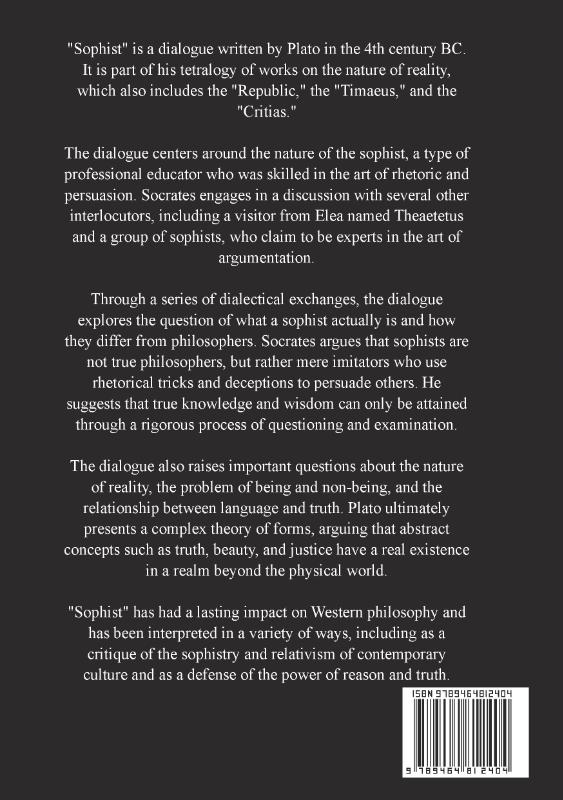
"Sophist" is a dialogue written by Plato in the 4th century BC. It is part of his tetralogy of works on the nature of reality, which also includes the "Republic," the "Timaeus," and the "Critias."The dialogue centers around the nature of the sophist, a type of professional educator who was skilled in the art of rhetoric and persuasion. Socrates engages in a discussion with several other interlocutors, including a visitor from Elea named Theaetetus and a group of sophists, who claim to be experts in the art of argumentation.Through a series of dialectical exchanges, the dialogue explores the question of what a sophist actually is and how they differ from philosophers. Socrates argues that sophists are not true philosophers, but rather mere imitators who use rhetorical tricks and deceptions to persuade others. He suggests that true knowledge and wisdom can only be attained through a rigorous process of questioning and examination.The dialogue also raises important questions about the nature of reality, the problem of being and non-being, and the relationship between language and truth. Plato ultimately presents a complex theory of forms, arguing that abstract concepts such as truth, beauty, and justice have a real existence in a realm beyond the physical world."Sophist" has had a lasting impact on Western philosophy and has been interpreted in a variety of ways, including as a critique of the sophistry and relativism of contemporary culture and as a defense of the power of reason and truth.
In het kort
ISBN-13
9789464812404
Uitgever
Verschenen
18 maart 2023
Bibliografisch
ISBN-139789464812404
Editie1
TaalEngels eng
Pagina’s155
GeïllustreerdNee
Uitgave
UitgeverPumbo.nl B.V.
CB-relatie-id7344356
Verschenen18 maart 2023
StatusLeverbaar 04
BeschikbaarheidBeschikbaar 20
Adviesprijs (incl. btw)€ 27,95
Vorm & inhoud
ProductvormPaperback BC
SamenstellingLos product
Classificatie
NUR (hoofd)Oudheid (tot 500) 683
NUR (alle)683 Oudheid (tot 500)
Medewerkers
Auteur A01Plato
Herkomst
Werk-id (NSTC)501552503
MeldingBevestigd bij publicatie 03
Bijgewerkt6 augustus 2026
NSTC 501552503 · CB-relatie 7344356 · Bijgewerkt 6 augustus 2026