
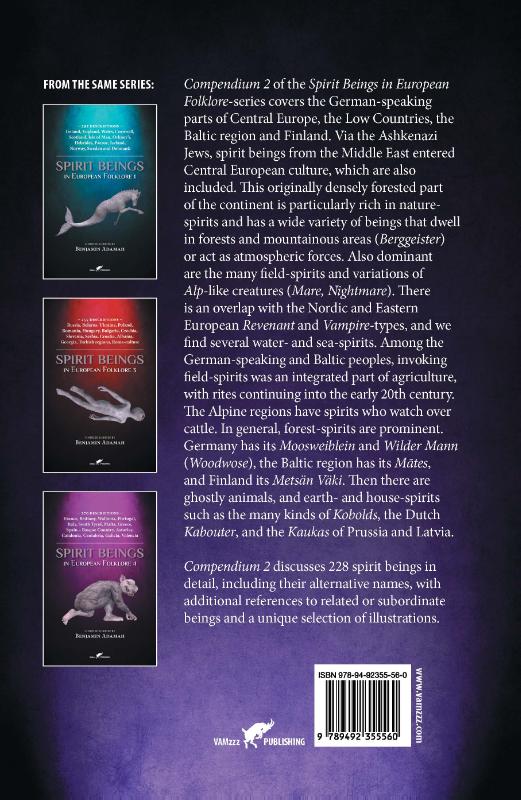
Spirit Beings in European Folklore 2 228 descriptions – Germany, Austria, Alpine regions, Switzerland, Netherlands, Flanders, Luxembourg, Lithuania, Latvia, Estonia, Finland, Jewish influences
Compendium 2 of the Spirit Beings in European Folklore-series covers the German-speaking parts of Central Europe, the Low Countries, the Baltic region and Finland.Compendium 2 of the Spirit Beings in European Folklore-series covers the German-speaking parts of Central Europe, the Low Countries, the Baltic region and Finland. Via the Ashkenazi Jews, spirit beings from the Middle East entered Central European culture, which are also included. This originally densely forested part of the continent is particularly rich in nature-spirits and has a wide variety of beings that dwell in forests and mountainous areas (Berggeister) or act as atmospheric forces. Also dominant are the many field-spirits and variations of Alp-like creatures (Mare, Nightmare). There is an overlap with the Nordic and Eastern European Revenant and Vampire-types, and we find several water- and sea-spirits. Among the German-speaking and Baltic peoples, invoking field-spirits was an integrated part of agriculture, with rites continuing into the early 20th century. The Alpine regions have spirits who watch over cattle. In general, forest-spirits are prominent. Germany has its Moosweiblein and Wilder Mann (Woodwose), the Baltic region has its Mātes, and Finland its Metsän Väki. Then there are ghostly animals, and earth- and house-spirits such as the many kinds of Kobolds, the Dutch Kabouter, and the Kaukas of Prussia and Latvia.Compendium 2 discusses 228 spirit beings in detail, including their alternative names, with additional references to related or subordinate beings and a unique selection of illustrations.
In het kort
ISBN-13
9789492355560
Uitgever
Verschenen
1 september 2022
Serie
Imprint
Bibliografisch
Uitgave
UitgeverVAMzzz Publishing
ImprintVAMzzz Publishing
CB-relatie-id6391696
Verschenen1 september 2022
StatusOnbekend 00
BeschikbaarheidContact leverancier 99
Adviesprijs (incl. btw)€ 25,00
Vorm & inhoud
ProductvormPaperback BC
SamenstellingLos product
Classificatie
NUR (hoofd)Naslagwerken algemeen 530
NUR (alle)530 Naslagwerken algemeen
Medewerkers
Auteur A01Benjamin Adamah
Herkomst
Werk-id (NSTC)501516332
MeldingBevestigd bij publicatie 03
Bijgewerkt6 augustus 2026
Lijkt op dit boek
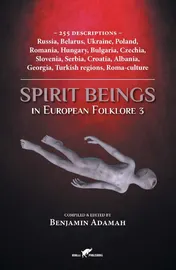
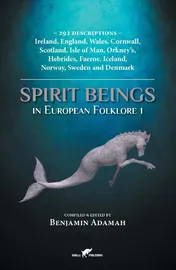
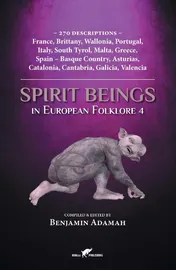

NSTC 501516332 · CB-relatie 6391696 · Bijgewerkt 6 augustus 2026