
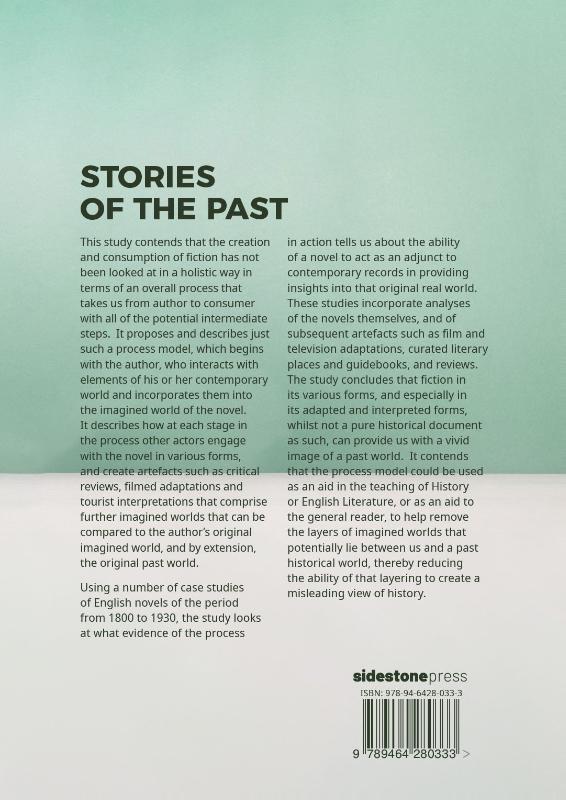
Stories of the Past Viewing History through Fiction
Hardback250 pagina’sEngels
Ook verkrijgbaar als
1 Introduction1.1 Stories of the Past1.2 History and Fiction1.3 Beyond the Novel1.4 A Fiction ‘Process’1.5 Overall Structure2 The Literary Tourism Process2.1 Introduction2.2 Thomas Hardy – Wessex and Dorset2.3 Jane Austen – Interpretation through Association2.4 Conclusion: Literary Tourism and the Classic Fiction Process Model3 The Adaptation Process3.1 Introduction3.2 The ‘Classic’ Novel Canon and Film and TV adaptations3.3 Far from the Madding Crowd – Recreating Wessex3.4 North and South – Consumer Perceptions of Milton3.5 Conclusion: Adaptation and the Classic Fiction Process Model4 The Critical Process4.1 Introduction4.2 Thomas Hardy and the London Critics4.3 Elizabeth Gaskell and William Rathbone Greg4.4 Conclusion: Criticism and the Classic Fiction Process Model5 The Writing Process5.1 Introduction5.2 Jane Austen and Hampshire5.3 Elizabeth Gaskell and Manchester5.4 Conclusion: Writing and the Classic Fiction Process Model6 J.B. Priestley’s The Good Companions – Discerning History6.1 Introduction6.2 J.B. Priestley and The Good Companions6.3 Mind Mapping the World of The Good Companions6.3.1 Mind Maps as a technique6.3.2 Mind Mapping – Analysis and Summary6.4 Textual Interpretation of the Yorkshire of The Good Companions6.4.1 Interpretive Footnotes as a technique6.4.2 Textual interpretation – Analysis and Summary6.5 Analysing Adaptations of the World of The Good Companions6.5.1 The Good Companions on Film6.5.2 Comparing adaptations – Faithfulness to the Novel6.5.3 Comparing Adaptations – Faithfulness to the Period6.5.4 Comparing Adaptations – Summary6.6 Visiting Priestley’s World6.6.1 Priestley and Bradford6.6.2 Visiting the Bradford of The Good Companions and Bright Day6.6.3 Visiting Priestley’s World – Summary6.7 Conclusion: The Good Companions as a Historical Resource7 Stories of the Past: ConclusionsThis study contends that the creation and consumption of fiction has not been looked at in a holistic way in terms of an overall process that takes us from author to consumer with all of the potential intermediate steps. It proposes and describes just such a process model, which begins with the author, who interacts with elements of his or her contemporary world and incorporates them into the imagined world of the novel. It describes how at each stage in the process other actors engage with the novel in various forms, and create artefacts such as critical reviews, filmed adaptations and tourist interpretations that comprise further imagined worlds that can be compared to the author’s original imagined world, and by extension, the original past world. Using a number of case studies of English novels of the period from 1800 to 1930, the study looks at what evidence of the process in action tells us about the ability of a novel to act as an adjunct to contemporary records in providing insights into that original real world. These studies incorporate analyses of the novels themselves, and of subsequent artefacts such as film and television adaptations, curated literary places and guidebooks, and reviews. The study concludes that fiction in its various forms, and especially in its adapted and interpreted forms, whilst not a pure historical document as such, can provide us with a vivid image of a past world. It contends that the process model could be used as an aid in the teaching of History or English Literature, or as an aid to the general reader, to help remove the layers of imagined worlds that potentially lie between us and a past historical world, thereby reducing the ability of that layering to create a misleading view of history.
In het kort
ISBN-13
9789464280340
Uitgever
Verschenen
15 september 2022
Bibliografisch
ISBN-139789464280340
Editie1
TaalEngels eng
Pagina’s250
GeïllustreerdJa
Uitgave
Vorm & inhoud
ProductvormHardback BB
SamenstellingLos product
Classificatie
NUR (hoofd)Geschiedenis algemeen 680
NUR (alle)680 Geschiedenis algemeen
Medewerkers
Auteur A01Chris Green
Herkomst
Werk-id (NSTC)501494370
MeldingBevestigd bij publicatie 03
Bijgewerkt6 augustus 2026
Lijkt op dit boek
NSTC 501494370 · CB-relatie 9180064 · Bijgewerkt 6 augustus 2026