AI-GEGENEREERD
The Architecture of Prisons How Design Shapes Punishment, Power, and Human Behavior
Paperback124 pagina’sEngelsAI-gegenereerd
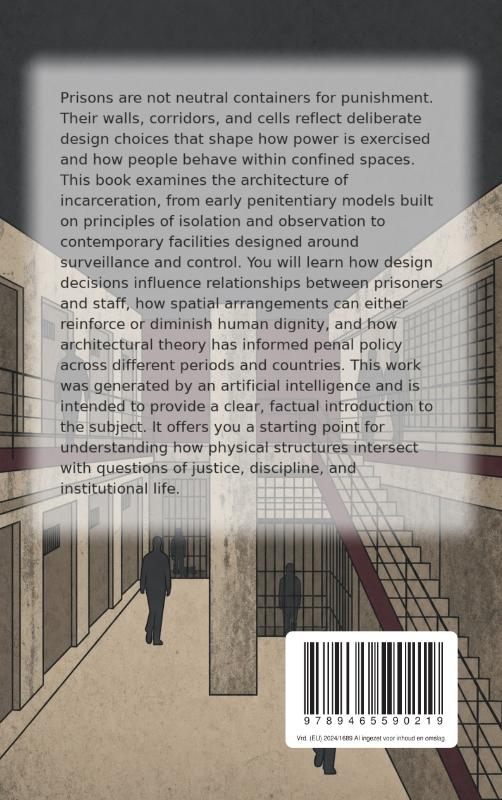
Prisons are not neutral containers for punishment. Their walls, corridors, and cells reflect deliberate design choices that shape how power is exercised and how people behave within confined spaces.Prisons are not neutral containers for punishment. Their walls, corridors, and cells reflect deliberate design choices that shape how power is exercised and how people behave within confined spaces. This book examines the architecture of incarceration, from early penitentiary models built on principles of isolation and observation to contemporary facilities designed around surveillance and control. You will learn how design decisions influence relationships between prisoners and staff, how spatial arrangements can either reinforce or diminish human dignity, and how architectural theory has informed penal policy across different periods and countries. This work was generated by an artificial intelligence and is intended to provide a clear, factual introduction to the subject. It offers you a starting point for understanding how physical structures intersect with questions of justice, discipline, and institutional life.Prisons are not neutral containers for punishment. Their walls, corridors, and cells reflect deliberate design choices that shape how power is exercised and how people behave within confined spaces. This book examines the architecture of incarceration, from early penitentiary models built on principles of isolation and observation to contemporary facilities designed around surveillance and control. You will learn how design decisions influence relationships between prisoners and staff, how spatial arrangements can either reinforce or diminish human dignity, and how architectural theory has informed penal policy across different periods and countries. This work was generated by an artificial intelligence and is intended to provide a clear, factual introduction to the subject. It offers you a starting point for understanding how physical structures intersect with questions of justice, discipline, and institutional life.
In het kort
ISBN-13
9789465590219
Uitgever
Verschenen
16 juli 2026
Imprint
Bibliografisch
ISBN-139789465590219
Editie1
TaalEngels eng
Pagina’s124
GeïllustreerdNee
Uitgave
UitgeverAndries B.V.
ImprintWaries B.V.
CB-relatie-id6750323
Verschenen16 juli 2026
StatusAangekondigd 02
BeschikbaarheidContact leverancier 99
Adviesprijs (incl. btw)€ 16,95
Vorm & inhoud
ProductvormPaperback BC
SamenstellingLos product
Classificatie
NUR (hoofd)Mens en maatschappij algemeen 740
NUR (alle)740 Mens en maatschappij algemeen
Herkomst
Werk-id (NSTC)501686042
MeldingUpdate 04
Laatste CB-bericht7768
Bijgewerkt5 augustus 2026
Lijkt op dit boek
How Casinos Are Designed to Shape Behavior

Airport Architecture

The History of the Castle

How a State Exercises the Monopoly on Violence

The Science of Interrogation

How the United Nations Is Structured

The History of the Almshouse

How Sanctions Against Countries Work

How Propaganda Works

How a Constitution Shapes a Country
NSTC 501686042 · CB-relatie 6750323 · Laatste CB-bericht 7768 · Bijgewerkt 5 augustus 2026