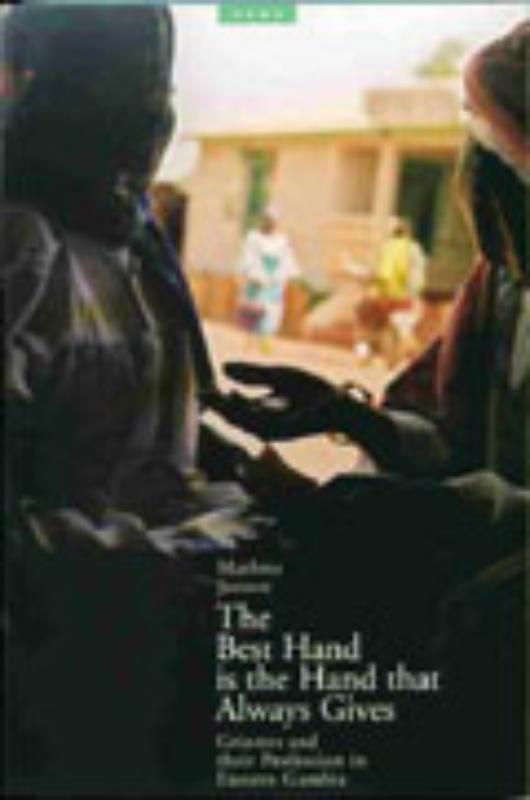
The best hand is the hand that always gives griotes and their profession in Eastern Gambia
Griottes (female bards) are a striking feature of Mandinka culture. They can be recognized by their flamboyant style of dressing and their sharp voices. Nevertheless, griottes have largely been neglected in scientific literature, while ample attention has been paid to griots (male bards). This book tries to fill the gap.
Marloes Janson lived with the griottes from a Mandinka community in eastern Gambia for more than a year and was trained by them as an apprentice. From this perspective she describes the daily life and concerns of the griottes, their skills, their techniques for learning the profession, their means of subsistence, their relationships with the griots and their patrons.
The main activity of griottes is daaniroo. When they set out for daaniroo, they praise their patrons, and in return they are rewarded with money or goods. This book shows that daaniroo is a highly controversial practice. It is sometimes considered a new development, while at the same time it fits in with the bardic tradition. Some patrons disapprove of daaniroo, yet they are dependent on it to have their prestige confirmed. Several Koranic scholars regard daaniroo as conflicting with Islam, while the griottes do their best to embed their activities in an Islamic discourse. By studying the gendered practice of daaniroo, the dynamics of female 'griotism' are demonstrated.
In English, 322 pp. incl. bibl.& index)
'A very fine achievement that gives scholars of Africa, performance, and gender much richness to build on.' - Caroline Bledsoe in: The Journal of the Royal Anthropological Institute, Vol. 11, no. 4, Dec. 2005, pp.874-875.
In het kort
ISBN-13
9789057890802
Uitgever
Verschenen
1 juli 2002
Bibliografisch
ISBN-139789057890802
SerieCNWS publications — deel 118
Editie1
TaalEngels eng
Pagina’s321
GeïllustreerdJa
Uitgave
UitgeverCnws Publicaties
CB-relatie-id8767404
Verschenen1 juli 2002
StatusOnbekend 00
BeschikbaarheidContact leverancier 99
Zonder prijsPrijs volgt
Vorm & inhoud
ProductvormHardback BB
SamenstellingLos product
Classificatie
Medewerkers
Auteur A01Marloes Janson
Herkomst
Werk-id (NSTC)500309556
MeldingBevestigd bij publicatie 03
Bijgewerkt6 augustus 2026
Lijkt op dit boek


NSTC 500309556 · CB-relatie 8767404 · Bijgewerkt 6 augustus 2026