
The Body as a Mirror of the Soul Physiognomy from Antiquity to the Renaissance
Ook verkrijgbaar als
Illustrations Acknowledgements Lisa DevriesePhysiognomy from Antiquity to the Renaissance : an Introduction Maria Michela SassiThe Beginnings of Physiognomy in Ancient Greece Maria Fernanda FerriniOἰνωποί/Aἰγωποί: Manuscript Tradition and Conjecture Enikő BékésThe Physiognomy of Apostle Paul: Between Texts and Images Steven J. WilliamsSome Observations on the Scholarly Reception of Physiognomy in the Thirteenth and Early Fourteenth Century: Success, and the Limits of SuccessLisa DevrieseFirst Medieval Attestations of the PhysiognomonicaOleg VoskoboynikovMichael Scotus’ Physiognomy: Notes on Text and Context Joël Biard and Christophe GrellardLa place des Questiones circa librum de physionomia dans le système philosophique de Jean BuridanGabriella ZuccolinTowards a Critical Edition of Michele Savonarola’s Speculum Physionomie Joseph Ziegler and Luís Campos RibeiroAstral Physiognomy in the Fifteenth Century : the Case of the Illuminated Opening Folio of Rolandus Scriptoris’ Reductorium PhisonomieNotes on Contributors Index codicum manu scriptorum Index nominumPhysiognomy, the history of racial classifications, and the interplay between natural philosophy, medicine, and ethicsThe idea of the body as a mirror of the soul has fascinated mankind throughout history. Being able to see through an individual, and drawing conclusions on their character solely based on a selection of external features, is the subject of physiognomy, and has a long tradition running well into recent times. However, the pre-modern, especially medieval background of this discipline has remained underexplored. The selected case studies in this volume each contribute to a better understanding of the history of physiognomy from antiquity to the Renaissance, and offer discussions on unedited treatises and on the application, development, and reception of this field of knowledge, as well as on visual sources inspired by physiognomic theory.The idea of the body as a mirror of the soul has fascinated mankind throughout history. Being able to see through an individual, and drawing conclusions on their character solely based on a selection of external features, is the subject of physiognomy, and has a long tradition running well into recent times. However, the pre-modern, especially medieval background of this discipline has remained underexplored. The selected case studies in this volume each contribute to a better understanding of the history of physiognomy from antiquity to the Renaissance, and offer discussions on unedited treatises and on the application, development, and reception of this field of knowledge, as well as on visual sources inspired by physiognomic theory.
In het kort
ISBN-13
9789461664075
Uitgever
Verschenen
21 september 2021
Imprint
Bibliografisch
ISBN-139789461664075
SerieMediaevalia Lovaniensia - Series 1-Studia — deel 50
Editie1
TaalEngels eng
Pagina’s233
GeïllustreerdNee
Uitgave
UitgeverUniversitaire Pers Leuven
ImprintLeuven University Press
CB-relatie-id8004161
Verschenen21 september 2021
StatusLeverbaar 04
BeschikbaarheidBeschikbaar 20
Zonder prijsPrijs volgt
Vorm & inhoud
ProductvormE-book ED
VormdetailE107 PDF
SamenstellingLos product
Beveiliging e-bookDigitaal watermerk 02
Classificatie
NUR (hoofd)Middeleeuwen (500-1500) 684
NUR (alle)684 Middeleeuwen (500-1500)
Trefwoordenstereotype · pseudo-aristotle · commentary · visual representation · character · physiognomy · reception history · physiognomonica
Medewerkers
Redacteur B01Lisa Devriese
Herkomst
Werk-id (NSTC)501469203
MeldingBevestigd bij publicatie 03
Bijgewerkt6 augustus 2026
Trefwoorden
Lijkt op dit boek
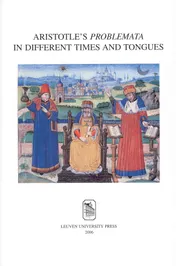
Aristotle's Problemata in different times and tongues
The science of the soul
Ancient Perspectives on Aristotle's De Anima
The soul-body problem at Paris ca 1200-1250
Between text and tradition
Science translated
The Medieval Aristotle
Medieval manuscripts in transition
Portraits and Poses
Questiones super I-VII libros Politicorum
NSTC 501469203 · CB-relatie 8004161 · Bijgewerkt 6 augustus 2026