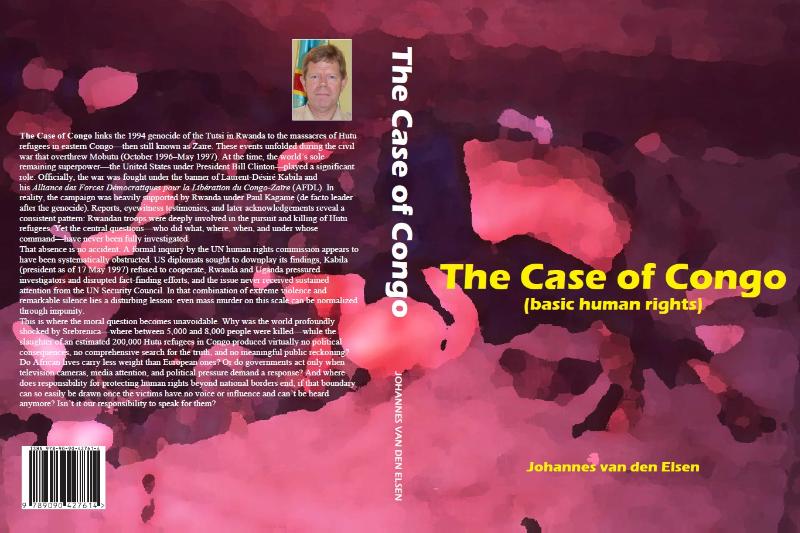
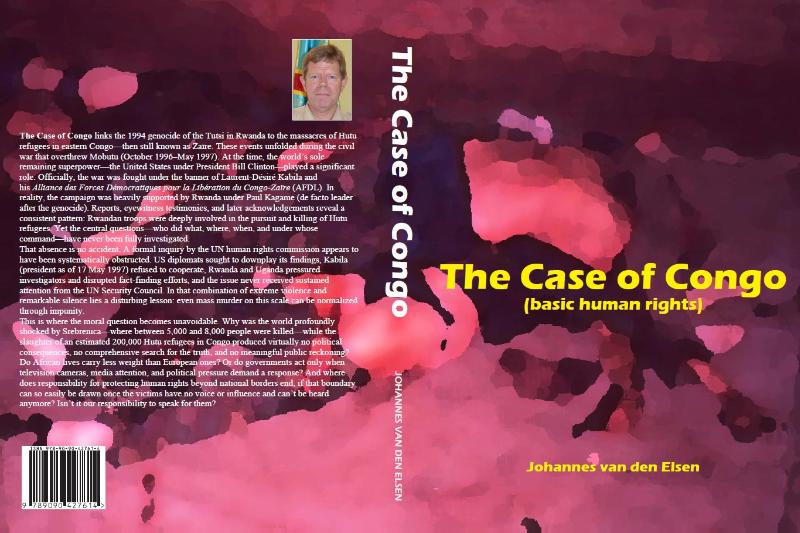
The Case of Congo: Are Basic Human Rights Merely a Thin Veneer for the Public?
PaperbackEngels
PrefacePart I Introduction: What this book is about- The influence of Machiavelli after 500 years- Four geopolitical factors with impact on the development of and within DRCPart II In politics the End justifies the Means?The intervention that did not take place- Genocide in Rwanda 1994- No tribalism- A free ride to kill due to IC’s feelings of guilt- The Gersony report- Kibeho and misleading the IC- Anglo-Saxon plot and the role of France- The role of the US- The refugee camps - The Banyamulenge affair in South Kivu- The spectre of the international intervention- The number of refugees stranded in eastern Zaire after 15 November 1996- The massacres- From Ubundu in the direction of Kisangani- The End game: the last part of the journey to Mbandaka- Mbandaka- UNHCR Decision to repatriate refugees even after MbandakaPart III Conclusion Case of Congo- Probing for significance after all this bloodshed- Recap concerning the genocide of Tutsi in 1994- Some concluding remarks regarding the Dénouement of the doom history of Hutu refugees in DRC (Oct’96-June’97)- What it meant to be part of the ‘New African Leaders’ policy used by the Clinton administration in its second term.Why was the world profoundly shocked by Srebrenica (8,000 victims) while the slaughter of 200 k Hutu refugees in Congo produced virtually no political consequences, no comprehensive search for the truth, and no meaningful public reckoning?The Case of Congo links the 1994 genocide of the Tutsi in Rwanda to the massacres of Hutu refugees in eastern Congo - then still known as Zaïre. These events unfolded during the civil war that overthrew Mobutu (October 1996-May 1997). At the time, the world’s sole remaining superpower - the United States under President Bill Clinton - played a significant role. Officially, the war was fought under the banner of Laurent-Désiré Kabila and his Alliance des Forces Démocratiques pour la Libération du Congo-Zaïre (AFDL). In reality, the campaign was heavily supported by Rwanda under Paul Kagame (de facto leader after the genocide). Reports, eyewitness testimonies, and later acknowledgements reveal a consistent pattern: Rwandan troops were deeply involved in the pursuit and killing of Hutu refugees. Yet the central questions - who did what, where, when, and under whose command - have never been fully investigated.A formal inquiry by the UN human rights commission appears to have been systematically obstructed. US diplomats sought to downplay its findings, Kabila (president as of 17 May 1997) refused to cooperate, Rwanda and Uganda pressured investigators and disrupted fact-finding efforts, and the issue never received sustained attention from the UN Security Council. In that combination of extreme violence and remarkable silence lies a disturbing lesson: even mass murder on this scale can be normalized through impunity.Here a moral question is unavoidable. Why was the world profoundly shocked by Srebrenica - where between 5,000 and 8,000 people were killed - while the slaughter of an estimated 200,000 Hutu refugees in Congo produced virtually no political consequences, no comprehensive search for the truth, and no meaningful public reckoning? Do African lives carry less weight than European ones? Or do governments act only when television cameras, media attention, and political pressure demand a response? And where does responsibility for protecting human rights beyond national borders end, if that boundary can so easily be drawn once the victims have no voice or influence and can’t be heard anymore? Isn’t it our responsibility to speak for them?
In het kort
ISBN-13
9789090427614
Uitgever
Verschenen
1 december 2026
Bibliografisch
ISBN-139789090427614
Editie1
TaalEngels eng
GeïllustreerdJa
Uitgave
UitgeverVan den Elsen
CB-relatie-id7131167
Verschenen1 december 2026
StatusOnbekend 00
BeschikbaarheidContact leverancier 99
Zonder prijsPrijs volgt
Vorm & inhoud
ProductvormPaperback BC
SamenstellingLos product
Classificatie
Medewerkers
Auteur A01Johannes Van den Elsen
Herkomst
Werk-id (NSTC)501681773
MeldingUpdate 04
Laatste CB-bericht7891
Bijgewerkt2 november 2026
Lijkt op dit boek
Winx Club - Paniek op de toverschool
Volume III International and European Private Law
Volume I International and European Law
Volume II Comparative Public Law
Volume IV
Volume I-IV
Internationaal publiekrecht als wereldrecht
Cases and Materials European Union Law
Protecting the Public Interest in Times of Climate Change: From Abandoning Fossil Fuel to Sharing our Earth
Kern van het internationaal publiekrecht
NSTC 501681773 · CB-relatie 7131167 · Laatste CB-bericht 7891 · Bijgewerkt 2 november 2026