
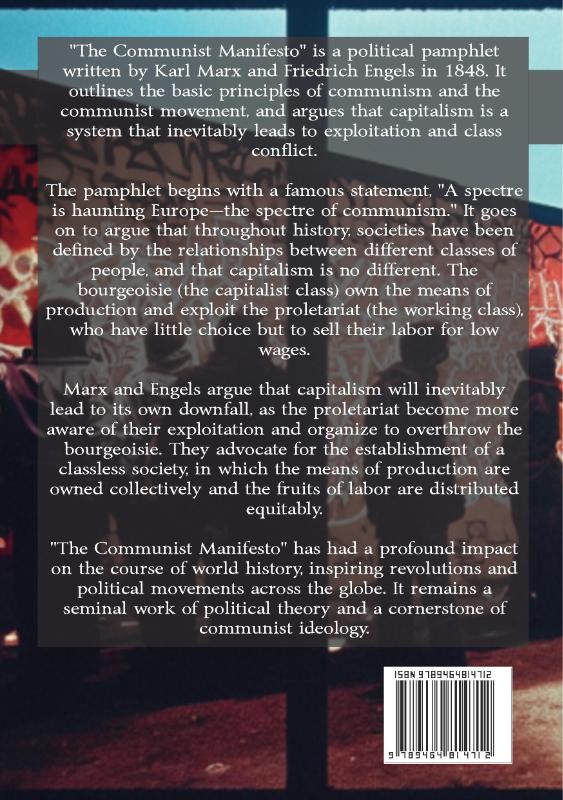
The Communist Manifesto
Paperback50 pagina’sEngelsLeverbaar
Ook verkrijgbaar als
"The Communist Manifesto," written by Karl Marx and Friedrich Engels and published in 1848, is a foundational text of modern political thought and a key work in the development of communist theory. The manifesto presents a critical analysis of the socioeconomic conditions of the time, particularly the industrial revolution and the emerging class struggles between the bourgeoisie (the capitalist class) and the proletariat (the working class).Marx and Engels argue that throughout history, societies have been characterized by class conflict, with one class exploiting the other. In the context of the 19th century, they highlight how the bourgeoisie's rise to power through industrialization has led to the exploitation of the proletariat, resulting in alienation, inequality, and economic oppression.The manifesto outlines the fundamental ideas of historical materialism, which suggests that the development of society is determined by the material conditions of production. Marx and Engels predict that capitalism's inherent contradictions and inequalities will lead to its downfall. They propose that the proletariat will eventually overthrow the bourgeoisie in a revolutionary struggle, leading to the establishment of a classless society: communism.Key points of "The Communist Manifesto" include:1: Class Struggle: The authors emphasize that history has been marked by a series of class struggles, with different modes of production (feudalism, capitalism, etc.) leading to conflicts between those who own the means of production and those who perform the labor.2: Bourgeoisie and Proletariat: Marx and Engels describe how the capitalist system perpetuates class divisions. The bourgeoisie owns the means of production and exploits the proletariat for labor, paying them wages that are lower than the value they produce.3: Capitalism's Contradictions: The manifesto argues that capitalism's pursuit of profit leads to the concentration of wealth among the bourgeoisie, while the proletariat's conditions worsen. This creates tensions and contradictions within the system.4: Communist Revolution: Marx and Engels predict that the proletariat will eventually unite, overthrow the bourgeoisie in a revolutionary uprising, and seize control of the means of production. This will pave the way for a classless society, where resources are collectively owned and distributed according to need.5: Abolition of Private Property: The manifesto calls for the abolition of private property and the means of production being controlled collectively by the working class.6: End of Alienation: Communism is presented as a way to overcome the alienation experienced by workers under capitalism, allowing individuals to have a more fulfilling and meaningful relationship with their labor.While "The Communist Manifesto" has had a profound impact on the course of history and political thought, its ideas have been interpreted and applied in various ways, often leading to divergent movements and revolutions around the world. The document remains a crucial text for understanding the dynamics of class struggle, economic inequality, and the quest for social justice.
In het kort
ISBN-13
9789464814712
Uitgever
Verschenen
29 oktober 2023
Imprint
Bibliografisch
ISBN-139789464814712
Editie1
TaalEngels eng
Pagina’s50
GeïllustreerdNee
Uitgave
UitgeverPumbo.nl B.V.
ImprintThe Alliance
CB-relatie-id7344356
Verschenen29 oktober 2023
StatusLeverbaar 04
BeschikbaarheidBeschikbaar 20
Adviesprijs (incl. btw)€ 24,95
Vorm & inhoud
ProductvormPaperback BC
SamenstellingLos product
Classificatie
NUR (hoofd)Agogiek 753
NUR (alle)753 Agogiek
Medewerkers
Auteur A01Karl Marx
Auteur A01Friedrich Engels
Herkomst
Werk-id (NSTC)500352079
MeldingBevestigd bij publicatie 03
Bijgewerkt6 augustus 2026
Lijkt op dit boek







NSTC 500352079 · CB-relatie 7344356 · Bijgewerkt 6 augustus 2026