
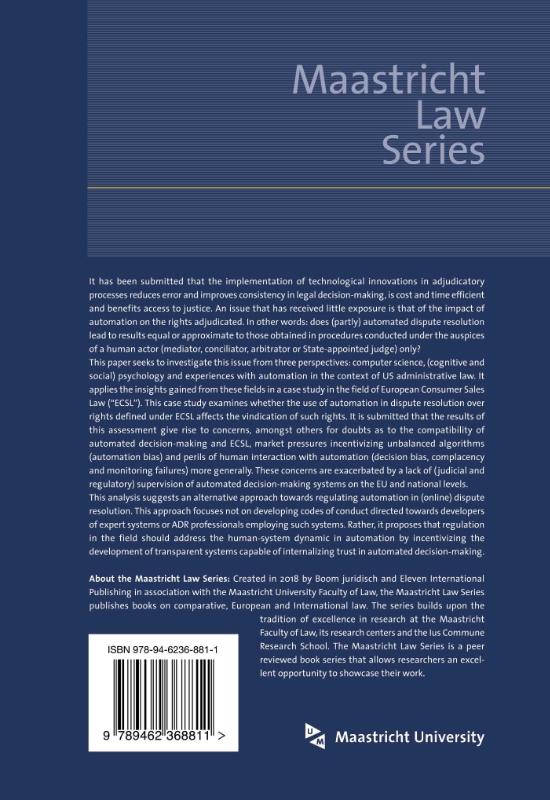
The End of Justice(s)? Perspectives and thoughts on (regulating) automation in dispute resolution
Ook verkrijgbaar als
It has been submitted that the implementation of technological innovations in adjudicatory processes reduces error and improves consistency in legal decision-making, is cost and time efficient and benefits access to justice. An issue that has received little exposure is that of the impact of automation on the rights adjudicated. In other words: does (partly) automated dispute resolution lead to results equal or approximate to those obtained in procedures conducted under the auspices of a human actor (mediator, conciliator, arbitrator or State-appointed judge) only?This paper seeks to investigate this issue from three perspectives: computer science, (cognitive and social) psychology and experiences with automation in the context of US administrative law. It applies the insights gained from these fields in a case study in the field of European Consumer Sales Law (“ECSL”). This case study examines whether the use of automation in dispute resolution over rights defined under ECSL affects the vindication of such rights. It is submitted that the results of this assessment give rise to concerns, amongst others for doubts as to the compatibility of automated decision-making and ECSL, market pressures incentivizing unbalanced algorithms (automation bias) and perils of human interaction with automation (decision bias, complacency and monitoring failures) more generally. These concerns are exacerbated by a lack of (judicial and regulatory) supervision of automated decision-making systems on the EU and national levels.This analysis suggests an alternative approach towards regulating automation in (online) dispute resolution. This approach focuses not on developing codes of conduct directed towards developers of expert systems or ADR professionals employing such systems. Rather, it proposes that regulation in the field should address the human-system dynamic in automation by incentivizing the development of transparent systems capable of internalizing trust in automated decision-making.
In het kort
ISBN-13
9789462368811
Uitgever
Verschenen
15 november 2018
Bibliografisch
Uitgave
UitgeverKoninklijke Boom uitgevers PW
CB-relatie-id7500275
Verschenen15 november 2018
StatusOnbekend 00
BeschikbaarheidContact leverancier 99
Adviesprijs (incl. btw)€ 21,00
Vorm & inhoud
ProductvormPaperback BC
SamenstellingLos product
Classificatie
NUR (hoofd)Recht algemeen 820
NUR (alle)820 Recht algemeen
Medewerkers
Auteur A01Bastiaan van Zelst
Herkomst
Werk-id (NSTC)500139272
MeldingBevestigd bij publicatie 03
Bijgewerkt6 augustus 2026
Lijkt op dit boek
Consumer Online Dispute Resolution Pathways in Europe
Online dispute resolution: theory and practice

Volume 2
Evolution in dispute resolution
Online Dispute Resolution
Creating Digital Justice: AI-Driven Innovation in Family Law, and Beyond
AI and Contracting
An introduction to Law & Technology
Criminal Behavior and Accountability of Artificial Intelligence Systems
NSTC 500139272 · CB-relatie 7500275 · Bijgewerkt 6 augustus 2026