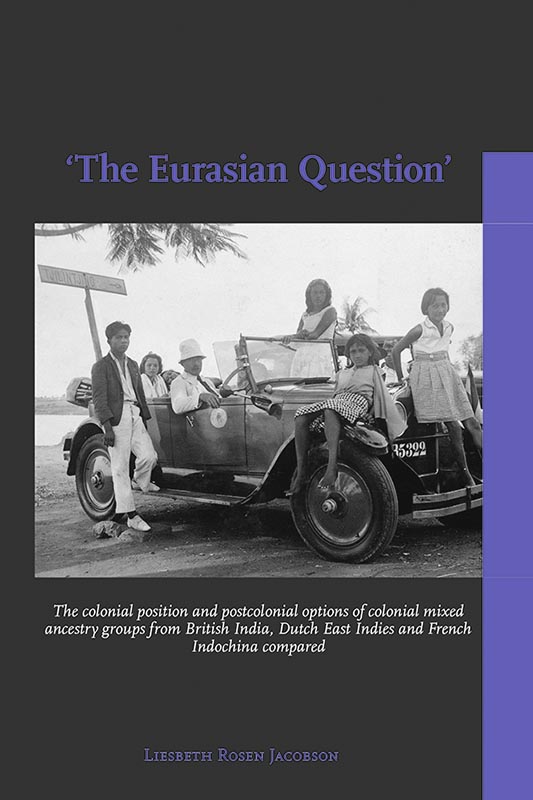
'The Eurasian Question' The colonial position and postcolonial options of colonial mixed-ancestry groups from British India, Dutch East Indies and French Indochina compared
‘Within the borders of these isles shall remain a race one calls Indo. Neither white, nor brown.’ This ‘Indo’ was part of the Indo-Europeans, a group of mixed indigenous and European ancestry, from the former Dutch East Indies. In almost all other Asian colonies, including British India and French Indochina, which are also covered in this study, such a group of mixed ancestry came into being. The future of these Eurasians after decolonisation was quite insecure. The European rulers, on which their status was based, were gone. The new indigenous rulers perceived them suspiciously as colonial remnants and often even as traitors. In this chaotic situation, they were forced to make a choice, between staying in the former colony or leaving for the European mother country. Did they belong in the country of their European fathers or the former colony, the country of their Asian mothers?
In het kort
ISBN-13
9789087047313
Uitgever
Verschenen
13 november 2018
Imprint
Bibliografisch
ISBN-139789087047313
SerieHistorische Migratiestudies — deel 6
Editie1
TaalEngels eng
Pagina’s256
GeïllustreerdJa
Uitgave
UitgeverVerloren b.v., uitgeverij
ImprintUitgeverij Verloren
CB-relatie-id7300840
Verschenen13 november 2018
StatusInactief 08
BeschikbaarheidContact leverancier 99
Adviesprijs (incl. btw)€ 29,00
Vorm & inhoud
ProductvormPaperback BC
SamenstellingLos product
Classificatie
NUR (hoofd)Europese overzeese expansie 691
NUR (alle)691 Europese overzeese expansie
Medewerkers
Auteur A01Liesbeth Rosen Jacobson
Herkomst
Werk-id (NSTC)500149420
MeldingBevestigd bij publicatie 03
Bijgewerkt6 augustus 2026
Lijkt op dit boek
NSTC 500149420 · CB-relatie 7300840 · Bijgewerkt 6 augustus 2026