
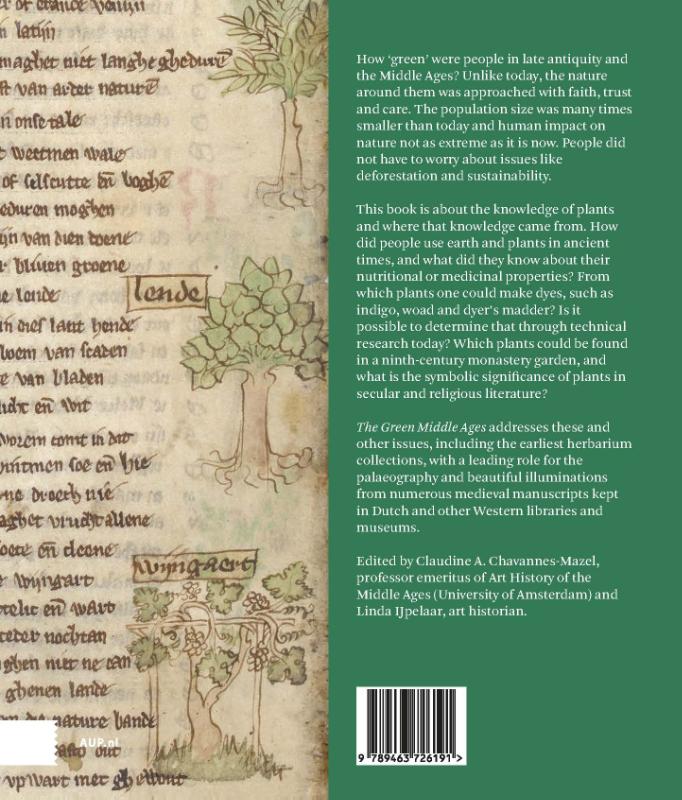
The Green Middle Ages The Depiction and Use of Plants in the Western World 600-1600
Linda IJpelaar red.
Preface PART 1 - Chronological Development: from herbarium pictum to herbarium vivumIntroduction | Early Writings on Beneficial Plants: Perceptions and PrescriptionsThe Web of Written and Illustrated Plant Books from Antiquity to the Invention of the Printing PressChapter 1. From Copy to Copy. 1500 years of Plant Illustrations Chapter 2 Early Printed Herbaria. A Brief Sketch Based on Examples from the Liberna CollectionChapter 3. ‘Everlasting Gardens’ . Origin, Distribution and Purpose of the First herbaria vivaPart II - The Use of Plants in the Middle AgesChapter 4. Painting with Plants. The Use of Vegetable-based Dyes in Medieval Manuscripts Chapter 5. Naming Names. Plants in the Age of CharlemagneChapter 6. The Long Shadow of AntiquityMedicine and PlantsChapter 7. ‘The Cook is the Best Doctor'. Plants for Food and Health: Recipes and Prescriptions Part III - Plants in medieval literatureChapter 8. ‘And it Grew and Waxed a Great Tree' A Short Survey of Plants in the BibleChapter 9. Good Trees, Bad TreesBiblical Tree and Plant Symbolism in the Liber floridus Chapter 10. The Herb Book in Jacob van Maerlant's Der naturen bloemeChapter 11. A Thorny Rosebush and Other Greenery: Love, Lust and Suffering in the Romance of the RosePart IV - Plants in Medieval Book IlluminationChapter 12. Names of Flowers and Plants in the Margins of late Medieval ManuscriptsChapter 13. Flowering Margins. The Development of Strewn-Flower Borders in Early Netherlandish Manuscript Illumination in the Fifteenth CenturyChapter 14. Flowers of Meaning. The Interpretation of Marginal Decoration in Southern Netherlandish Manuscripts from around 1500Appendix I: A Hand-written Text from Late Antiquity in the Leiden University Library. The Wonders of Plantain in Apuleius Platonicus’ herbarium (Leiden, UB ms VLQ 9)Appendix II: A Late Medieval Printed Text in the Athenaeum Library in Deventer Recipes in a Herb Book from 1497, the Ortus sanitatis (Deventer, AB 2000 E 45 KL)FootnotesPicture acknowledgmentsAbout the authorsBibliographyIndicesHow ‘green’ were people in late antiquity and the Middle Ages? Unlike today, the nature around them was approached with faith, trust and care. The population size was many times smaller than today and human impact on nature not as extreme as it is now. People did not have to worry about issues like deforestation and sustainability.This book is about the knowledge of plants and where that knowledge came from. How did people use earth and plants in ancient times, and what did they know about their nutritional or medicinal properties? From which plants one could make dyes, such as indigo, woad and dyer’s madder? Is it possible to determine that through technical research today? Which plants could be found in a ninth-century monastery garden, and what is the symbolic significance of plants in secular and religious literature?'The Green Middle Ages' addresses these and other issues, including the earliest herbarium collections, with a leading role for the palaeography and beautiful illuminations from numerous medieval manuscripts kept in Dutch and other Western libraries and museums.
In het kort
ISBN-13
9789463726191
Uitgever
Verschenen
23 maart 2023
Imprint
Bibliografisch
ISBN-139789463726191
Editie1
TaalEngels eng
Pagina’s344
GeïllustreerdJa
Uitgave
UitgeverAmsterdam University Press
ImprintAmsterdam University Press
CB-relatie-id7400597
Verschenen23 maart 2023
StatusLeverbaar 04
BeschikbaarheidBeschikbaar 20
Adviesprijs (incl. btw)€ 59,95
Vorm & inhoud
ProductvormHardback BB
SamenstellingLos product
Classificatie
NUR (hoofd)Middeleeuwen (500-1500) 684
NUR (alle)684 Middeleeuwen (500-1500)
Medewerkers
Redacteur B01Claudine Chavannes-Mazel
Redacteur B01Linda IJpelaar
Herkomst
Werk-id (NSTC)501532948
MeldingBevestigd bij publicatie 03
Bijgewerkt6 augustus 2026
Lijkt op dit boek
NSTC 501532948 · CB-relatie 7400597 · Bijgewerkt 6 augustus 2026