
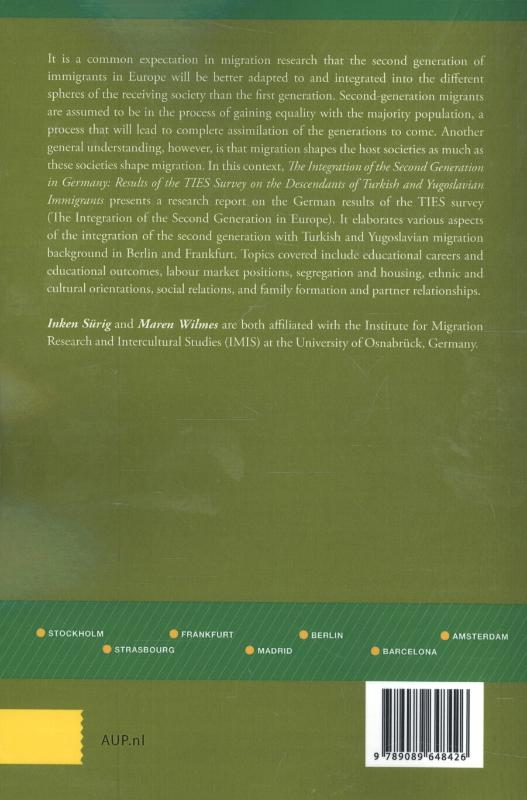
The integration of the second generation in Germany results of the TIES Survey on the descendants of Turkish and Yugoslavian migrants
Ook verkrijgbaar als
1 Introduction[-]1.1 The integration of the second generation: Theoretical considerations[-]1.2 TIES Germany: Method and data base[-]2 Migration history and basic demographic characteristics of the first generation[-]2.1 Introduction[-]2.2 The two cities under study: Berlin and Frankfurt[-]2.3 The parents of the TIES respondents[-]3 Educational careers and educational outcomes[-]3.1 Introduction[-]3.2 Kindergarten and primary school[-]3.4 The transition from primary school to lower secondary: Recommendations for secondary schools and their ramifications[-]3.5 Subsequent educational careers: lower secondary school[-]3.6 The first status passage: From school to vocational training - general tendencies[-]3.7 Parent's educational background and academic support from family[-]3.8 Sense of well-being at school[-]3.9 Conclusions[-]4 Labour market positions[-]4.1 Introduction[-]4.2 Labour force participation and current work status[-]4.3 Transition from the education system to the labour market[-]4.4 Significance of the highest qualification for labour market position[-]4.5 Occupational groups[-]4.6 The respondents' financial situation[-]4.7 Current work status in Berlin and Frankfurt[-]4.8 Working conditions[-]4.9 Career conditions and discrimination at work[-]4.10 Conclusions[-]5 Segregation and housing[-]5.1 Introduction[-]5.2 Second-generation Turks and Yugoslavs in Berlin[-]5.3 Second-generation Turks and Yugoslavs in Frankfurt[-]5.4 Comparison Berlin - Frankfurt[-]5.5 Conclusions[-]6 Ethnic and cultural orientations[-]6.1 Introduction[-]6.2 Ethnic orientations[-]6.3 Attachment to the parents' country of origin[-]6.4 Religious orientations[-]6.5 Intercultural orientations[-]6.6 Conclusions[-]7 Social relations[-]7.1 Introduction[-]7.2 Friendships[-]7.3 Participation in public contexts[-]7.4 Experiences of discrimination[-]7.5 Conclusions[-]8 Family formation and partner relationships[-]8.1 Introduction[-]8.2 Cohabitation, marriage, and procreation[-]8.3 Ethnic, cultural, and socio-economic orientations in partner relationships[-]8.4 Family life[-]8.5 Conclusions[-]9 Conclusions and international comparisons[-]References[-]This report on the German results of the Integration of the Second Generation in Europe (TIES) survey looks at the integration process for secondgeneration inhabitants of Turkish and Yugoslavian backgrounds living in Berlin and Frankfurt. Examining the TIES results, Inken Sürig and Maren Wilmes discuss diverse topics such as educational outcomes, segregation and housing, ethnic and cultural orientations, and social relations.
In het kort
ISBN-13
9789089648426
Uitgever
Verschenen
16 maart 2015
Imprint
Bibliografisch
Uitgave
UitgeverAmsterdam University Press
ImprintAmsterdam University Press
CB-relatie-id7400597
Verschenen16 maart 2015
StatusInactief 08
BeschikbaarheidContact leverancier 99
Adviesprijs (incl. btw)€ 30,99
Vorm & inhoud
ProductvormPaperback BC
SamenstellingLos product
Classificatie
NUR (hoofd)Mens en maatschappij algemeen 740
NUR (alle)740 Mens en maatschappij algemeen
Medewerkers
Auteur A01Inken Sürig
Auteur A01Maren Wilmes
Herkomst
Werk-id (NSTC)100029560
MeldingBevestigd bij publicatie 03
Bijgewerkt6 augustus 2026
Lijkt op dit boek










NSTC 100029560 · CB-relatie 7400597 · Bijgewerkt 6 augustus 2026