
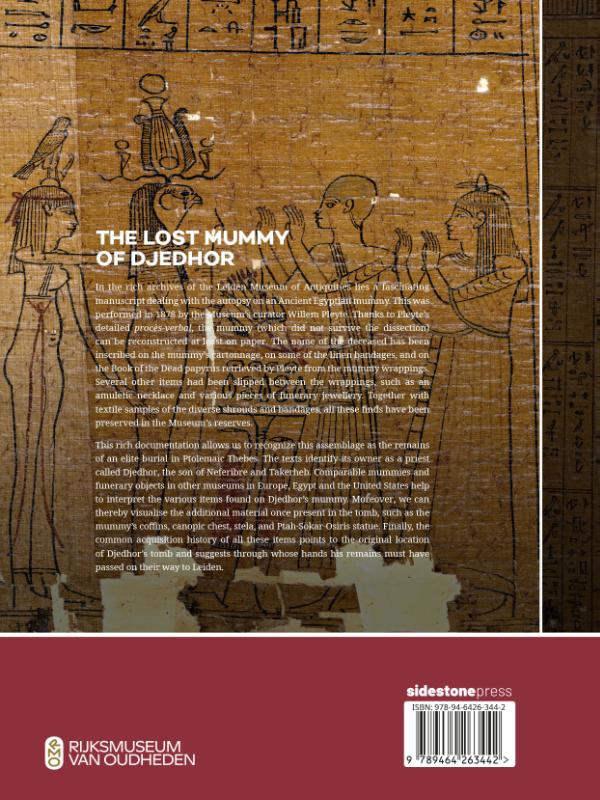
The lost mummy of Djedhor Reconstructing the burial of a Ptolemaic priest from Thebes
Ook verkrijgbaar als
PrefaceI. The autopsy and its museological context1. The Leiden mummy collection and its formation2. Previous dissections3. The acquisition of Djedhor’s mummy4. The 1878 autopsy5. The procès-verbalII. Djedhor’s funerary ensemble and its parallels6. Numbering issues7. The cartonnage8. The garlands9. The bead net10. Outer wrappings11. Anklets and sandals12. The Book of the Dead papyrus13. Amuletic necklace14. Inner wrappings15. Mummification techniques16. Other burial giftsIII. Djedhor’s burial and its archaeological context17. Date18. Social status19. Provenance20. ConclusionAppendix 1. Comments by LeemansAppendix 2. Reply by PleyteList of illustrationsAbbreviationsBibliographyIndicesIn the rich archives of the Leiden Museum of Antiquities lies a fascinating manuscript dealing with the autopsy on an Ancient Egyptian mummy. This was performed in 1878 by the Museum’s curator Willem Pleyte. Thanks to Pleyte’s detailed procès-verbal, the mummy (which did not survive the dissection) can be reconstructed at least on paper. The name of the deceased has been inscribed on the mummy’s cartonnage, on some of the linen bandages, and on the Book of the Dead papyrus retrieved by Pleyte from the mummy wrappings. Several other items had been slipped between the wrappings, such as an amuletic necklace and various pieces of funerary jewellery. Together with textile samples of the diverse shrouds and bandages, all these finds have been preserved in the Museum’s reserves.This rich documentation allows us to recognize this assemblage as the remains of an elite burial in Ptolemaic Thebes. The texts identify its owner as a priest called Djedhor, the son of Neferibre and Takerheb. Comparable mummies and funerary objects in other museums in Europe, Egypt and the United States help to interpret the various items found on Djedhor’s mummy. Moreover, we can thereby visualise the additional material once present in the tomb, such as the mummy’s coffins, canopic chest, stela, and Ptah-Sokar-Osiris statue. Finally, the common acquisition history of all these items points to the original location of Djedhor’s tomb and suggests through whose hands his remains must have passed on their way to Leiden.
In het kort
ISBN-13
9789464263442
Uitgever
Verschenen
29 april 2025
Serie
Imprint
Bibliografisch
Uitgave
UitgeverSidestone Press
ImprintSidestone Press
CB-relatie-id9180064
Verschenen29 april 2025
StatusOnbekend 00
Vorm & inhoud
ProductvormPaperback BC
SamenstellingLos product
Classificatie
NUR (hoofd)Archeologie 682
NUR (alle)682 Archeologie
Medewerkers
Auteur A01Maarten Raven
Herkomst
Werk-id (NSTC)501611732
MeldingBevestigd bij publicatie 03
Bijgewerkt6 augustus 2026
Lijkt op dit boek

NSTC 501611732 · CB-relatie 9180064 · Bijgewerkt 6 augustus 2026