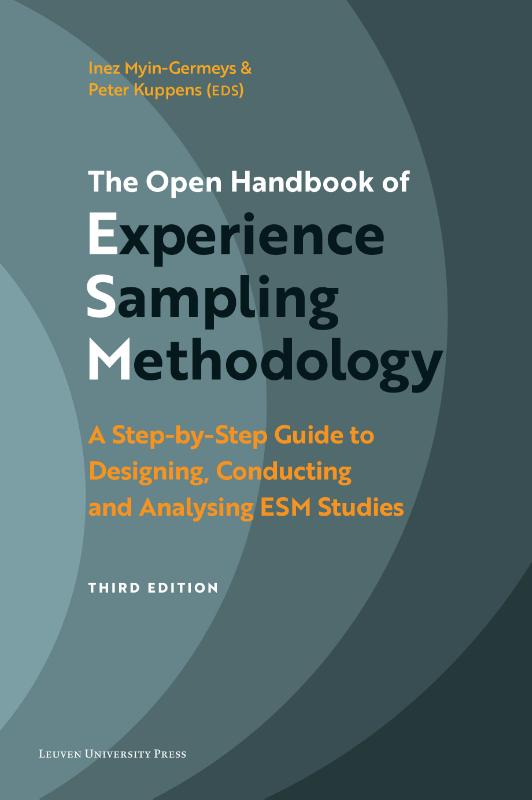
The Open Handbook of Experience Sampling Methodology A Step-by-Step Guide to Designing, Conducting and Analysing ESM Studies
Peter Kuppens red.
Paperback716 pagina’sEngelsLeverbaar
Ook verkrijgbaar als
Chapter 1. Experience Sampling Methods: An Introduction1.1 What are Experience Sampling Methods?1.2 The scientific roots of ESM1.3 ConclusionChapter 2. Research Questions That Can Be Answered with ESM Research2.1 Research questions in observational ESM research2.2 Research questions involving non-natural variationChapter 3. Designing an Experience Sampling Study3.1 A selection of five ESM studies as examples3.2 The most important design parameters of an ESM protocol3.3 Fine-tuning the ESM parameters of your study: A guiding frameworkChapter 4. Questionnaire Design and Evaluation4.1 Defining the target construct and identifying the need for a new measure4.2 Constructing individual ESM items4.3 Constructing a questionnaire4.4 Assessing measurement quality4.5 Beyond self-reportChapter 5. Ethical Issues in Experience Sampling Method Research5.1 Inclusivity in research5.2 Privacy and consent5.3 Real-time data, real-time responsibility?5.4 Participant burden5.5 Reactivity5.6 ConclusionChapter 6. Experience Sampling Platforms6.1 The online dashboard6.2 ESM apps6.3 Wearables6.4 Legal considerations6.5 Sustainability of ESM software and hardware6.6 Recommended ESM platforms6.7 ConclusionChapter 7. Briefing and Debriefing in an Experience Sampling Study7.1 Briefing session7.2 Debriefing sessionChapter 8. Structuring, Checking and Preparing the Data8.1 Data Structure8.2 Example data and research questions8.3 Software and code8.4 Data checks and preparation8.5 Data visualization8.6 ConclusionChapter 9. Statistical Methods for ESM Data9.1 Mixed-effects and multilevel models9.2 Disentangling within- and between-person variability9.3 Examining between-person differences9.4 Examining within-person associations9.5 Examining between-person differences in within-person associations9.6 Disentangling within- and between-person associations9.7 Examining lagged relationships9.8 Controlling for autocorrelation9.9 Controlling for time trends9.10 ConclusionsChapter 10. Non-Normal, Higher-Level, and VAR(1) Models for the Analysis of ESM Data10.1 Non-normal data10.2 Three-level models10.3 Multilevel vector autoregressive models10.4 ConclusionsChapter 11. Sample Size Selection in ESM Studies11.1 Power analysis in multilevel models11.2 Methodological approaches for power analyses in multilevel models11.3 Illustrations11.4 Additional consideration when selecting the temporal design11.5 Feasibility and sample size planning in ESM studies11.6 ConclusionsChapter 12. ESM as a Clinical Tool and Foundation for Intervention : From Research to Clinical Practice12.1 ESM as a clinical tool12.2 Ecological Momentary Interventions (EMIs)12.3 Co-design and stakeholder engagement12.4 Clinical implementation of ESM and EMIs12.5 ConclusionsChapter 13. Passive Sensing in ESM Research13.1 Applications of passive sensing13.2 How to combine ESM with Passive Sensing Data13.3 ConclusionChapter 14. Dyadic Experience Sampling Research14.1 Considerations before running the study14.2 Considerations during the study14.3 Considerations after the study14.4 ConclusionReferencesAbout RealAbout the AuthorsUpdated third edition covering every step of Experience Sampling Method researchAs obvious as it may sound, the essence of human experience — our thoughts, emotions, behaviours and social interactions — plays out in the course of everyday life.Experience Sampling Methodology (ESM) is the gold standard for studying people’s experiences in their everyday environments. In this third edition of The Open Handbook, experts from the Center for Research on Experience Sampling and Ambulatory Methods Leuven (REAL) provide up-to-date, empirically based advice for designing, conducting and analysing ESM studies.This comprehensive guide walks readers through every step of ESM research: from formulating research questions and optimally designing ESM studies and questionnaires, to addressing ethical considerations and practical issues such as power calculations, software choices and briefing/debriefing procedures. It also covers preprocessing and analysing intensive longitudinal data and explores future applications of ESM.Each chapter of this third edition has been updated with the latest methodological developments and insights, and a new chapter on dyadic ESM research has been added. Ideal for both novice and expert researchers, this handbook is an invaluable resource for anyone embarking on ESM research.
In het kort
ISBN-13
9789462704916
Uitgever
Verschenen
22 april 2026
Imprint
Bibliografisch
ISBN-139789462704916
Editie3
TaalEngels eng
Pagina’s716
GeïllustreerdJa
Uitgave
UitgeverUniversitaire Pers Leuven
ImprintLeuven University Press
CB-relatie-id8004161
Verschenen22 april 2026
StatusLeverbaar 04
BeschikbaarheidBeschikbaar 20
Adviesprijs (incl. btw)€ 49,50
Vorm & inhoud
ProductvormPaperback BC
SamenstellingLos product
Classificatie
NUR (hoofd)Psychologie algemeen 770
NUR (alle)770 Psychologie algemeen
Medewerkers
Redacteur B01Inez Myin-Germeys
Redacteur B01Peter Kuppens
Herkomst
Werk-id (NSTC)501628384
MeldingBevestigd bij publicatie 03
Bijgewerkt6 augustus 2026
Trefwoorden
Lijkt op dit boek










NSTC 501628384 · CB-relatie 8004161 · Bijgewerkt 6 augustus 2026