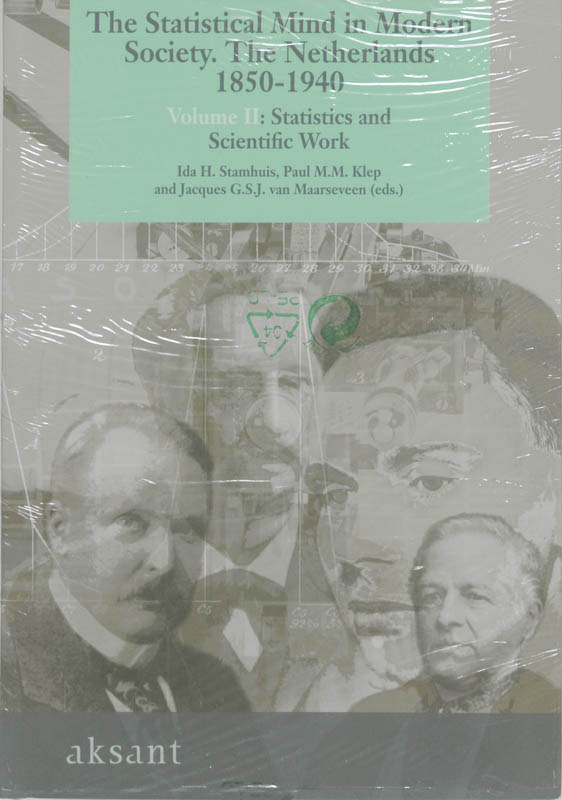
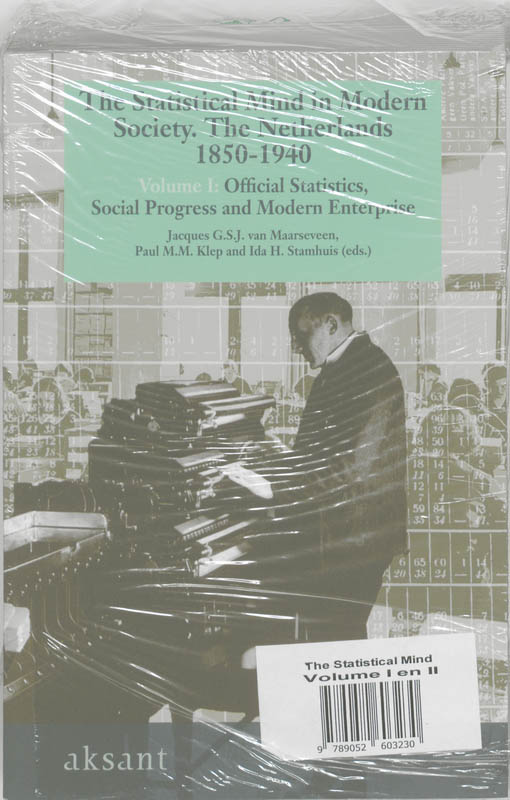
The statistical mind in modern society the Netherlands 1850-1940
PaperbackEngels
In the period 1850-1940 statistics developed as a new combination of theory and practice. A wide range of phenomena were looked at in a novel way and this statistical mindset had a pervasive influence in contemporary society. This development of statistics is closely interlinked with the process of modernisation of society at the time, and with the rapid progress in the sciences. The increasing influence of the statistical approach sometimes evoked strong opposition on the part of government, business and science, and gave rise to lively debates.
This two-volume publication is a follow-up to 'The statistical mind in a pre-statistical era: The Netherlands 1750-1850' (Paul M.M. Klep and Ida H. Stamhuis, eds), published in 2002.
The contributions in volume I 'Official statistics, social progress and modern enterprise', produced by experts from various disciplines, cover a great diversity of topics. In addition to the institutionalisation and internationalisation of official governmental statistics, attention is paid to statistics supporting policies for modernising society, in areas like agriculture, social legislation, education and justice. The application of statistics in trade and industry (such as banking and insurance, and the railways) is also discussed, as well as the growth of state power to combat social and economic problems such as child labour, the fight against alcoholism and economic crises.
The contributions volume II 'Statistics and scientific work', also produced by experts from various disciplines, also cover a great diversity of topics. The application of statistics in the sciences (demography, geography, genetics, economic historiography, agricultural and medical sciences) is discussed in an international context. Special attention is given to the general emergence of thinking in terms of probabilities and the influence of mechanisation in statistics, as well as to the way Dutch scholars and scientists tried to solve statistical measurement problems (in meteorology, demographic forecasting, business-cycle research and unemployment).
- Paul Klep is a professor of social and economic history at the Radboud University Nijmegen.
- Jacques van Maarseveen worked for many years at the Dutch Central Bureau of Statistics.
- Ida Stamhuis teaches history of science at the Free University, Amsterdam.
This two-volume publication is a follow-up to 'The statistical mind in a pre-statistical era: The Netherlands 1750-1850' (Paul M.M. Klep and Ida H. Stamhuis, eds), published in 2002.
The contributions in volume I 'Official statistics, social progress and modern enterprise', produced by experts from various disciplines, cover a great diversity of topics. In addition to the institutionalisation and internationalisation of official governmental statistics, attention is paid to statistics supporting policies for modernising society, in areas like agriculture, social legislation, education and justice. The application of statistics in trade and industry (such as banking and insurance, and the railways) is also discussed, as well as the growth of state power to combat social and economic problems such as child labour, the fight against alcoholism and economic crises.
The contributions volume II 'Statistics and scientific work', also produced by experts from various disciplines, also cover a great diversity of topics. The application of statistics in the sciences (demography, geography, genetics, economic historiography, agricultural and medical sciences) is discussed in an international context. Special attention is given to the general emergence of thinking in terms of probabilities and the influence of mechanisation in statistics, as well as to the way Dutch scholars and scientists tried to solve statistical measurement problems (in meteorology, demographic forecasting, business-cycle research and unemployment).
- Paul Klep is a professor of social and economic history at the Radboud University Nijmegen.
- Jacques van Maarseveen worked for many years at the Dutch Central Bureau of Statistics.
- Ida Stamhuis teaches history of science at the Free University, Amsterdam.
In het kort
ISBN-13
9789052603230
Uitgever
Verschenen
1 juli 2009
Bibliografisch
ISBN-139789052603230
Editie1
TaalEngels eng
GeïllustreerdJa
Uitgave
UitgeverAmsterdam University Press
CB-relatie-id7400597
Verschenen1 juli 2009
StatusInactief 08
BeschikbaarheidContact leverancier 99
Adviesprijs (incl. btw)€ 59,90
Vorm & inhoud
ProductvormPaperback BC
SamenstellingPakket (meerdelig)
Classificatie
NUR (hoofd)Sociaal-economische geschiedenis 696
NUR (alle)696 Sociaal-economische geschiedenis
Medewerkers
Herkomst
Werk-id (NSTC)500585189
MeldingBevestigd bij publicatie 03
Bijgewerkt6 augustus 2026
Lijkt op dit boek






NSTC 500585189 · CB-relatie 7400597 · Bijgewerkt 6 augustus 2026