
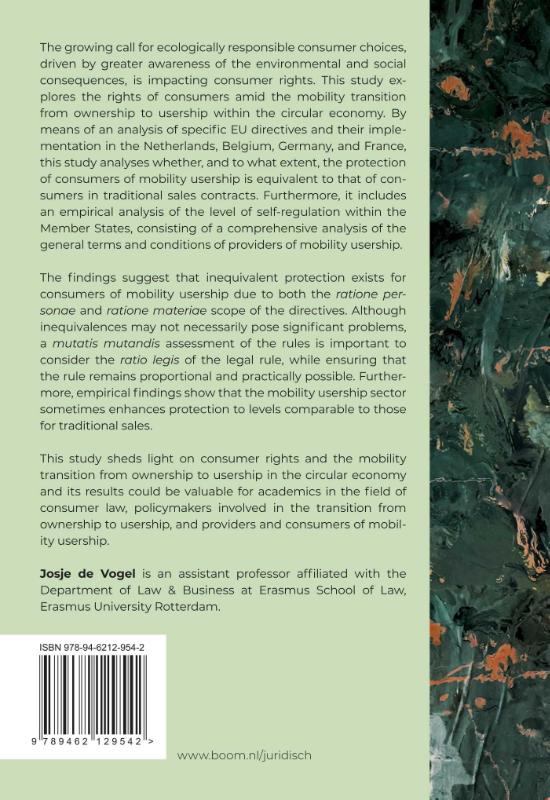
The Transition from Mobility Ownership to Mobility Usership: Is EU Consumer Law Pushing the Brakes? A Comparative Legal Study
Paperback512 pagina’sEngels
Ook verkrijgbaar als
1 Introduction; 2 Ratione personae scope; 3 Ratione materiae scope; 4 Non-applicable substantive rights to mobility usership; 5 Applicable substantive rights to mobility usership; 6 Study of the general terms and conditions according to sector conduct of exclusive mobility providers; 7 Study of the general terms and conditions according to sector conduct of shared mobility; 8 Key improvements for equivalent protection and its accessibility through regulation; 9 Summary and conclusion; 10 Bibliography; 11 AppendicesThe growing call for ecologically responsible consumer choices, driven by greater awareness of the environmental and social consequences, is impacting consumer rights. This study explores the rights of consumers amid the mobility transition from ownership to usership within the circular economy. By means of an analysis of specific EU directives and their implementation in the Netherlands, Belgium, Germany, and France, this study analyses whether, and to what extent, the protection of consumers of mobility usership is equivalent to that of consumers in traditional sales contracts. Furthermore, it includes an empirical analysis of the level of self-regulation within the Member States, consisting of a comprehensive analysis of the general terms and conditions of providers of mobility usership. The findings suggest that inequivalent protection exists for consumers of mobility usership due to both the ratione personae and ratione materiae scope of the directives. Although inequivalences may not necessarily pose significant problems, a mutatis mutandis assessment of the rules is important to consider the ratio legis of the legal rule, while ensuring that the rule remains proportional and practically possible. Furthermore, empirical findings show that the mobility usership sector sometimes enhances protection to levels comparable to those for traditional sales. This study sheds light on consumer rights and the mobility transition from ownership to usership in the circular economy and its results could be valuable for academics in the field of consumer law, policymakers involved in the transition from ownership to usership, and providers and consumers of mobility usership. Josje de Vogel is an assistant professor affiliated with the Department of Law & Business at Erasmus School of Law, Erasmus University Rotterdam.
In het kort
ISBN-13
9789462129542
Uitgever
Verschenen
28 juni 2024
Imprint
Bibliografisch
ISBN-139789462129542
Editie1
TaalEngels eng
Pagina’s512
GeïllustreerdNee
Uitgave
UitgeverKoninklijke Boom uitgevers PW
ImprintBoom juridisch
CB-relatie-id7500275
Verschenen28 juni 2024
StatusOnbekend 00
BeschikbaarheidContact leverancier 99
Zonder prijsPrijs volgt
Vorm & inhoud
ProductvormPaperback BC
SamenstellingLos product
Classificatie
NUR (hoofd)Privaatrecht 822
NUR (alle)822 Privaatrecht
Trefwoordensharing · self-regulation · policy · consumer · market · commercial · protection · burgerlijk · recht · private · law · eu · european · ownership · usership · mobility · circular · economy · equivalent · product-service · systems · sustainable
Medewerkers
Auteur A01J.J. de Vogel
Herkomst
Werk-id (NSTC)501586699
MeldingUpdate 04
Laatste CB-bericht7794
Bijgewerkt7 augustus 2026
Trefwoorden
Lijkt op dit boek
NSTC 501586699 · CB-relatie 7500275 · Laatste CB-bericht 7794 · Bijgewerkt 7 augustus 2026