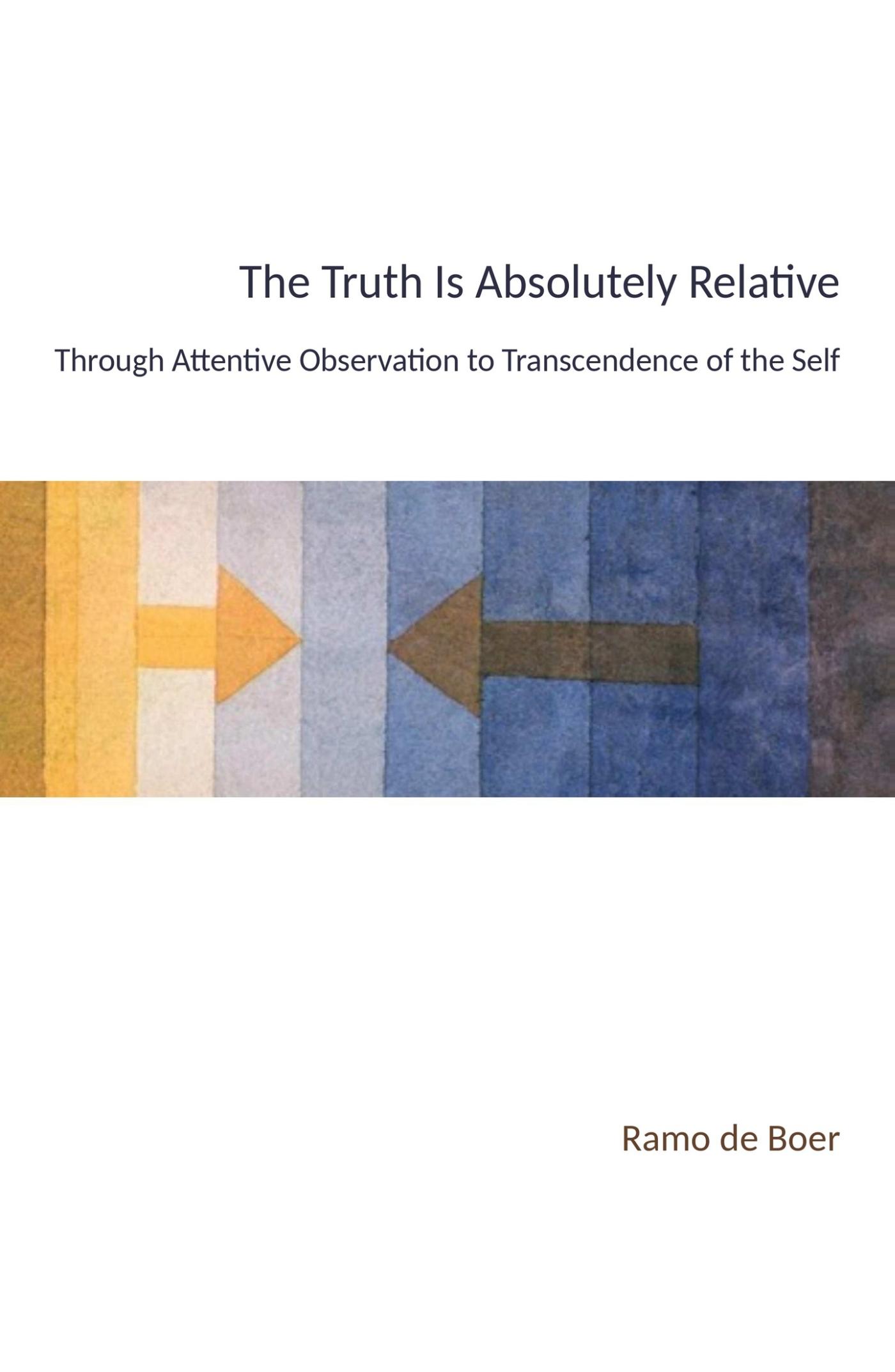
The Truth Is Absolutely Relative Through Attentive Observation to Transcendence of the Self
E-book321 pagina’sEngels
Ook verkrijgbaar als
The Truth Is Absolutely RelativeColophonDedicationIntroductionPerception Introduction to Perception Perception – I See, I See What You Don’t See!? Phenomenology and the Nature of Mind Believing Is Inevitable and Not Without Consequence Everything Revolves Around Perception Integration ExercisesAttention and Awareness Introduction to Attention and Awareness The Four Trainings of Attention Mindlessness Without Attention, All Efforts Are Pointless Integration ExercisesMeditation Introduction to Meditation Shamatha Meditation Meditation Brings Nothing! Meditating Will Not Make You Relaxed, Nor Happy Meditating – the Seven Problems and Their Solution The Goal of Meditation Is (Not) a Head Without Thoughts Integration ExercisesTraining Your Mind Introduction to Training Your Mind Addictions and Allergies to Free Yourself From Cherish Your Problems and Use Them as the Cause of Your Success If You Are Not Happy, It Is Your Own Fault, Right? The Eight Verses for Training Your Mind The Seven Points of Training the Mind Four Thoughts for Training the Mind Integration ExercisesThe Spiritual Path Introduction to The Spiritual Path Spiritual Development Is Simple, but Not Easy Open Presence Ís Spiritual Meaning Does Surrender Lead to Liberation? The Trinity of Spiritual Development Integration ExercisesRelationships Introduction to Relationships Loving Attention in Relationships Quality of Relationship Is Essential Quality Is Not a Fact but an Experience Integration ExercisesReactivity Introduction to Reactivity Dismantling Emotional Reactivity and Cultivating Contentment How Do We Dismantle Emotional Consumption and Other Addictions? Integration ExercisesConsciousness Development Introduction to Consciousness Development The 4 Phases of Consciousness Development Evolution of Attention in the 4 Phases Interrupt the Vicious Circle Relax into How It Is One – A Reflection on Consciousness Development Integration ExercisesCreating Meaning Introduction to Creating Meaning What Is the Meaning of Life? From Receiving Meaning to Discovering Meaning Why Realizing Our Dream Is So Important Creating Meaning Is a Verb From Insight to Realization The Sense of Meaning Integration ExercisesInner Leadership Introduction to Leadership Everyone Is a Leader! The Essence of Inner Leadership Integration ExercisesWisdom Introduction to Wisdom How to Develop Practical Wisdom From Wishing to Willing Know Thyself! No Freedom Without Limitation From Monologue to Dialogue in the World Integration ExercisesTruth Introduction to Truth The Truth Is Absolutely Relative Integration ExercisesAfterwordIndexIndex of Integration ExercisesAppendices The Slogans of the Seven-Point Mind Training The 4 Phases of Consciousness Development The Consciousness SpectrumBibliographyAbout the AuthorOther BooksTranscending the self is the ultimate liberation from your emotional and mental limitations. By attentively observing your own behavior — physical, emotional, and mental — freedom comes within reach.Why do we react automatically in ways that no longer serve us? Worse still, ways that are downright counterproductive. And how can we break through these emotional and mental algorithms without getting entangled in endless self-analysis?This book offers a clear path from observation to transformation, toward a transcending of the self. By attentively observing how we shape reality through our perception, develop emotional algorithms, and assign meaning, a fundamental insight emerges:The 'self' we defend so automatically is itself a limiting construct - one that can be transcended!Through theory and practical applications of perception, attention, and awareness, through unmasking and dismantling reactivity, you learn not only to know yourself, but to become free of the limitations of that self.Across 12 themes, we explore the essence and realization of inner freedom, and the obstacles you may encounter in manifesting this freedom in daily life.Each of the theme chapters opens with an Introduction and closes with Integration Exercises - because insight without application remains theory.The truth is absolutely relative. And precisely because of that, absolutely liberating.From personal development to spiritual liberationYou are stuck in traffic and someone cuts you off. Before you know it, irritation rises, you mutter something unfriendly, and your mood is spoiled for the next ten minutes. Or someone keeps interrupting you in a meeting, and you withdraw without saying a word. Recognizable? Reactions like these unfold razor-fast, completely automatically. You do not have to do anything consciously for them — stronger still, you can hardly stop them.Such automatisms are everywhere in our thinking and doing: in how we react to criticism, how we deal with disappointment, how we make ourselves smaller in certain situations or, on the contrary, bigger and more defensive, how we respond to compliments, how we handle disapproval. They are emotional and mental algorithms that once arose as functional protection, but now often produce precisely what you wanted to prevent.There is a way out. Not by working on yourself, but by investigating yourself and your behavior — attentively, without judgment. In this way you experience the space beyond your automatic reactions. Through phenomenological self-inquiry you discover something even more surprising: what you experience as ‘I’, as self, is a habit, an identity that arose on its own. And it is precisely the unconscious identification with your self-image that limits your freedom of thinking and doing.The twelve themes — from Perception, Attention, Relationships and Creating Meaning to Wisdom and Truth — invite you to look in a radically different way, and to experience that there is more freedom of thinking and doing than you ever imagined. Each theme has an Introduction and, at the end, Integration Exercises for active integration.After reading and practicing you can —train your mind in attentive observationrecognize and interrupt counterproductive habitual behaviorpurposefully widen your emotional and mental freedom of movementrelax into the natural space and stillness of your mindRamo de Boer (1957) works as a Gestalt and relationship therapist, trainer and author.
In het kort
ISBN-13
9789083586144
Uitgever
Verschenen
20 juli 2026
Imprint
Bibliografisch
ISBN-139789083586144
Editie1
TaalEngels eng
Pagina’s321
GeïllustreerdJa
Uitgave
Vorm & inhoud
ProductvormE-book ED
VormdetailE200 Reflowable
E101 EPUB
E101 EPUB
SamenstellingLos product
EPUB-versie3
Beveiliging e-bookDigitaal watermerk 02
Classificatie
NUR (hoofd)Psychologie algemeen 770
NUR (alle)770 Psychologie algemeen
Medewerkers
Auteur A01Ramo De Boer
Herkomst
Werk-id (NSTC)501684751
MeldingUpdate 04
Laatste CB-bericht7876
Bijgewerkt21 oktober 2026
Lijkt op dit boek









NSTC 501684751 · CB-relatie 6324250 · Laatste CB-bericht 7876 · Bijgewerkt 21 oktober 2026