
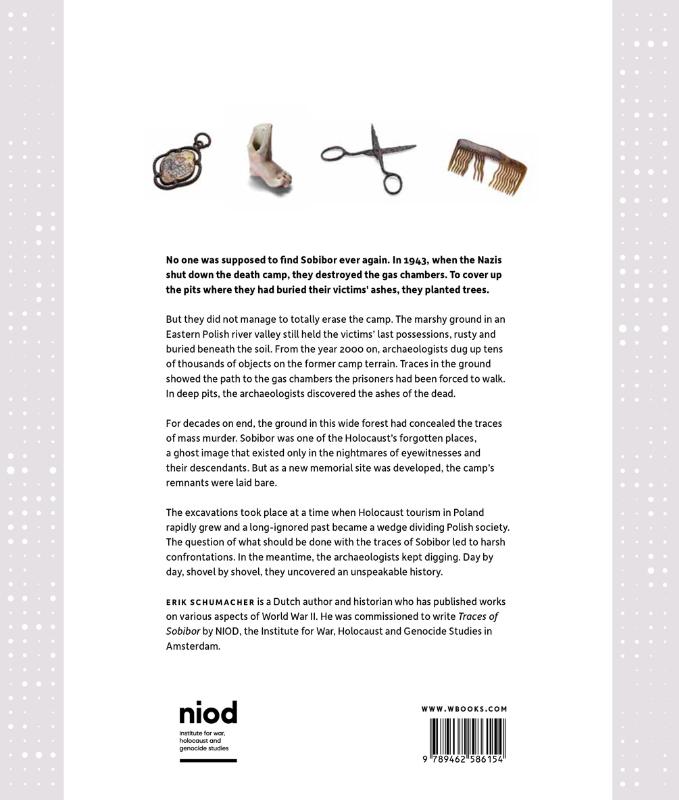
Traces of Sobibor Archaeology of a Death Camp
Hardback160 pagina’sEngels
No one was supposed to find Sobibor ever again. In 1943, when the Nazis shut down the death camp, they destroyed the gas chambers. To cover up pits where they buried their victims’ ashes, they planted trees.But their attempt to totally erase the camp failed. The marshy ground in an Eastern Polish river valley still held the victims’ last possessions, rusty and buried beneath the soil. From 2007 on, archaeologists dug up tens of thousands of objects on the former camp terrain. Traces in the ground showed the ‘road to heaven’ the prisoners had been forced to walk. In deep pits, the archaeologists discovered the ashes of the dead.For decades on end, the ground in this wide forest had concealed the traces of mass murder. Sobibor was one of the Holocaust’s forgotten places, a ghost image that existed only in the nightmares of eyewitnesses and their descendants. But as the development of a new memorial site progressed, the camp’s remnants were laid bare.The excavations took place at a time when Holocaust tourism in Poland took off and a long-ignored past became a wedge deeply dividing Polish society. The question of what should be done with the traces of Sobibor led to harsh confrontations. In the meantime, the archaeologists kept digging, day after day. Spade by spade, they uncovered an unspeakable history. Erik Schumacher is an author and researcher. His works include the Jewish dual biography Mau en Gerty, and two parts of the NIOD series Leven in bezet Nederland.No one was supposed to find Sobibor ever again. In 1943, when the Nazis shut down the death camp, they destroyed the gas chambers. To cover up pits where they buried their victims’ ashes, they planted trees.But their attempt to totally erase the camp failed. The marshy ground in an Eastern Polish river valley still held the victims’ last possessions, rusty and buried beneath the soil. From 2007 on, archaeologists dug up tens of thousands of objects on the former camp terrain. Traces in the ground showed the ‘road to heaven’ the prisoners had been forced to walk. In deep pits, the archaeologists discovered the ashes of the dead.For decades on end, the ground in this wide forest had concealed the traces of mass murder. Sobibor was one of the Holocaust’s forgotten places, a ghost image that existed only in the nightmares of eyewitnesses and their descendants. But as the development of a new memorial site progressed, the camp’s remnants were laid bare.The excavations took place at a time when Holocaust tourism in Poland took off and a long-ignored past became a wedge deeply dividing Polish society. The question of what should be done with the traces of Sobibor led to harsh confrontations. In the meantime, the archaeologists kept digging, day after day. Spade by spade, they uncovered an unspeakable history. Erik Schumacher is an author and researcher. His works include the Jewish dual biography Mau en Gerty, and two parts of the NIOD series Leven in bezet Nederland.
In het kort
Bibliografisch
ISBN-139789462586154
Editie1
TaalEngels eng
Pagina’s160
GeïllustreerdJa
Uitgave
UitgeverUitgeverij WBOOKS
CB-relatie-id6509637
Verschenen1 maart 2024
StatusInactief 08
BeschikbaarheidContact leverancier 99
Adviesprijs (incl. btw)€ 29,95
Vorm & inhoud
ProductvormHardback BB
SamenstellingLos product
Classificatie
NUR (hoofd)Oorlog en vrede 689
NUR (alle)689 Oorlog en vrede
Medewerkers
Auteur A01Erik Schumacher
Herkomst
Werk-id (NSTC)501567498
MeldingBevestigd bij publicatie 03
Bijgewerkt6 augustus 2026
Lijkt op dit boek

NSTC 501567498 · CB-relatie 6509637 · Bijgewerkt 6 augustus 2026