
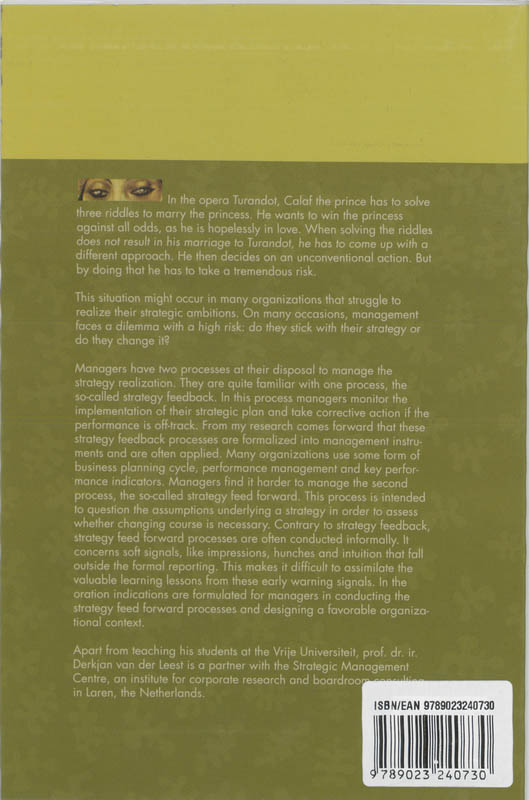
Turandot the riddles around strategy realization
Paperback48 pagina’sEngelsLeverbaar
"In the opera Turandot, Calaf the prince has to solve three riddles to marry the princess. He wants to win the princess against all odds, as he is hopelessly in love. When solving the riddles does not result in his marriage to Turandot, he has to come up with a different approach. He then decides on an unconventional action. But by doing that he has to take a tremendous risk.
This situation might occur in many organizations that struggle to realize their strategic ambitions. On many occasions, management faces a dilemma with a high risk: do they stick with their strategy or do they change it?
Managers have two processes at their disposal to manage the strategy realization. They are quite familiar with one process, the so-called strategy feedback. In this process managers monitor the implementation of their strategic plan and take corrective action if the performance is off-track. From my research comes forward that these strategy feedback processes are formalized into management instruments and are often applied. Many organizations use some form of business planning cycle, performance management and key performance indicators. Managers find it harder to manage the second process, the so-called strategy feed forward. This process is intended to question the assumptions underlying a strategy in order to assess whether changing course is necessary. Contrary to strategy feedback, strategy feed forward processes are often conducted informally. It concerns soft signals, like impressions, hunches and intuition that fall outside the formal reporting. This makes it difficult to assimilate the valuable learning lessons from these early warning signals. In the oration indications are formulated for managers in conducting the strategy feed forward processes and designing a favorable organizational context.
Apart from teaching his students at the Vrije Universiteit, prof. dr. ir. Derkjan van der Leest is a partner with the Strategic Management Centre, an institute for corporate research and boardroom consulting in Laren, the Netherlands.
Turandot
1 Introduction
2 Turandot: An example of strategy realization in imperial China
2.1What is the role of opera?
2.2Turandot or the ice princess
2.3Reflections on the strategy processes in Turandot
3My view on strategy
3.1Introduction
3.2A rational approach to strategy
3.2.1 What to do?
3.2.2 How to do it?
3.2.3 Contribution of the rational approach to strategy
3.3An evolutionary view on strategy
3.3.1 Contribution of the evolutionary perspective
3.4Four key themes in strategy realization
3.4.1 Strategy realization depends on the dynamic of actions
3.4.2 A strategic plan is a snapshot
3.4.3 Strategy demands commitment
3.4.4 Strategy demands perseverance and responsiveness
3.5A framework for strategy realization
4My research on strategy realization
4.1Introduction
4.2Strategy feedback is necessary but not enough
4.3Strategy feed forward is necessary for strategy realization
4.3.1 Added value of strategy feed forward processes
4.3.2 Strategy feed forward is aimed at changing action patterns
4.4Creating a favourable setting for strategy feed forward
4.4.1 Operationalization of the strategy
4.4.2 Non-hierarchical devices for strategy feed forward
4.5The role of senior management in directing strategy feed forward processes
4.6When to engage in strategy feedback and when in strategy feed forward
5Epilogue"
This situation might occur in many organizations that struggle to realize their strategic ambitions. On many occasions, management faces a dilemma with a high risk: do they stick with their strategy or do they change it?
Managers have two processes at their disposal to manage the strategy realization. They are quite familiar with one process, the so-called strategy feedback. In this process managers monitor the implementation of their strategic plan and take corrective action if the performance is off-track. From my research comes forward that these strategy feedback processes are formalized into management instruments and are often applied. Many organizations use some form of business planning cycle, performance management and key performance indicators. Managers find it harder to manage the second process, the so-called strategy feed forward. This process is intended to question the assumptions underlying a strategy in order to assess whether changing course is necessary. Contrary to strategy feedback, strategy feed forward processes are often conducted informally. It concerns soft signals, like impressions, hunches and intuition that fall outside the formal reporting. This makes it difficult to assimilate the valuable learning lessons from these early warning signals. In the oration indications are formulated for managers in conducting the strategy feed forward processes and designing a favorable organizational context.
Apart from teaching his students at the Vrije Universiteit, prof. dr. ir. Derkjan van der Leest is a partner with the Strategic Management Centre, an institute for corporate research and boardroom consulting in Laren, the Netherlands.
Turandot
1 Introduction
2 Turandot: An example of strategy realization in imperial China
2.1What is the role of opera?
2.2Turandot or the ice princess
2.3Reflections on the strategy processes in Turandot
3My view on strategy
3.1Introduction
3.2A rational approach to strategy
3.2.1 What to do?
3.2.2 How to do it?
3.2.3 Contribution of the rational approach to strategy
3.3An evolutionary view on strategy
3.3.1 Contribution of the evolutionary perspective
3.4Four key themes in strategy realization
3.4.1 Strategy realization depends on the dynamic of actions
3.4.2 A strategic plan is a snapshot
3.4.3 Strategy demands commitment
3.4.4 Strategy demands perseverance and responsiveness
3.5A framework for strategy realization
4My research on strategy realization
4.1Introduction
4.2Strategy feedback is necessary but not enough
4.3Strategy feed forward is necessary for strategy realization
4.3.1 Added value of strategy feed forward processes
4.3.2 Strategy feed forward is aimed at changing action patterns
4.4Creating a favourable setting for strategy feed forward
4.4.1 Operationalization of the strategy
4.4.2 Non-hierarchical devices for strategy feed forward
4.5The role of senior management in directing strategy feed forward processes
4.6When to engage in strategy feedback and when in strategy feed forward
5Epilogue"
In het kort
Bibliografisch
ISBN-139789023240730
Editie1
TaalEngels eng
Pagina’s48
GeïllustreerdNee
Uitgave
UitgeverUitgeverij Van Gorcum B.V.
CB-relatie-id6127604
StatusLeverbaar 04
BeschikbaarheidBeschikbaar 20
Adviesprijs (incl. btw)€ 9,50
Vorm & inhoud
ProductvormPaperback BC
SamenstellingLos product
Classificatie
NUR (hoofd)Management algemeen 801
NUR (alle)801 Management algemeen
Medewerkers
Auteur A01D.J.B. van der Leest
Herkomst
Werk-id (NSTC)501206685
MeldingBevestigd bij publicatie 03
Bijgewerkt6 augustus 2026
Lijkt op dit boek

NSTC 501206685 · CB-relatie 6127604 · Bijgewerkt 6 augustus 2026