
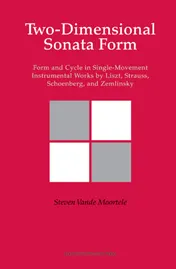
Two-Dimensional Sonata Form Form and Cycle in Single-Movement Instrumental Works by Liszt, Strauss, Schoenberg and Zemlinsky
Paperback220 pagina’sEngels
AcknowledgementsIntroductionChapter 1 Two‑Dimensional Sonata Form: A terminological and conceptual frameworkLevels of formAnalogies between levelsProjection of hierarchiesIdentification, interpolation, and exocyclic unitsIntegration, process, and tensionFurther terminological considerationsNotesChapter 2 L iszt’s B-minor SonataThe locus romanticus of two‑dimensional sonata formThe exposition of the overarching sonata formIdentification: first movement and expositionInterpolation: the slow movementIdentification: scherzo–finale and recapitulation–codaNotesChapter 3 L iszt: Tasso and Die IdealeTwo‑dimensional sonata form in the second half of the nineteenth centuryForm in Liszt’s symphonic poemsTasso: Lamento e trionfo (1847–54)Die Ideale (1856–57)NotesChapter 4 S trauss: Don Juan and Ein HeldenlebenStrauss and LisztDon Juan Op. 20 (1888–89)Ein Heldenleben Op. 40 (1897–98)NotesChapter 5 Schoenberg’s Pelleas und MelisandeBefore PelleasPelleas und Melisande Op. 5 (1902–03)NotesChapter 6 S choenberg’s First String QuartetFrom program to absolute musicIssues of form in the overarching sonata formIdentificationInterpolation and integrationOverall form and tonal planNotesChapter 7 S choenberg’s First Chamber SymphonyOverviewIdentificationInterpolationRecapitulation, coda, and finaleNotesChapter 8 Z emlinsky’s Second String QuartetFirst approachIdentificationInterpolationNotesConclusion: The significance of two-dimensional sonata formAppendix: M easure-Number TablesBibliographyIndex of Names and WorksThe first book dedicated to the combination of the movements of a multimovement sonata cycle with an overarching single-movement form that is itself organized as a sonata form.Two-Dimensional Sonata Form is the first book dedicated to the combination of the movements of a multimovement sonata cycle with an overarching single-movement form that is itself organized as a sonata form. Drawing on a variety of historical and recent approaches to musical form (e.g., Marxian and Schoenbergian Formenlehre, Caplin’s theory of formal functions, and Hepokoski and Darcy’s Sonata Theory), it begins by developing an original theoretical framework for the analysis of this type of form that is so characteristic of the later nineteenth and early twentieth century. It then offers an in-depth examination of nine exemplary works by four Central European composers: the Piano Sonata in B minor and the symphonic poems Tasso and Die Ideale by Franz Liszt, Richard Strauss’s tone poems Don Juan and Ein Heldenleben, the symphonic poem Pelleas und Melisande, the First String Quartet and the First Chamber Symphony by Arnold Schoenberg, and Alexander Zemlinsky’s Second String Quartet.Two-Dimensional Sonata Form is the first book dedicated to the combination of the movements of a multimovement sonata cycle with an overarching single-movement form that is itself organized as a sonata form. Drawing on a variety of historical and recent approaches to musical form (e.g., Marxian and Schoenbergian Formenlehre, Caplin’s theory of formal functions, and Hepokoski and Darcy’s Sonata Theory), it begins by developing an original theoretical framework for the analysis of this type of form that is so characteristic of the later nineteenth and early twentieth century. It then offers an in-depth examination of nine exemplary works by four Central European composers: the Piano Sonata in B minor and the symphonic poems Tasso and Die Ideale by Franz Liszt, Richard Strauss’s tone poems Don Juan and Ein Heldenleben, the symphonic poem Pelleas und Melisande, the First String Quartet and the First Chamber Symphony by Arnold Schoenberg, and Alexander Zemlinsky’s Second String Quartet.
In het kort
ISBN-13
9789462704381
Uitgever
Verschenen
13 juni 2024
Serie
Studies in Musical Form
Imprint
Bibliografisch
ISBN-139789462704381
SerieStudies in Musical Form
Editie2
TaalEngels eng
Pagina’s220
GeïllustreerdNee
Uitgave
UitgeverUniversitaire Pers Leuven
ImprintLeuven University Press
CB-relatie-id8004161
Verschenen13 juni 2024
StatusAangekondigd 02
BeschikbaarheidContact leverancier 99
Adviesprijs (incl. btw)€ 34,00
Vorm & inhoud
ProductvormPaperback BC
SamenstellingLos product
Classificatie
NUR (hoofd)Muziektheorie 663
NUR (alle)663 Muziektheorie
Trefwoordenmusic theory · sonata cycle · sonata form · musical form
Medewerkers
Auteur A01Steven Vande Moortele
Herkomst
MeldingBevestigd bij publicatie 03
Bijgewerkt6 augustus 2026
Trefwoorden
Lijkt op dit boek


CB-relatie 8004161 · Bijgewerkt 6 augustus 2026