
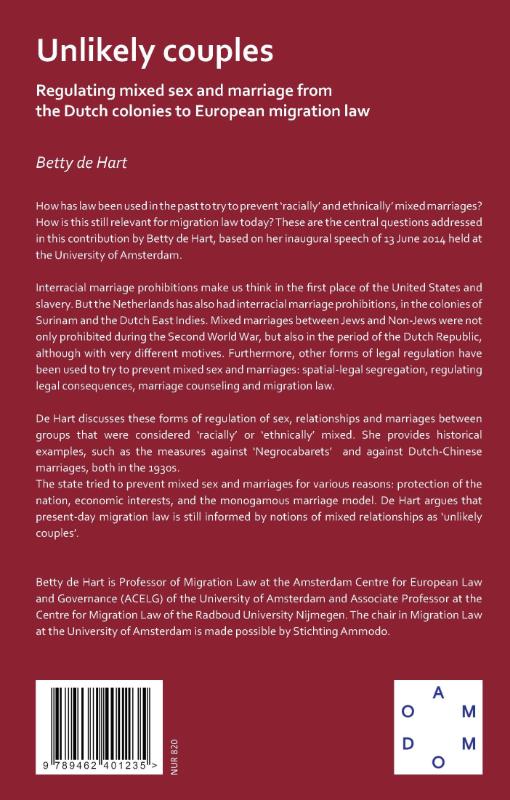
Unlikely couples regulating mixed sex and marriage from the Dutch colonies to European migration law
PaperbackEngels
How has law been used in the past to try to prevent 'racially' and ethnically' mixed marriages? How is this still relevant for migration law today? These are the central questions addressed in this contribution by Betty de Hart, based on her inaugural speech of 13 June 2014 held at the University of Amsterdam.Interracial marriage prohibitions make us think in the first place of the United States and slavery. But the Netherlands has also had interracial marriage prohibitions, in the colonies of Surinam and the Dutch East Indies. Mixed marriages between Jews and Non-Jews were not only prohibited during the Second World War, but also in the period of the Dutch Republic, although with very different motives. Furthermore, other forms of legal regulation have been used to try to prevent mixed sex and marriages: spatiallegal segregation, regulating legal consequences, marriage counseling and migration law.De Hart discusses these forms of regulation of sex, relationships and marriages between groups that were considered 'racially' or 'ethnically' mixed. She provides historical examples, such as the measures against 'Negrocabarets' and against Dutch-Chinese marriages, both in the 1930s.The state tried to prevent mixed sex and marriages for various reasons: protection of the nation, economic interests, and the monogamous marriage model. De Hart argues that present-day migration law is still informed by notions of mixed relationships as 'unlikely couples'.
In het kort
ISBN-13
9789462401235
Uitgever
Verschenen
13 juni 2014
Bibliografisch
ISBN-139789462401235
Editie1
TaalEngels eng
GeïllustreerdNee
Uitgave
Vorm & inhoud
ProductvormPaperback BC
SamenstellingLos product
Classificatie
NUR (hoofd)Internationaal (publiek)recht 828
NUR (alle)828 Internationaal (publiek)recht
Medewerkers
Auteur A01Betty de Hart
Herkomst
Werk-id (NSTC)500264938
MeldingBevestigd bij publicatie 03
Bijgewerkt6 augustus 2026
Lijkt op dit boek
Some cursory remarks on race, mixture and law by three Dutch jurists
Detection, Detention, Deportation
Queering Courts
Breaking Eurocentric Frames on Arranged Marriage
Discrimination and the Foundation of Justice
Racial discrimination
The human rights of migrant women in International and European Law
Diaspora status and citizenship rights
NSTC 500264938 · CB-relatie 8037459 · Bijgewerkt 6 augustus 2026