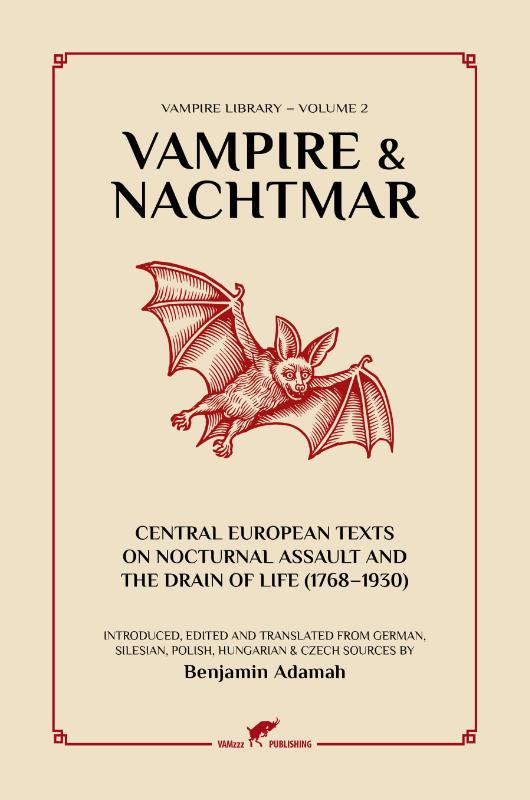
Vampire & Nachtmar Central European Texts on Nocturnal Assault and the Drain of Life (1768–1930)
Benjamin Adamah vert.
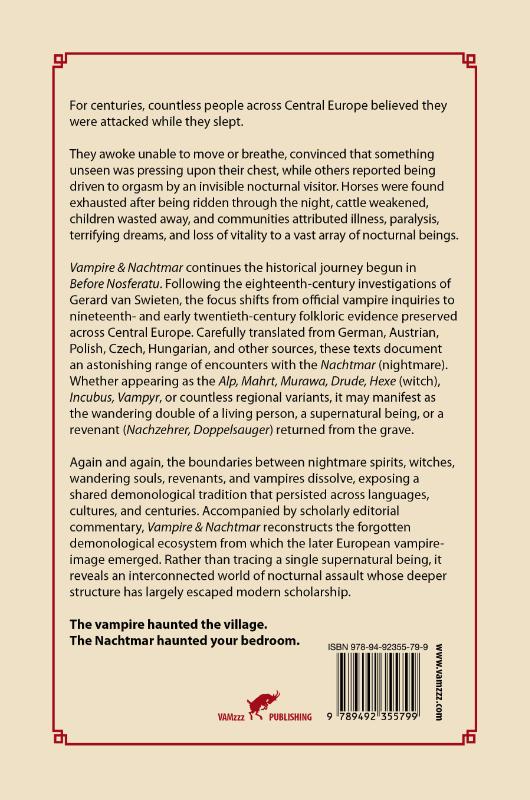
PrefaceThe Nachtmar as the Forgotten Half of the Vampire Spectrum 9The Evolution of the Vampire During the Eighteenth, Nineteenth, and Early Twentieth Centuries11The Birth Pangs of the Literary Vampire 14The Distortion of the Vampire Concept in the Modern Psychosphere 23IntroductionA Prelude to the Alp-Mahr and Vampire Traditions 31Silvanus, the Silvani, and the Fauns as Precursors of the Incubus 32Isidore of Seville and the Early Medieval Definition of the Incubus as a Sexual Predator 37No Connection to the Undead Corpse Yet 38The Rise and Influence of Scholasticism 40Johann Nider and his Formicarius 41The Witch-concept of the Scholastic Demonologists in Relation to the Alp-Mahr-complex 43The Incubus in the 'Malleus Maleficarum' 45Silvestro Mazzolini da Prierio's account of the Strigimagae 47Peter Binsfeld and the Physiologization of the Incubus Tradition 50Ludwig Lavater and the Phenomenology of Nocturnal Assault 51Martin Delrio and the Scholastic Synthesis of Demonology 52The Eighteenth and Nineteenth Centuries 53Wilhelm Mannhardt and Comparative Folklore 54Toward Psychological Interpretation 54PART I. Cancelling the BloodsuckerMaria Theresa, the Enlightenment and the Official End of the Vampire 57Van Swieten's memorandum 65Vampirism (1768) 66by Herrn Baron Gerhard van SwietenPART II. Collecting from Oral TraditionThe Vampire Spectrum as Recorded by Nineteenth-Century Folklorists 85Introduction 861. Alp 922. Aufhocker 1043. Doppelsauger, Nachzehrer, Neuntöter and the Ghostly Returning Dead 1104. The Estry - the Female Bloodsucker of the Ashkenaz 1335. Jüdel 1386. Heugütel 1407. Mahrt 1428. Murawa, Můra, and Zmora: A Point of Convergence within the Alp-Mahrt-Incubus-Vampire Complex 1579. Schrackagerl 17210. Schrezelein 17211. Strzygoń and Strzygonie 17312. Trud, Trude, Drude 17513. Vampire 18714. Wålriderske 19115. Zmora 193PART III. CONNECTING THE TRADITIONSThe Vampire Spectrum in Nineteenth-Century Comparative Folklore 197The Vampire (1859) by Ign.c Jan Hanuš 197On Vampirism (1859) by Wilhelm Mannhardt 201The Lid.rc (1854) by Arnold Ipolyi 228Editorial Introduction to Matthias H.fler's 'Disease Demons' 241Disease Demons (1899) by Dr. M. H.fler 249PART IV. THE ALP AND MAHR ON THE COUCHThe Attempted Psychologization of the Vampire-Mahr Spectrum 353The Alp, the Wandering Soul, and the Origins of the Night-Mare 355The Enchantment and Deliverance of Man in Contemporary German Folk Legend (1926) by Hilde Boesebeck 357The Immortal Anomaly 368An Authenticated Vampire Story 373Selected Bibliography 381Index 386About the author 392A historical exploration of Central Europe's vampires, revenants, night-pressing spirits, witches, and incubi, revealing the forgotten folkloric world behind the vampire and the Nachtmar.For centuries, countless people across Central Europe believed they were attacked while they slept. They awoke unable to move or breathe, convinced that something unseen was pressing upon their chest, while others reported being driven to orgasm by an invisible nocturnal visitor. Horses were found exhausted after being ridden through the night, cattle weakened, children wasted away, and communities attributed illness, paralysis, terrifying dreams, and loss of vitality to a vast array of nocturnal beings.Vampire & Nachtmar continues the historical journey begun in Before Nosferatu. Following the eighteenth-century investigations of Gerard van Swieten, the focus shifts from official vampire inquiries to nineteenth- and early twentieth-century folkloric evidence preserved across Central Europe. Carefully translated from German, Austrian, Polish, Czech, Hungarian, and other sources, these texts document an astonishing range of encounters with the Nachtmar (nightmare). Whether appearing as the Alp, Mahrt, Murawa, Drude, Hexe (witch), Incubus, Vampyr, or countless regional variants, it may manifest as the wandering double of a living person, a supernatural being, or a revenant (Nachzehrer, Doppelsauger) returned from the grave.Again and again, the boundaries between nightmare spirits, witches, wandering souls, revenants, and vampires dissolve, exposing a shared demonological tradition that persisted across languages, cultures, and centuries. Accompanied by scholarly editorial commentary, Vampire & Nachtmar reconstructs the forgotten demonological ecosystem from which the later European vampire-image emerged. Rather than tracing a single supernatural being, it reveals an interconnected world of nocturnal assault whose deeper structure has largely escaped modern scholarship.The vampire haunted the village.The Nachtmar haunted your bedroom...
In het kort
ISBN-13
9789492355799
Uitgever
Verschenen
18 september 2026
Serie
Imprint
Bibliografisch
Uitgave
UitgeverVAMzzz Publishing
ImprintVAMzzz Publishing
CB-relatie-id6391696
Verschenen18 september 2026
StatusLeverbaar 04
BeschikbaarheidBeschikbaar 20
Adviesprijs (incl. btw)€ 29,95
Vorm & inhoud
ProductvormPaperback BC
SamenstellingLos product
Classificatie
Medewerkers
Auteur A01Benjamin Adamah
Vertaler B06Benjamin Adamah
Gerelateerde producten
GerelateerdBefore Nosferatu 9789492355782
Herkomst
Werk-id (NSTC)501696425
MeldingUpdate 04
Laatste CB-bericht7850
Bijgewerkt1 oktober 2026
Trefwoorden
Lijkt op dit boek

NSTC 501696425 · CB-relatie 6391696 · Laatste CB-bericht 7850 · Bijgewerkt 1 oktober 2026