
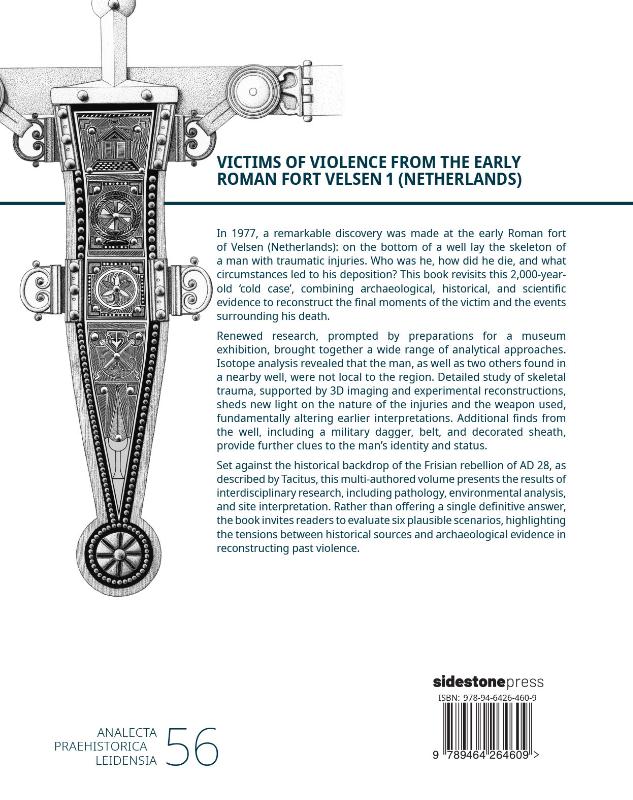
Victims of Violence from the early Roman fort Velsen 1 (Netherlands) Scenarios for a cold case review
Carol van Driel-Murray bewerker
Chapter 1. The Man in the Well of Velsen revisited : introductionMark Driessen and Carol van Driel-MurrayChapter 2. Well 2: structure, contents and human remainsMark Driessen and Carol van Driel-Murray with contributions by Frans Diederik, Johannes Huijbregts, Michael H. Field and Bert Verleijsdonk, Maarten Sepers and Hayley MickleburgBox 1. The excavationFrans DiederikBox 2. The botanical remainsMichael H. Field and Bert VerleijsdonkBox 3. The insect remainsJohannes HuijbregtsBox 4. Burnt DaubMark Driessen and Maarten SepersBox 5. Decomposition and bone movement in a seated burialHayley MickleburghChapter 3. Artefacts associated with the corpseCarol van Driel-MurrayChapter 4. The decorated dagger sheath: a question of datingMichael Johannes KleinChapter 5. The analysis of the man in the well at VelsenSarah InskipChapter 6. Joined in Death. The two males from Well S190 in Velsen IRachel SchatsChapter 7. Stranger in a Strange Land? Isotopic Determination of the Birthplace of a Renowned Roman Soldier from Velsen, The NetherlandsAndrea L. Waters-Rist and Jessica L.A. Palmer, with a contribution by Lisette KootkerChapter 8. 3D analysis of the pathological punctures of the man in well 2Maarten Sepers and Mark DriessenChapter 9. A Soldier’s FaceMaja d’HollosyChapter 10. Exhibiting the soldier from Velsen in the National Museum of Antiquities, LeidenJasper de BruinChapter 11. An ancient cold case in six scenariosMark Driessen and Carol van Driel-MurrayIn 1977, a remarkable discovery was made at the early Roman fort of Velsen (Netherlands): on the bottom of a well lay the skeleton of a man with traumatic injuries. Who was he, how did he die, and what circumstances led to his deposition? This book revisits this 2,000-year-old ‘cold case’, combining archaeological, historical, and scientific evidence to reconstruct the final moments of the victim and the events surrounding his death.Renewed research, prompted by preparations for a museum exhibition, brought together a wide range of analytical approaches. Isotope analysis revealed that the man, as well as two others found in a nearby well, were not local to the region. Detailed study of skeletal trauma, supported by 3D imaging and experimental reconstructions, sheds new light on the nature of the injuries and the weapon used, fundamentally altering earlier interpretations. Additional finds from the well, including a military dagger, belt, and decorated sheath, provide further clues to the man’s identity and status.Set against the historical backdrop of the Frisian rebellion of AD 28, as described by Tacitus, this multi-authored volume presents the results of interdisciplinary research, including pathology, environmental analysis, and site interpretation. Rather than offering a single definitive answer, the book invites readers to evaluate six plausible scenarios, highlighting the tensions between historical sources and archaeological evidence in reconstructing past violence.
In het kort
ISBN-13
9789464264609
Uitgever
Verschenen
14 oktober 2026
Imprint
Bibliografisch
ISBN-139789464264609
SerieAnalecta Praehistorica Leidensia — deel 56
Editie1
TaalEngels eng
Pagina’s200
GeïllustreerdJa
Uitgave
UitgeverSidestone Press
ImprintSidestone Press
CB-relatie-id9180064
Verschenen14 oktober 2026
StatusOnbekend 00
Vorm & inhoud
ProductvormPaperback BC
SamenstellingLos product
Classificatie
NUR (hoofd)Archeologie 682
NUR (alle)682 Archeologie
Medewerkers
Bewerker B05Mark Driessen
Bewerker B05Carol van Driel-Murray
Herkomst
Werk-id (NSTC)501668181
MeldingBevestigd bij publicatie 03
Bijgewerkt6 augustus 2026
Lijkt op dit boek
Living and dying on the Roman Frontier and beyond
Livestock for sale: animal husbandry in a Roman frontier zone
Change and continuity at the Roman coastal fort at Oudenburg from the late 2nd until the early 5th century AD
Strategy and Structures along the Roman Frontier
Settling with the norm?
Supplying the Roman Empire
Current Approaches to Roman Frontiers
The Winthir Collection
Social dynamics in the orthwest frontiers of the late roman empire

Living with Flint
NSTC 501668181 · CB-relatie 9180064 · Bijgewerkt 6 augustus 2026