AI-GEGENEREERD
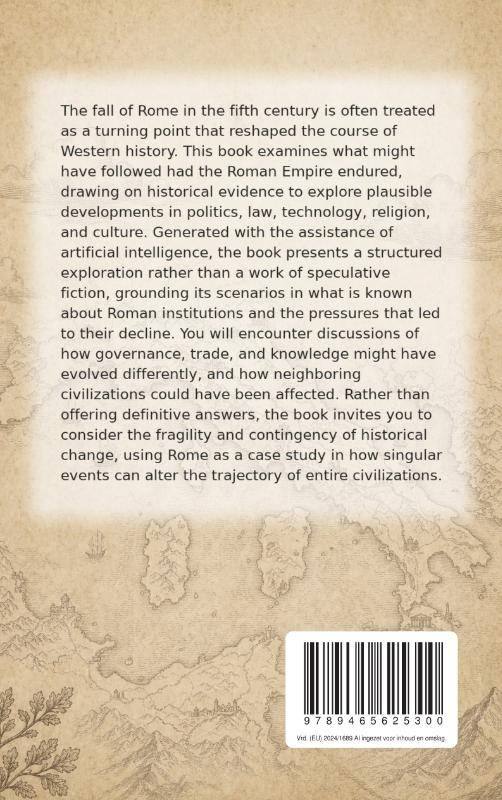
What If Rome Had Never Fallen? Exploring How History Might Have Changed Without Rome's Collapse
Paperback112 pagina’sEngelsAI-gegenereerd
The fall of Rome in the fifth century is often treated as a turning point that reshaped the course of Western history.The fall of Rome in the fifth century is often treated as a turning point that reshaped the course of Western history. This book examines what might have followed had the Roman Empire endured, drawing on historical evidence to explore plausible developments in politics, law, technology, religion, and culture. Generated with the assistance of artificial intelligence, the book presents a structured exploration rather than a work of speculative fiction, grounding its scenarios in what is known about Roman institutions and the pressures that led to their decline. You will encounter discussions of how governance, trade, and knowledge might have evolved differently, and how neighboring civilizations could have been affected. Rather than offering definitive answers, the book invites you to consider the fragility and contingency of historical change, using Rome as a case study in how singular events can alter the trajectory of entire civilizations.The fall of Rome in the fifth century is often treated as a turning point that reshaped the course of Western history. This book examines what might have followed had the Roman Empire endured, drawing on historical evidence to explore plausible developments in politics, law, technology, religion, and culture. Generated with the assistance of artificial intelligence, the book presents a structured exploration rather than a work of speculative fiction, grounding its scenarios in what is known about Roman institutions and the pressures that led to their decline. You will encounter discussions of how governance, trade, and knowledge might have evolved differently, and how neighboring civilizations could have been affected. Rather than offering definitive answers, the book invites you to consider the fragility and contingency of historical change, using Rome as a case study in how singular events can alter the trajectory of entire civilizations.
In het kort
ISBN-13
9789465625300
Uitgever
Verschenen
24 juli 2026
Imprint
Bibliografisch
ISBN-139789465625300
Editie1
TaalEngels eng
Pagina’s112
GeïllustreerdNee
Uitgave
UitgeverAndries B.V.
ImprintWaries B.V.
CB-relatie-id6750323
Verschenen24 juli 2026
StatusAangekondigd 02
BeschikbaarheidContact leverancier 99
Adviesprijs (incl. btw)€ 16,95
Vorm & inhoud
ProductvormPaperback BC
SamenstellingLos product
Classificatie
NUR (hoofd)Geschiedenis algemeen 680
NUR (alle)680 Geschiedenis algemeen
Herkomst
Werk-id (NSTC)501687958
MeldingBevestigd bij publicatie 03
Laatste CB-bericht7776
Bijgewerkt5 augustus 2026
Lijkt op dit boek

NSTC 501687958 · CB-relatie 6750323 · Laatste CB-bericht 7776 · Bijgewerkt 5 augustus 2026