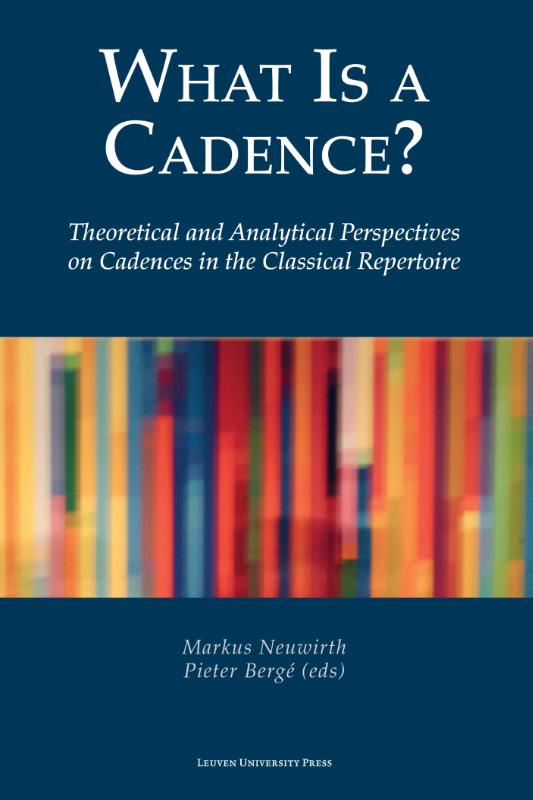
What is a Cadence? theoretical and analytical perspectives on cadences in the classical repertoire
Pieter Berge red.
Paperback320 pagina’sEngelsLeverbaar
Ook verkrijgbaar als
The variety and complexity of cadence.
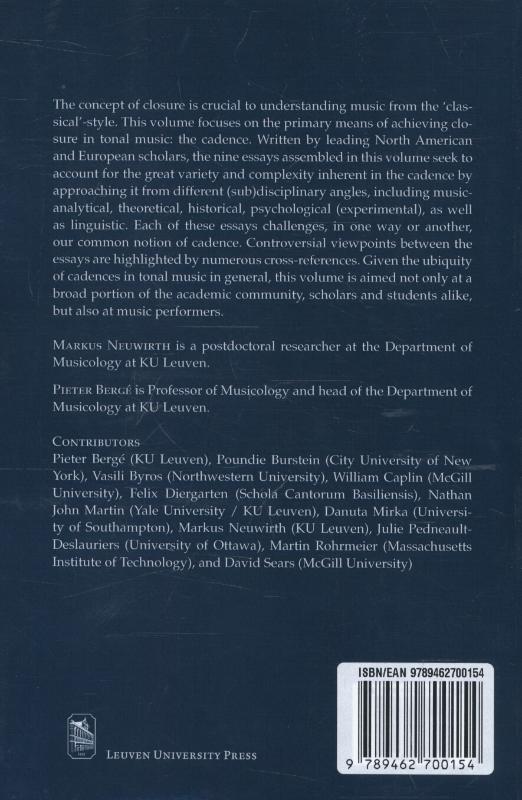
The concept of closure is crucial to understanding music from the "classical" style. This volume focuses on the primary means of achieving closure in tonal music: the cadence. Written by leading North American and European scholars, the nine essays assembled in this volume seek to account for the great variety and complexity inherent in the cadence by approaching it from different (sub)disciplinary angles, including music-analytical, theoretical, historical, psychological (experimental), as well as linguistic. Each of these essays challenges, in one way or another, our common notion of cadence. Controversial viewpoints between the essays are highlighted by numerous cross-references. Given the ubiquity of cadences in tonal music in general, this volume is aimed not only at a broad portion of the academic community, scholars and students alike, but also at music performers.
Contributors:
Pieter Bergé (KU Leuven), Poundie Burstein (City University of New York), Vasili Byros (Northwestern University), William Caplin (McGill University), Felix Diergarten (Schola Cantorum Basiliensis), Nathan John Martin (Yale University / KU Leuven), Danuta Mirka (University of Southampton), Markus Neuwirth (KU Leuven), Julie Pedneault-Deslauriers (University of Ottawa), Martin Rohrmeier (Massachusetts Institute of Technology), and David Sears (McGill University)
The concept of closure is crucial to understanding music from the "classical" style. This volume focuses on the primary means of achieving closure in tonal music: the cadence. Written by leading North American and European scholars, the nine essays assembled in this volume seek to account for the great variety and complexity inherent in the cadence by approaching it from different (sub)disciplinary angles, including music-analytical, theoretical, historical, psychological (experimental), as well as linguistic. Each of these essays challenges, in one way or another, our common notion of cadence. Controversial viewpoints between the essays are highlighted by numerous cross-references. Given the ubiquity of cadences in tonal music in general, this volume is aimed not only at a broad portion of the academic community, scholars and students alike, but also at music performers.
Contributors:
Pieter Bergé (KU Leuven), Poundie Burstein (City University of New York), Vasili Byros (Northwestern University), William Caplin (McGill University), Felix Diergarten (Schola Cantorum Basiliensis), Nathan John Martin (Yale University / KU Leuven), Danuta Mirka (University of Southampton), Markus Neuwirth (KU Leuven), Julie Pedneault-Deslauriers (University of Ottawa), Martin Rohrmeier (Massachusetts Institute of Technology), and David Sears (McGill University)
In het kort
ISBN-13
9789462700154
Uitgever
Verschenen
19 november 2014
Bibliografisch
ISBN-139789462700154
Editie1
TaalEngels eng
Pagina’s320
GeïllustreerdNee
Uitgave
UitgeverUniversitaire Pers Leuven
CB-relatie-id8004161
Verschenen19 november 2014
StatusLeverbaar 04
BeschikbaarheidBeschikbaar 20
Zonder prijsPrijs volgt
Vorm & inhoud
ProductvormPaperback BC
SamenstellingLos product
Classificatie
NUR (hoofd)Muziektheorie 663
NUR (alle)663 Muziektheorie
Medewerkers
Redacteur B01Markus Neuwirth
Redacteur B01Pieter Berge
Herkomst
Werk-id (NSTC)100029497
MeldingUpdate 04
Laatste CB-bericht7832
Bijgewerkt13 september 2026
Lijkt op dit boek
Essential Music Theory
Coup de Foudre!
Music Theory and Analysis Volume 12 Issue 2, 2025 (Journal Subscription)
Music Theory and Analysis Volume 12 Issue 1, 2025 (Journal Subscription)
Aberrant Nuptials
Music Theory and Analysis Volume 11 Issue 2, 2024 (Journal Subscription)
Two-Dimensional Sonata Form
De Taal van Geluid - in kleur - deel 1

Zo word je een songwriter
Music Theory: The Language of Sound – in colour
NSTC 100029497 · CB-relatie 8004161 · Laatste CB-bericht 7832 · Bijgewerkt 13 september 2026