
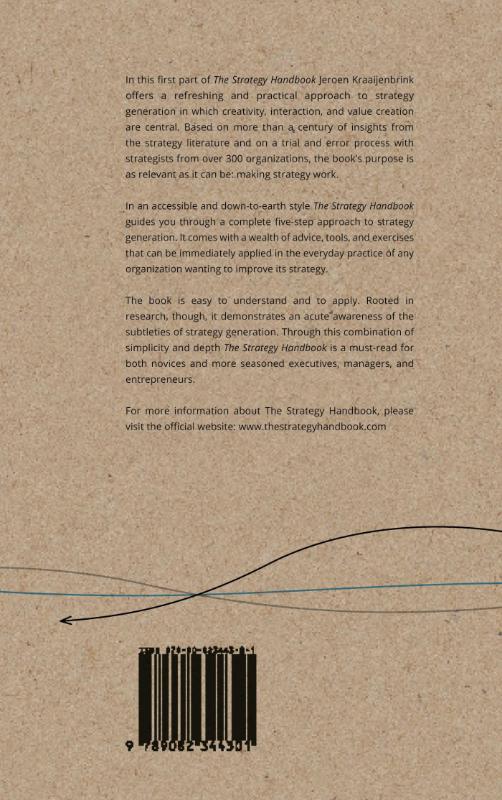
1. Motivation The challenge: Putting strategy into practice Recipe for a handbook? Origins and methodological basis Four ways to use this book2. Getting ready Defining strategy The ten elements of strategy Defining strategy generation The five steps of strategy generation The right mindset: how strategy experts think Introducing the four examples3. Step 1: Activating key stakeholders The activation challenge Excuses and causes for strategic inactivity Five activation tactics: 1. Open people’s minds, 2. Reveal the urgency, 3. Sell the benefits, 4. Take away risks, 5. Just start The four examples4. Step 2: Mapping strategy The meaning and role of mapping strategy How to use the tools The ten elements of strategy: 1. Resources & competences, 2. Partners, 3. Customers & needs, 4. Competitors, 5. Value proposition, 6. Revenue model, 7. Risks & costs, 8. Values & goals, 9. Organizational climate, 10. Trends & uncertainties The four examplesStepping back for a moment A brief summary of what we have so far A fast and frugal strategy generation format5. Step 3: Assessing strategy Why and when to assess your strategy Nine strategy checks: 1. Coherence check, 2. Efficiency check, 3. Effectiveness check, 4. Uniqueness check, 5. Flexibility check, 6. Robustness check, 7. Scalability check, 8. Responsibility check, 9. Pros & cons check A quick strategy checklist How to use the strategy checks The four examples6. Step 4: Innovating strategy 139 Defining your latitude for strategic innovation Five strategic innovation approaches: 1. Elementary innovation, 2. Amplifying innovation, 3. Routed innovation, 4. Projective innovation, 5. Freestyle innovation Generating and selecting strategic options The four examples7. Step 5: Formulating strategy The strategy formulation challenge The core and structure of your strategy Formulating strategy in words The four examples Formulating strategy in pictures Pitching your strategy8. Strategy generation formats Strategy generation formats: 1. Do-it-yourself, 2. Nominal group technique (Post-it™ sessions), 3. Breakout groups, 4. Brainwriting, 5. Phase-gate approach A final recommendationAfterwordIn dit eerste deel van The Strategy Handbook presenteert Jeroen Kraaijenbrink een verfrissende en praktische aanpak van strategieontwikkeling waarin creativiteit, interactie, en waardecreatie centraal staan. Gebaseerd op meer dan een eeuw aan inzichten uit de strategieliteratuur en op een leerproces met managers en ondernemers van meer dan 300 organisaties, is het doel van dit boek helder: het creëren van strategie die werkt.In een toegankelijke en nuchtere stijl leidt het boek de lezer in vijf stappen door het complete proces van strategieontwikkeling. Het boek bevat een rijke schat aan advies, tools, modellen en oefeningen die direct toegepast kunnen worden op de alledaagse praktijk van elke organisatie die haar strategie wil verbeteren. Het boek is eenvoudig te begrijpen en toe te passen. Door de wetenschappelijke basis gaat het echter ook voldoende diep in op de details van strategieontwikkeling. Door deze combinatie van eenvoud en diepgang is The Strategy Handbook een must-read voor zowel beginners als meer ervaren leiders, managers en ondernemers.
Recensies
If you query "business strategy" on any online bookseller, you will find more than 100,000 results. The fact is that strategy is both so important, and so misunderstood that many authors have worked to understand, present and explain it in their own way. Amidst such a range of work, it is easy to ask why we need another book on strategy. But when you see this book, you will understand precisely why we do need this work on strategy. The overall goals of The Strategy Handbook are clear. First to bring together much of the diverse and current thinking in contemporary management strategy. And second to make it applicable to the practical use of strategy in everyday organizations. The Strategy Handbook is effective at both, making it an essential for anyone active in the creation or implementation of strategy.
Stuart Read – Professor of Strategic Management, Willamette University — Stuart Read — 26 februari 2015
Dr Kraaijenbrink has given strategizing managers, strategy consultants, and even some academics, a really useful book. Some books pretend to supply a complete solution. This one is designed to help managers who know they must stay in charge and not expect others – consultants or academics – to do their strategizing for them. The guidance offered is down-to-earth, well presented, and tested in Dr . Kraaijenbrink’s considerable executive, consulting, and academic experience. It also leverages from the most recent business-relevant thinking in this area. Strongly recommended.
JC Spender - Research Professor, Kozminski University and ESADE Business School — JC Spender — 3 april 2015
In het kort
ISBN-13
9789082344301
Uitgever
Verschenen
1 april 2015
Imprint
Bibliografisch
Uitgave
UitgeverEffectual Strategy BV
ImprintEffectual Strategy Press
CB-relatie-id6277431
Verschenen1 april 2015
StatusInactief 08
BeschikbaarheidContact leverancier 99
Adviesprijs (incl. btw)€ 27,95
Vorm & inhoud
ProductvormHardback BB
SamenstellingLos product
Classificatie
NUR (hoofd)Management algemeen 801
Trefwoordenstrategisch management · strategie ontwikkeling · strategie · handboek
Medewerkers
Auteur A01Jeroen Kraaijenbrink
Gerelateerde producten
GerelateerdPart 1. strategy generation 9789082344325
Herkomst
Werk-id (NSTC)100032104
MeldingBevestigd bij publicatie 03
Bijgewerkt6 augustus 2026
Trefwoorden
Lijkt op dit boek



NSTC 100032104 · CB-relatie 6277431 · Bijgewerkt 6 augustus 2026