
148 CNWS Publications
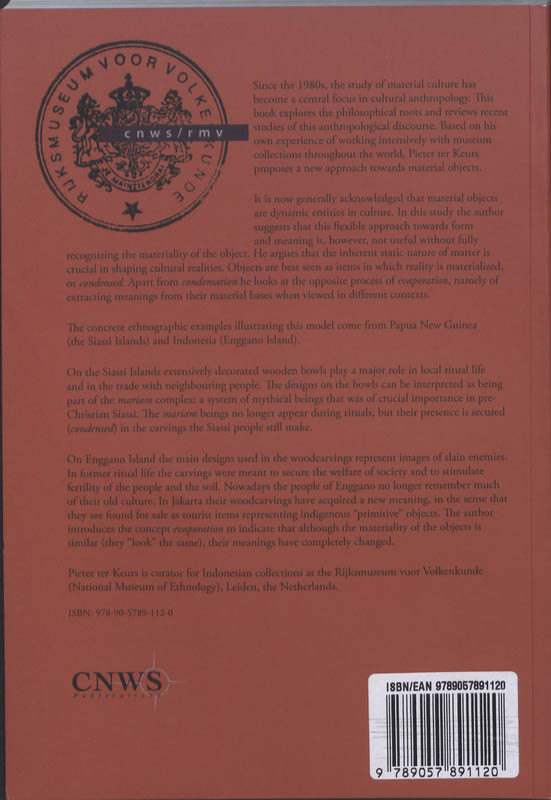
Since the 1980s, the study of material culture has become a central focus in cultural anthropology. This book explores the philosophical roots and reviews recent studies of this anthropological discourse. Based on his own experience of working intensively with museum collections throughout the world, Pieter ter Keurs proposes a new approach towards material objects.
It is now generally acknowledged that material objects are dynamic entities in culture. In this study the author suggests that this flexible approach towards form and meaning is, however, not useful without fully recognizing the materiality of the object. He argues that the inherent static nature of matter is crucial in shaping cultural realities. Objects are best seen as items in which reality is materialized, or condensed . Apart from condensation he looks at the opposite process of evaporation, namely of extracting meanings from their material bases when viewed in different contexts.
The concrete ethnographic examples illustrating this model come from Papua New Guinea (the Siassi Islands) and Indonesia (Enggano Island).
On the Siassi Islands extensively decorated wooden bowls play a major role in local ritual life and in the trade with neighbouring people. The designs on the bowls can be interpreted as being part of the mariam complex: a system of mythical beings that was of crucial importance in pre-Christian Siassi. The mariam beings no longer appear during rituals, but their presence is secured (condensed) in the carvings the Siassi people still make.
On Enggano Island the main designs used in the woodcarvings represent images of slain enemies. In former ritual life the carvings were meant to secure the welfare of society and to stimulate fertility of the people and the soil. Nowadays the people of Enggano no longer remember much of their old culture. In Jakarta their woodcarvings have acquired a new meaning, in the sense that they are found for sale as tourist items representing indigenous "primitive" objects. The author introduces the concept evaporation to indicate that although the materiality of the objects is similar (they "look" the same), their meanings have completely changed.
Pieter ter Keurs is curator for Indonesian collections at the Rijksmuseum voor Volkenkunde (National Museum of Ethnology), Leiden, the Netherlands.
It is now generally acknowledged that material objects are dynamic entities in culture. In this study the author suggests that this flexible approach towards form and meaning is, however, not useful without fully recognizing the materiality of the object. He argues that the inherent static nature of matter is crucial in shaping cultural realities. Objects are best seen as items in which reality is materialized, or condensed . Apart from condensation he looks at the opposite process of evaporation, namely of extracting meanings from their material bases when viewed in different contexts.
The concrete ethnographic examples illustrating this model come from Papua New Guinea (the Siassi Islands) and Indonesia (Enggano Island).
On the Siassi Islands extensively decorated wooden bowls play a major role in local ritual life and in the trade with neighbouring people. The designs on the bowls can be interpreted as being part of the mariam complex: a system of mythical beings that was of crucial importance in pre-Christian Siassi. The mariam beings no longer appear during rituals, but their presence is secured (condensed) in the carvings the Siassi people still make.
On Enggano Island the main designs used in the woodcarvings represent images of slain enemies. In former ritual life the carvings were meant to secure the welfare of society and to stimulate fertility of the people and the soil. Nowadays the people of Enggano no longer remember much of their old culture. In Jakarta their woodcarvings have acquired a new meaning, in the sense that they are found for sale as tourist items representing indigenous "primitive" objects. The author introduces the concept evaporation to indicate that although the materiality of the objects is similar (they "look" the same), their meanings have completely changed.
Pieter ter Keurs is curator for Indonesian collections at the Rijksmuseum voor Volkenkunde (National Museum of Ethnology), Leiden, the Netherlands.
In het kort
ISBN-13
9789057891120
Uitgever
Verschenen
1 juli 2006
Bibliografisch
ISBN-139789057891120
SerieMededelingen Rijksmuseum Volkenkunde — deel 34
Editie1
TaalNederlands dut
Pagina’s240
GeïllustreerdJa
Uitgave
UitgeverCnws Publicaties
CB-relatie-id8767404
Verschenen1 juli 2006
StatusOnbekend 00
BeschikbaarheidContact leverancier 99
Zonder prijsPrijs volgt
Vorm & inhoud
ProductvormPaperback BC
SamenstellingLos product
Classificatie
NUR (hoofd)Culturele antropologie 761
NUR (alle)761 Culturele antropologie
Medewerkers
Auteur A01Pieter ter Keurs
Herkomst
Werk-id (NSTC)500309668
MeldingBevestigd bij publicatie 03
Bijgewerkt6 augustus 2026
Lijkt op dit boek

NSTC 500309668 · CB-relatie 8767404 · Bijgewerkt 6 augustus 2026